waguide
EN

Waguide

Catalogue · The Vatican Museums

Select an exhibit, read its story and find it on the route.

186 exhibits, 91 full stories. Stories about the exhibits in the Egyptian Museum, the Pio-Clementino, the Candelabra Gallery and the Pinacoteca are available in full on the website, as are selected stories about the works of Raphael and the Sistine Chapel. The remaining stories are presented in excerpts.

01Gregorian Egyptian Museum15 · exhibits
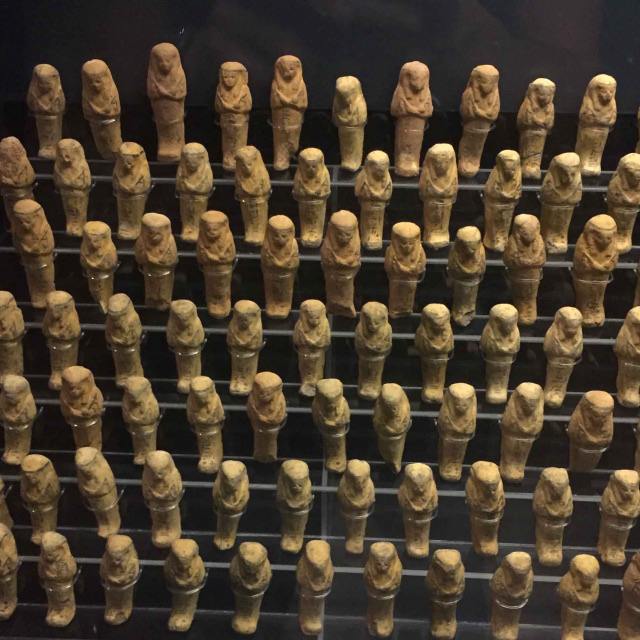
When you enter the Gregorian Egyptian Museum, you understand with excitement that this is pretty much the biggest exposition of Egyptian artifacts in the world. Here one may learn about Egyptian culture from the exhibits made in Mesopotamia and Syria many centuries ago. The Gregorian Egyptian Museum was opened in 1839. With nine halls, it was established by Pope Gregory XVI to be the biggest collection of cultural heritage of Ancient Egypt. Today you may see sculptures, papyruses, sarcophagi, the fragments of mummies. Pope Pius VII started to gather the collection with the artifacts of III century, the period of the Roman invasion in Egypt, which were discovered during the excavation. Do not pass by the sculpture of Ramesses II seated on the throne and the statue of Udjaḥorresnet that are displayed in the first hall among other numerous exhibits. The second hall houses Egyptian painted wood sarcophagi, mummies, canopic jars and ushabti figurines. In the fourth hall a statue of Anubis draws special attention, in the fifth hall you should see the statues of Ptolemy II and Tiye. The seventh hall holds the collection of Hellenistic and Roman sculptures made of bronze and clay, Islamic and Christian ceramics. In the eighth and ninth halls there are artifacts of Mesopotamia and Ancient Syria.

Original author’s text, preserved unchanged.

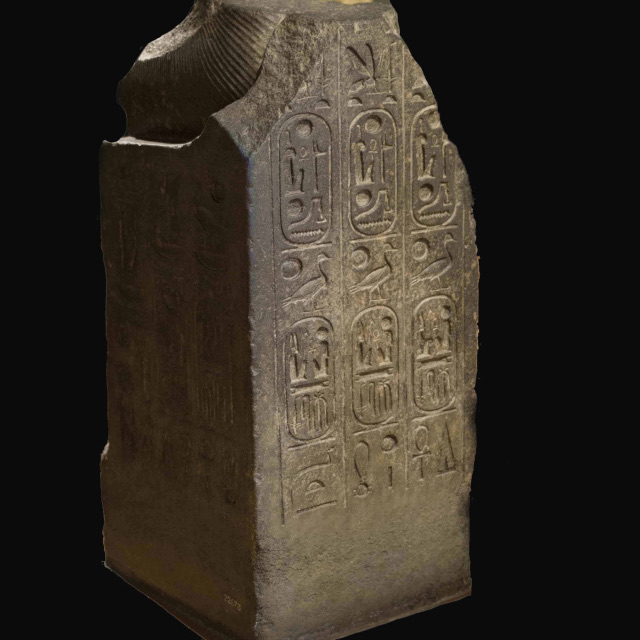
UdjaḥorresnetEpigraphic ArtefactsThe full story

521 year BC · basalt

Vatican Museums audio guide

Udjaḥorresnet was an ancient Egyptian religious and public representative, honorable nobleman and priest of Neith, the goddess of war and hunting. Udjaḥorresnet held positions of prime-minister, diplomat, royal treasurer, chief physician, chief of copyists of the Great Texts and the commander of the Egyptian fleet. He was a powerful person and took part in ruling Egypt. When he was the commander of the Egyptian fleet, Egypt was conquered by the Persian army, which put an end to XXVI Dynasty. While digging the figurines ushabti bearing the name of Udjaḥorresnet were found in his Naophorous statue. The statue was in a limestone sarcophagus placed in the tomb. The second sarcophagus made of basalt, in the form of human body, was placed in the first sarcophagus. The Naophorus statue contains the inscriptions of the titles and honorable acts committed by Udjaḥorresnet at the court of the pharaohs.

Original author’s text, preserved unchanged.

This story is part of the itinerary
Ramesses IIEpigraphic ArtefactsThe full story

1279 year BC · black granite

Vatican Museums audio guide

Ramesses the Great ruled Egypt in the 13th century B.C. He was one of the most prominent representatives of the 19th Dynasty of Egyptian pharaohs. Ramesses was a sensible statesman. He ruled the kingdom in the way so that Egypt could develop in all areas. At the same time he strengthened his military power. Ramesses ended the devastating struggle between Egyptians and Hittites and established peace by having strengthened it with personal family ties. The pharaoh got married to the daughter of the king of Hittites and persuaded the people that war could erase Egypt from the face of the Earth. Ramesses ensured peace and established favorable trade relations between Egypt and Asia for hundred years. In addition to his political affairs, he developed and implemented cultural projects. Ramesses built the Colonnade in Karnak and the temples of Osiris and his father Seti I. The Egyptian kings, ruling after the death of Ramesses, tried to copy him as they wanted to get the same kind of glory and people's affection. But it was in vain. Ramesses II was immortalized in stone. His statue rises in the middle of the sand of Luxor. This speaks more than any words about the attitude of the people to their ruler.

Original author’s text, preserved unchanged.

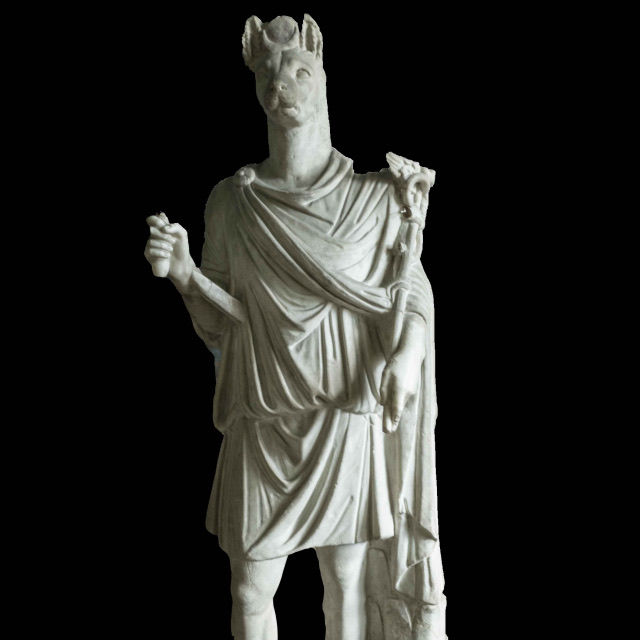
God AnubisEgypt and RomeThe full story

150 year · Parian marble

Vatican Museums audio guide

In ancient Egypt, Anubis was the god of embalming and burial rites. According to Egyptian myths, Anubis was the son of Osiris, the god of agriculture and the god of the dead. When Osiris was killed, Anubis set out to bury him. He wrapped the body in the cloth impregnated with a special solution. So this is how the first mummy was made. Then he was considered to have invented mummification and burial rites. Souls of the dead were believed to meet Anubis who led them by the hand to Osiris, the king of the Underworld. He had the head of a jackal and human body. There is a small solar disc on a crescent moon between its ears. This is the symbol referring to the god Mercury, whom Anubis was assimilated to. He was a ferryman of the dead to the Underworld, that's why he holds the caduceus in his hand as an attribute of the lord of the dead.

Original author’s text, preserved unchanged.

СaccoEgypt and RomeThe full story

159 year · Limestone

Vatican Museums audio guide

The name of Santo Stefano del Cacco refers precisely to this statue. As "cacco" is a Roman word that means "monkey". The statue bears the Latin inscription authorizing to place it in the temple built in 159 A.D. A dog-headed sculpture represents the Egyptian god Thoth. Thoth was the god of the moon, reckoning, writing and science. The god Thoth was considered to have created the calendar.

Original author’s text, preserved unchanged.

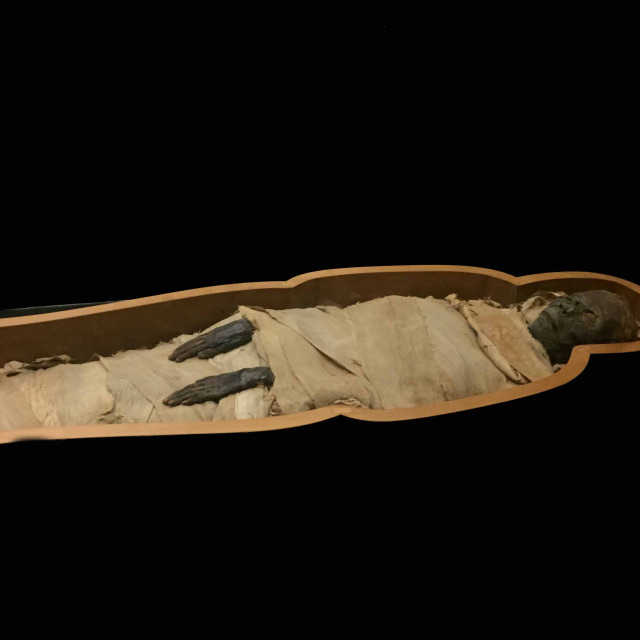
Mummies and embalmingFunerary customs of ancient EgyptThe full story

VIII century BC

Vatican Museums audio guide

The preservation of the body by embalming played a major role in the Egyptian culture. This is a traditional stage of burial. Ancient Egyptians believed that was how the soul of the dead reunited with his body after the death. For the first time, the embalming was done in III millennium B.C., and after the Arab conquest of Egypt in 641 B.C. the tradition disappeared. The entire process of embalming took around 70 days to complete by priests. They washed the body, removed its internal organs and covered it with so called divine salt to remove moisture from the tissues. The chest cavity was filled with resin to make the body heavy. The skin was rubbed and aromatized with aroma oil. Then the body was wrapped in linen bandages. Before placing in a coffin a mask was placed on the face of the mummy to protect and preserve it. For the better preservation of the mummy, Egyptians began to remove the brain. But later they stopped to do it as the brain was considered to be the physical, emotional and intellectual core, center of human being.

Original author’s text, preserved unchanged.

This story is part of the itinerary
Ushabti of the Pharaoh Seti IFunerary customs of ancient EgyptThe full story

wood

Vatican Museums audio guide

The group of twenty-two ushabti was found in the Valley of the Kings, the tomb of Pharaoh Seti I, father of Ramesses II. The Valley of the Kings is known to be the best burial site ever discovered. There 700 ushabtis were found in the tomb of Pharaoh Seti I. In the Egyptian culture, ushabti are funerary figurines made of wood or stone, representing human with the arms crossed on the chest. They were placed in tombs with the deceased. According to the Egyptian people's belief, such figurines replaced the deceased master and acted as his servants. They were supporters of the deceased, providing him food and taking his place to do manual labor. This ushabti was produced using several species of wood. Ushabti was covered with a glossy black resin of vegetable origin. Such black varnish was a symbol of survival beyond death.

Original author’s text, preserved unchanged.

Shroud of the Lady of the VaticanFunerary customs of ancient EgyptThe full story

IV century · Painted linen

Vatican Museums audio guide

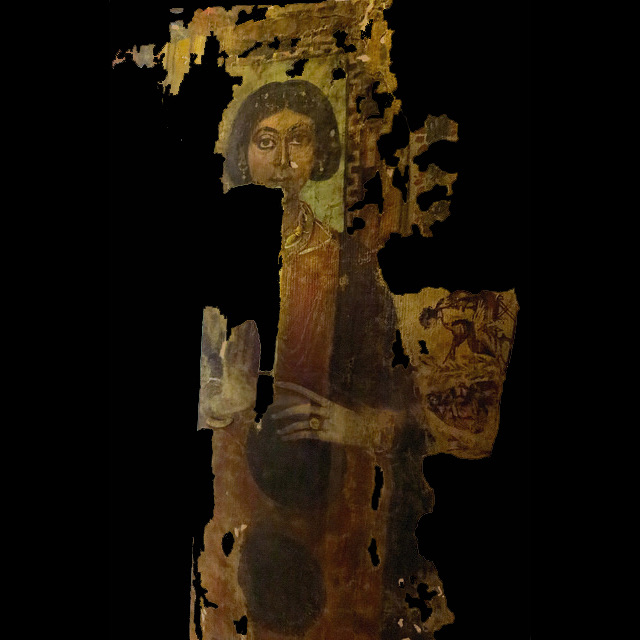
The canvas Lady of the Vatican belongs to a particular type of female burial shrouds. There are only six specimens, dispersed in various museums. The dress and precious golden jewels and the hairstyle of the depicted woman are typical of the Roman fashion and culture. The portrait depicts the full life-size figure of the woman. The woman in the rich clothes reclines on embroidered bedcover. Her arms are crossed on the breast, her feet rest on cushion, her eyes are widely open, she wears jewelry on her neck, ears and fingers. The figurative panel is framed by a series of rectangular illustrations. The shroud contains two illustrations conserved fragmentarily. One of them shows the teacher delivering philosophical speech to a young pupil. The second one depicts a cruel fight between a young man and a lion. The time did not spare Lady of the Vatican. So as for the rest of the illustrations, there is no alternative for historians but try to guess what was depicted on the shroud.

Original author’s text, preserved unchanged.

Sarcophagus of DjedmutFunerary customs of ancient EgyptThe full story

X century BC · Painted wood

Vatican Museums audio guide

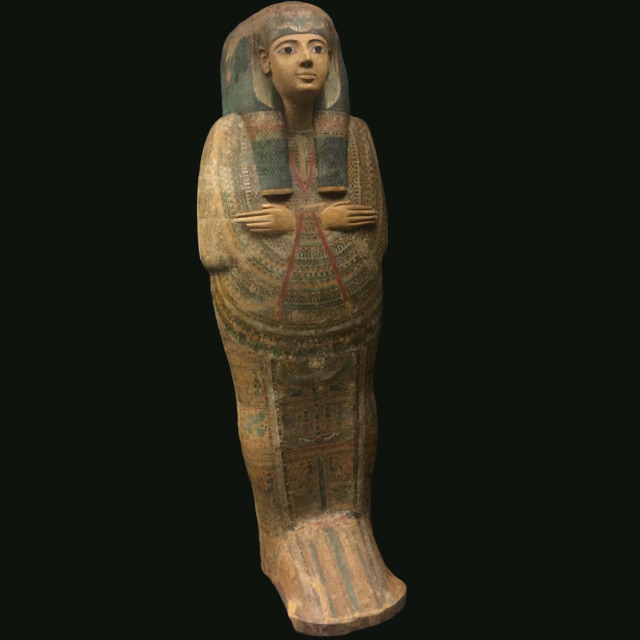
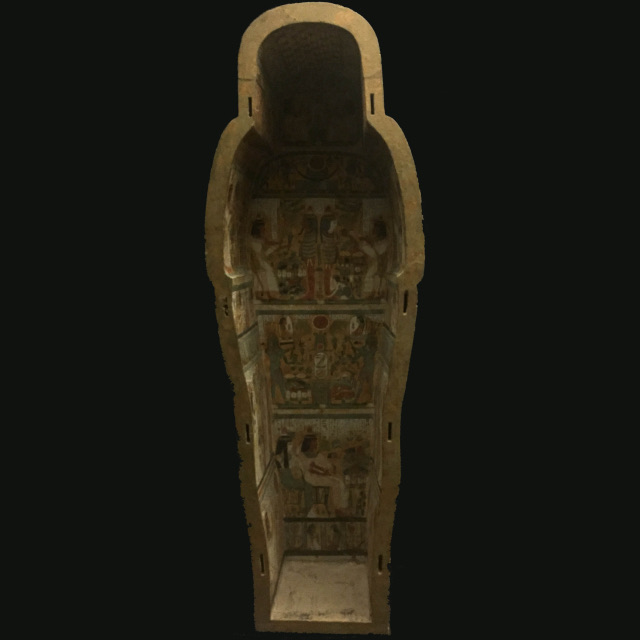
The sarcophagus belongs to Djedmut, an Egyptian priestess of the god Amon. She glorified the god, sang songs in his honor and was very respected in life. The sarcophagus dates from the XXII Dynasty. At that time Egypt suffered the economic crisis. Then sarcophagi became the most important element in the burial rites. The wooden sarcophagus of Djedmut falls within the category of so-called “yellow coffins”. Such sarcophagi were decorated with painting on yellow background. The yellow color was a symbol of eternal life, and the diversity of drawings on the sarcophagus showed the status of the deceased, her greatness and wealth in life. The wooden cover of the sarcophagus is decorated with the images of Djedmut and her husband, to whom the high priests gave the offerings.

Original author’s text, preserved unchanged.

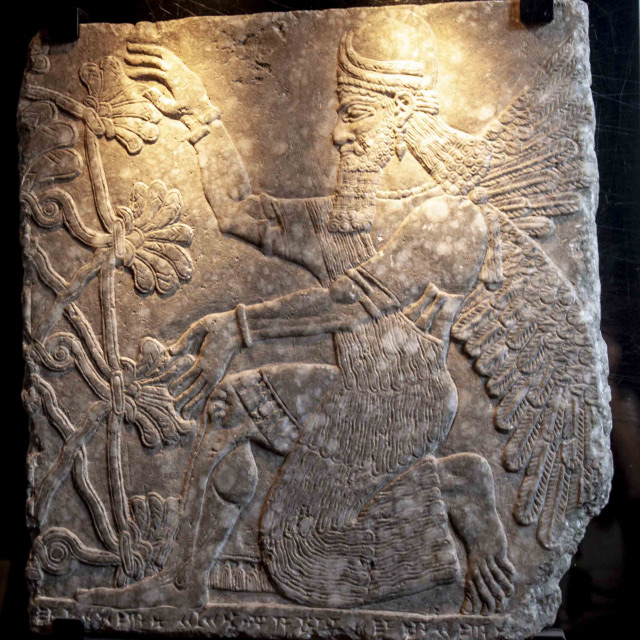
Relief with winged GeniusReliefs and inscriptions from Assyrian palacesThe full story

860 year BC · Breccia

Vatican Museums audio guide

Ashur-Nasir-pal II was the king of Assyria who ruled in IX B.C. The ruler was a successful conqueror and talented diplomat. He took the lead in conducting 14 military cruel and ruthless campaigns. Due to this, he was called the cruelest barbarian of Assyria. He developed a military strategy of quick progress that included a precision attack of the enemy and immediate creation of defensive posts at the territory taken by force. If any revolts took place, the rebels were massively killed, and the territory was fully devastated. Despite his cruelty showed during military campaigns, the king contributed to the flowering of Assyrian figurative art. One of the examples of such art was the decoration of the monumental Royal Palace of Ashur-Nasir-pal. The limestone wall relief was in the Room I of the palace and belonged to the mythical theme of the adoration of the Sacred Tree. The tree was a symbol of fruitfulness, life, and vital energy.

Original author’s text, preserved unchanged.

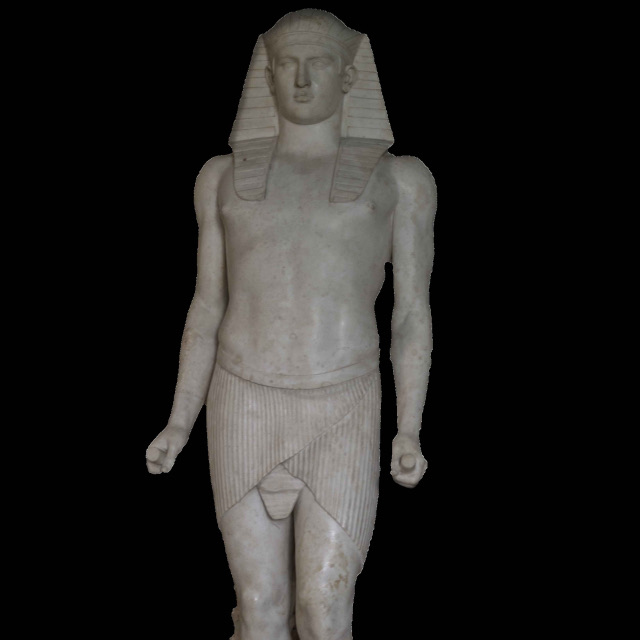
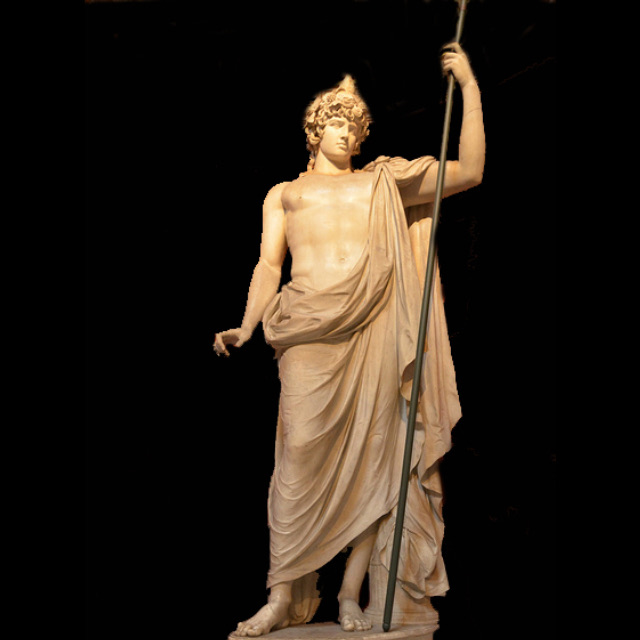
Statue of Osiris-AntinouReconstruction of Hadrian’s VillaThe full story

130 year · Parian marble

Vatican Museums audio guide

Antinous, a young Greek, was the favorite of the Roman emperor Hadrian. After his tragic death in the Nile Antinous was worshiped as Osiris, Apollo, Hermes and Hercules. His cult was extremely popular. At present, there are more images of Antinous than the images of many other more powerful and famous Romans. The cult of Antinous was firmly associated with Osiris who had drowned in the Nile and resurrected later to make soil fertile. Ancient Egyptians believed that Osiris invented the plough and gave it to people and learned them to farm. He was the king of the Underworld, their judge and at the same the power that brought life back to the banks of the Nile. Osiris was called "Master of Love", "Eternal Youth" and "Master of Silence". According to the legends, after the death the Egyptian pharaohs were associated with Osiris, and, like him, they could resurrect.

Original author’s text, preserved unchanged.

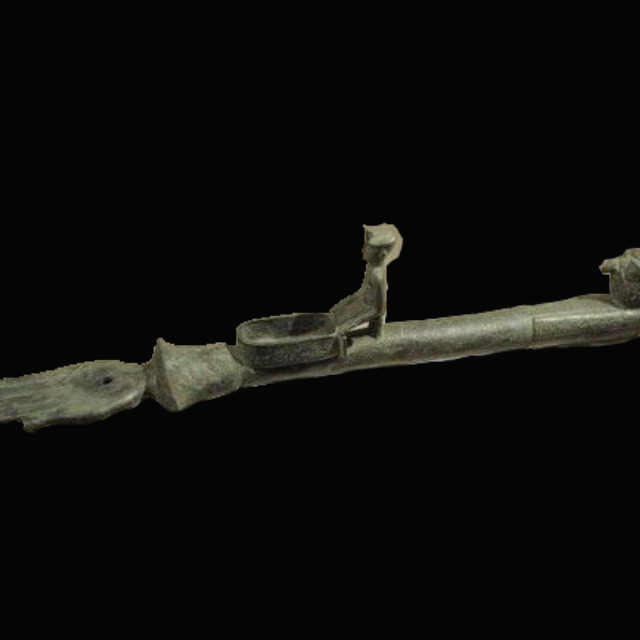
CenserCarlo Grassi CollectionThe full story

IV century BC · Bronze

Vatican Museums audio guide

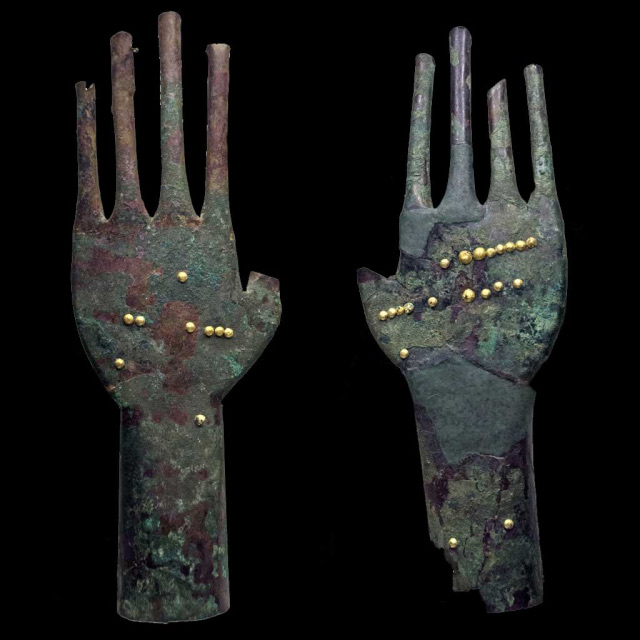
The Egyptian censer "Horus' arm" is reminiscent of a papyrus stem and consists of three clear symbols. This artifact is a tribute and symbol of the cult of Horus. He was believed to be a protector of the pharaohs, and they were considered to be the incarnation of Horus. The long handle is made up in the from of human arm serving a saucer placed on the open hand. The incense powder was placed and burned in this receptacle. The censer ends with the falcon's head of the god Horus. There is a figure of the kneeling pharaoh between the hand and the falcon. He seems to rest his hands on a receptacle, in which the spare incense was placed. During the rituals of the honoring of deities the burning of incense formed part of the purification of air. Because the shrines, in which the statue of gods were placed, were closed, and there was no possibility of an exchange of air. Thus, the burning incense purified the environment in the firmly locked shrines, where the holy relics were placed. In ancient Egypt incense was as much precious as gold. It was used for illuminating and obtaining wisdom by slowing down breathing and giving sense of inner peace.

Original author’s text, preserved unchanged.

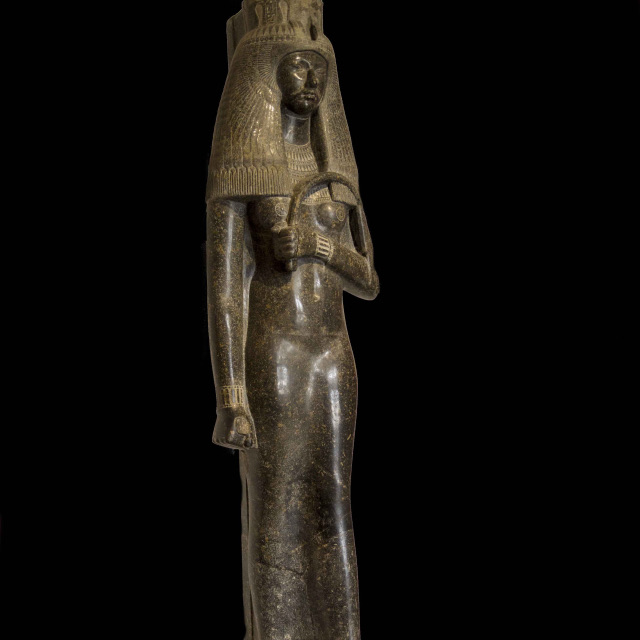
Queen TuyaStatuaryThe full story

granit

Vatican Museums audio guide

Tuya was a wife of the Egyptian pharaoh Amenhotep III. She was called "Great Royal Wife" who often influenced on the decisions made by the pharaoh. Tuya lived in the 14th century B.C. and played an important role in establishing the cult of Aton as a state religion of Ancient Egypt. She and Amenhotep had six children. After becoming the pharaoh, Akhenaten, one of her sons, established the cult of the god of the sun Aton. Hand in hand with the pharaoh the queen took part in official ceremonies and diplomatic visits. In order to show her power and greatness, she built a temple dedicated to her in Nubia, in the today's Sudan. Thus, Tuya managed to celebrate even more the power of her husband, Pharaoh Amenhotep.

Original author’s text, preserved unchanged.

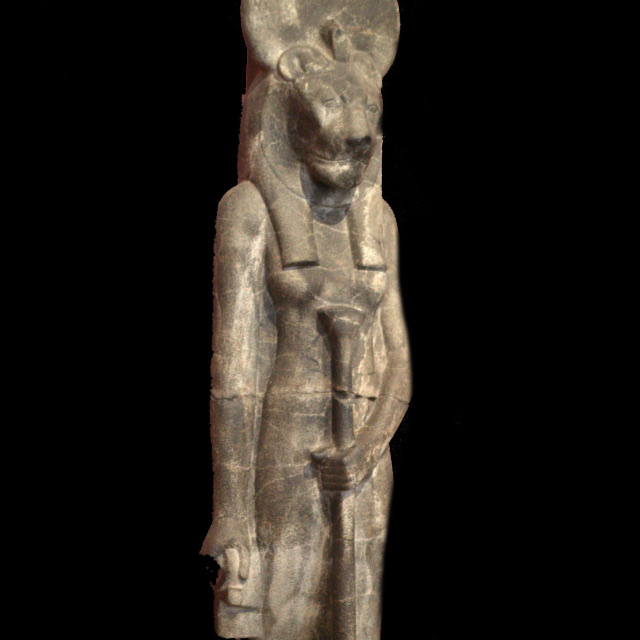
Goddess SekhmetStatuaryThe full story

1353 year BC · granit

Vatican Museums audio guide

Ancient Egyptians worshiped Sekhmet as a powerful goddess of war, hot sun and the daughter of the sun god Ra and mistress of the desert. Sekhmet had a fire-breathing and was depicted as a lioness, a cult animal. The goddess embodied blazing sunshine, and she was depicted with the solar disc on her head. The legends say that Sekhmet defended the pharaohs from enemies by leading them in warfare and overthrowing their rivals. The severe and quick-tempered goddess could kill people by sending diseases on them. According to the myths, Sekhmet punished Egypt with a plague. Pharaoh Amenhotep III ordered to make seven hundred statues of the goddess to propitiate him. Despite all this, Sekhmet was worshiped as the goddess of healing and a peacekeeper.

Original author’s text, preserved unchanged.

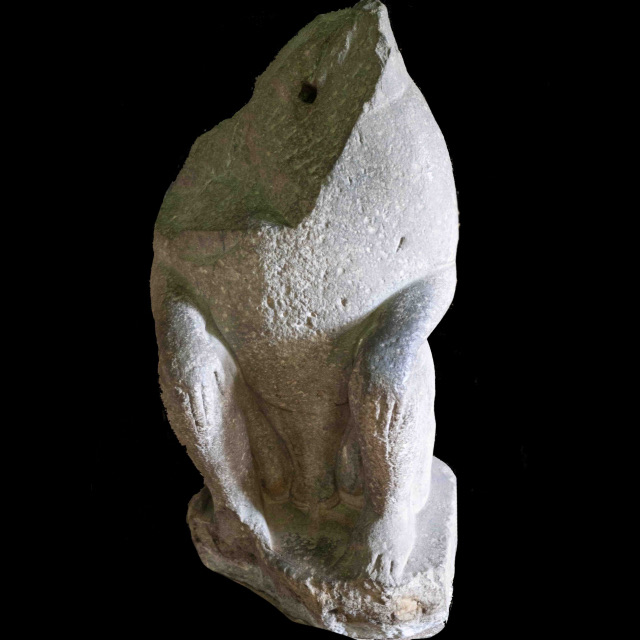
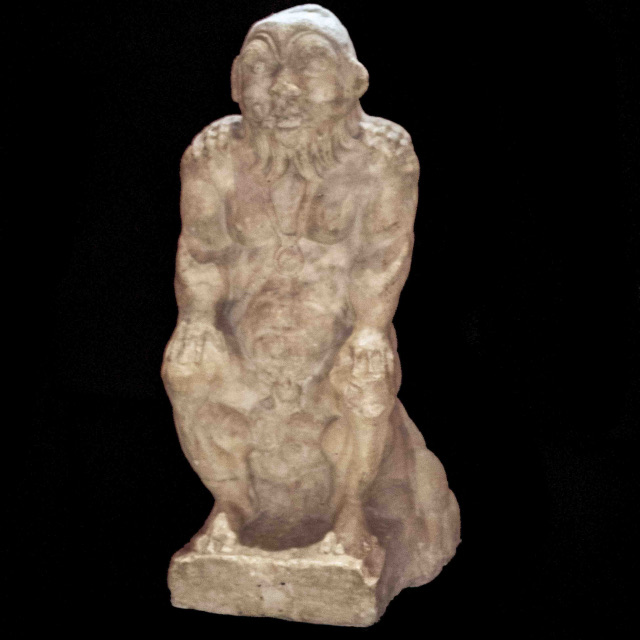
God BesStatuaryThe full story

II century BC · Limestone

Vatican Museums audio guide

In Egyptian mythology bes is a common word for dwarfs who were worshiped as a protector of households, family and defender from evil spirits. They were protectors of infants and expectant mothers. The name "bes" comes from the Nubian word besa, which means «cat». Historians believe that the cult of bes is a worship of cat as a protector of household from pests and wild animals. Bes was portrayed as a dwarf with a stocky body, a face similar to mask, a low forehead and swallowed eyes. He seems to be seated on a rock, with his hands resting on his knees and protruding tongue. His shoulders and hips are covered with a lion's pelt, and he wears a big adornment around his neck. On the head there is a hole for a metal attribute to support another stone headdress. Traditionally, bes wore a magnificent feathered headdress.

Original author’s text, preserved unchanged.

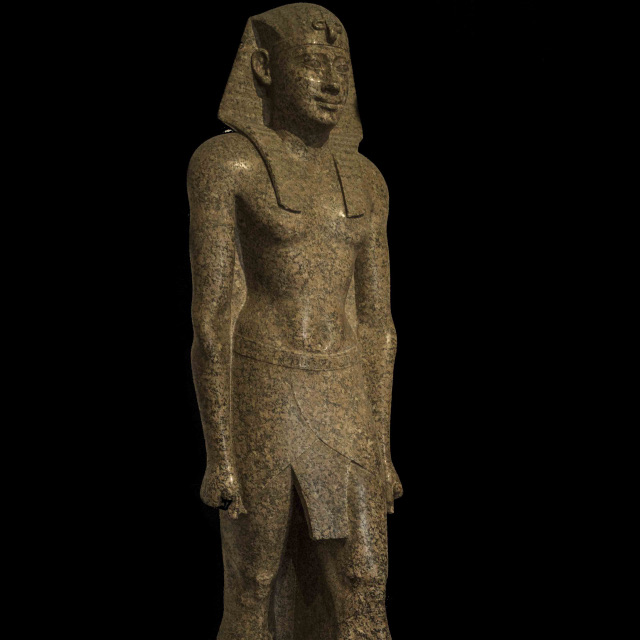
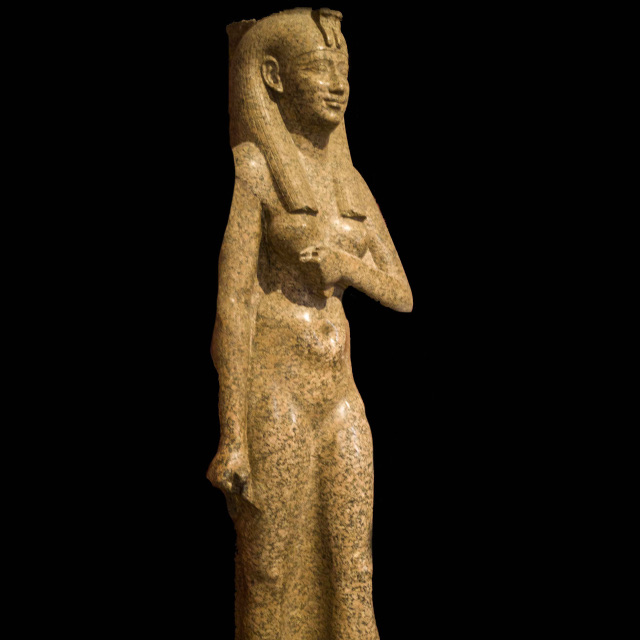
Statues Ptolemy IIStatuaryThe full story

280 year BC · Red granite

Vatican Museums audio guide

The statues represent Ptolemy II and his sister Arsinoe II who became his wife. Ptolemy II was the king of Egypt in the 3rd century B.C. In addition to political affairs, he is famous for marrying his sister Arsinoe. Having the throne, Ptolemy was seeking to extend its political influence beyond the borders of Egypt and take control over the territory stretching to Asia. For this purpose he strengthened his positions at sea. At that time his sister Arsinoe ran away from her husband in Macedonia to Egypt to become a queen. She was a perfidious and crafty intriguer in Macedonia. And she got married to her brother to take power. According to ancient Greek legends, these two statutes were brought to Rome by the emperor Caligula. In Rome they embellished a building dedicated to his sister-wife Drusilla. She was deified as Ptolemy defied Arsinoe II.

Original author’s text, preserved unchanged.

This story is part of the itinerary
02Pio Clementino Museum30 · exhibits
The Pio-Clementino Museum continues to show the best classical exhibits. Located in the Belvedere Palace, the Museum immortalized the names of its founders — Pope Clement XIV and Pius VI. The pontiffs had all reasons to establish the Museum. At that time, in the second half of the eighteenth century, the Vatican treasury did not house the biggest collection of works of art that their predecessors had gathered for some centuries. So the treasury and the Belvedere Palace were rebuilt. Since then the Pio-Clementino Museum began to place antique exhibits. You can see a variety of sculptures and sarcophagi everywhere, in the halls and the inner octagonal court with colonnades.

Original author’s text, preserved unchanged.

Cabinet of Masks
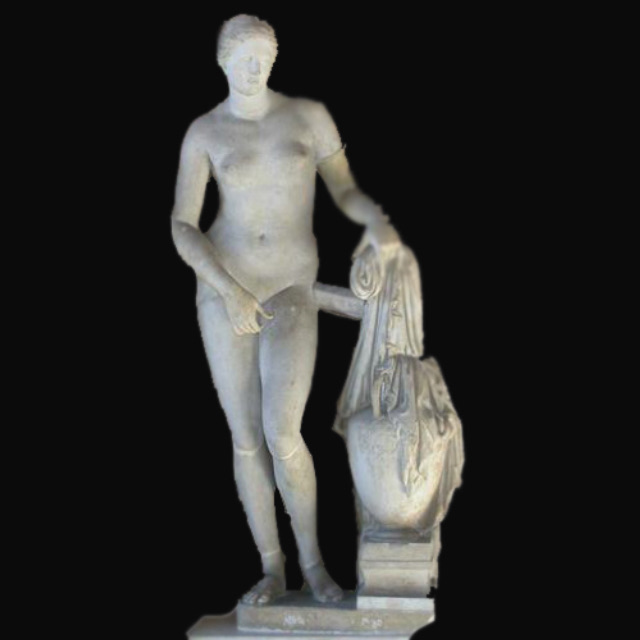
The Cabinet of Masks is a summer pavilion reconstructed in the 18th century that had been linked to the halls of the palace of Innocent VIII. The floor of the Cabinet is covered with the most ancient mosaic that has remained gorgeous for centuries. The four mosaics showing masks were found in 1780 at Hadrian's Villa in Tivoli. Interestingly, the masks are dated at 50 B.C. Marble antique statues are kept in the Gallery of Masks. The most significant of them are a Roman sculpture of the Three Graces; a statue of the Satire, a sculpture of the Dancing Woman and the main exhibit — a statue of the Aphrodite of Knidos. Kindly note that this statue is justly considered to be the best copy of the bronze sculpture by Praxiteles.

Original author’s text, preserved unchanged.

Greek Cross Hall
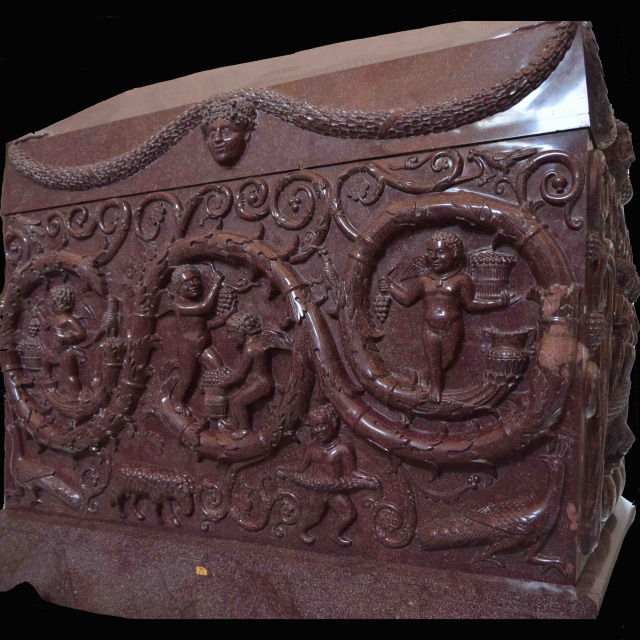
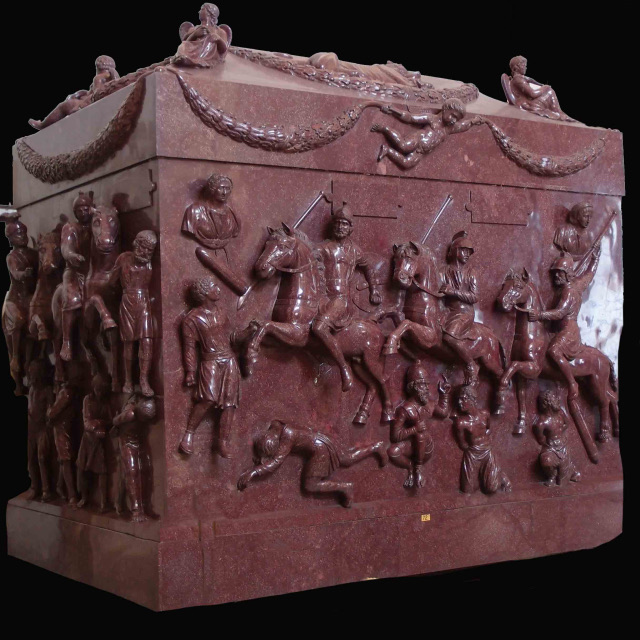
The Greek Cross Hall is designed by Michelangelo Simonetti. Please look down at the entrance of the hall and you will see that the floor is covered with the precious mosaic dated at III century B.C. First, this mosaic tiled the floor at the villa in Tusculum, near Rome. Interestingly, the Hall is built in the form of Greek cross. The Greek cross is a cross with rectangular arms of equal length that are perpendicular to each other. This particularity gave name to the hall. An attentive visitor will notice Egyptian decorative elements in this hall. Thus, you can see sarcophagi in porphyry. One sarcophagus was made for Constantia, the daughter of Emperor Constantine, and the second one — for his mother Helena. Look at the decoration of Helena's sarcophagus. The coffin is carved with Roman riders who defeated the barbarians. The Sarcophagus of Constantia is decorated with sculptured cupids picking grapes. Do not pass by the unique exhibit — the figure of woman shown in motion. You can see it behind the Sarcophagus of St Helena. Historians believe that this is a single survived statue of Cleopatra. Among other things, in the Greek Cross Hall you may admire the sculptures of Octavian Augustus and Julius Caesar and mosaics.

Original author’s text, preserved unchanged.

Gallery of Statues
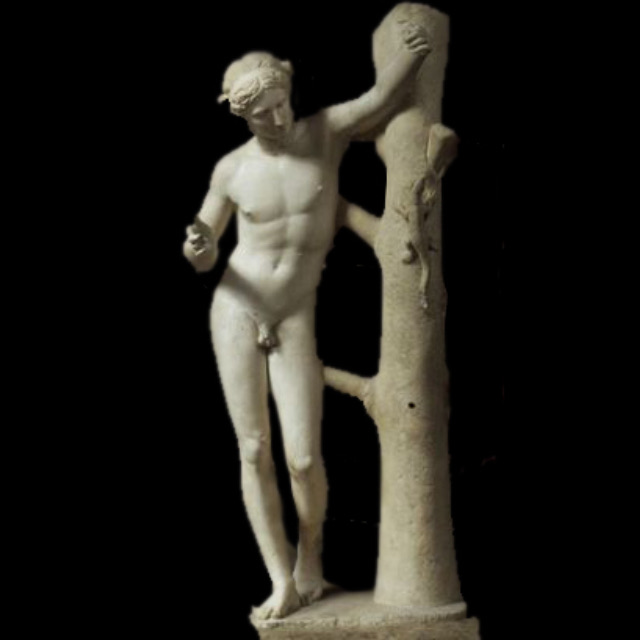
The Gallery of Statues was originally a summer wing of the palace of Innocent VIII. Visiting this place, you will see the frescoes painted by the Italian painters Andrea Mantegna and Pinturicchio. These were the first images that decorated the Gallery at the end of 15th century. In the second half of the eighteenth century this hall was turned into the gallery of statues, and it acquired the appearance you can see now. Here you can find classical sculptures. These are Roman copies of such masterpieces like the statue of Apollo Sauroktonos, the Sleeping Ariadne, Narcissus, Drunken Satyr, Seated Paris, bas-reliefs of Mars, Minerva, Venus.

Original author’s text, preserved unchanged.

Hall of Animals
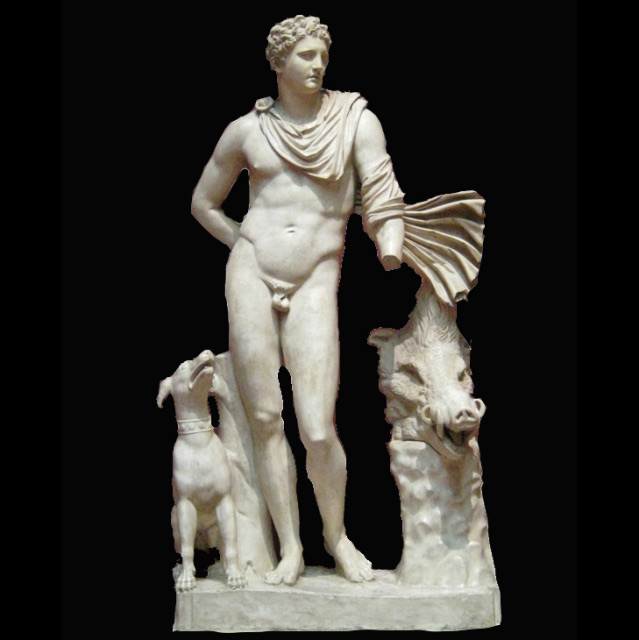
You are in the Hall of Animals. This is the biggest world collection of antique statues of wild animals. You are surrounded by almost 150 statues made of alabaster, colored and white marble. Almost all exhibits you can see are copies of Greek originals made by command of Pope Pius VI. The sculptor Francesco Antonio Franzoni worked on the statues. And the statues of animals and birds were restored at the end of XIX century. In the Hall of Animals you will see the statue of Meleager with dog and the head of the Calydonian boar, the torso of Minotaur, Roman sarcophagi belonged to the representatives of the Scipiones.

Original author’s text, preserved unchanged.

Hall of the Muses
Now you are in the Hall that was designed by the Italian painter Michelangelo Simonetti in 1782. The Hall of Muses is decorated with sixteen marble columns. Look up and you will see the ceiling frescoes by Tommaso Conca. They represent Apollo and nine Muses surrounded by the famous poets of the ancient world — Homer, Aeschylus, Pindar, Virgil, Tasso and Ariosto. In the Hall of Muses there are marble statues of Apollo and nine muses, the Greek protectresses of art. In fact, these sculptures are copies of the Greek original statues made of bronze in III century B.C. If you look at the center of the hall, you will see the Belvedere Torso, a model of ideally and beautifully proportioned body, according to Michelangelo.

Original author’s text, preserved unchanged.

Octagonal Court
Now you are in the inner yard that is the nucleus of all Vatican Museums. Here the exposition of magnificent Roman sarcophagi with bas-reliefs is displayed. Before this yard became a must-see attraction included into a guide-book of the Vatican Museums, the inner yard was an orange garden. But Pope Julius II improved it by placing antique statues in the shadows of trees here and there. Later, in 1775, Pope Pius VI instructed to fence the garden area with an octagonal portico that framed the entrance to the palace. After thirty years four niches separated by arcades were built in the four corners. These are the Laocoön Niche, Perseus Niche, Apollo Niche and Hermes Niche. Therefore, the garden acquired the appearance you can see.

Original author’s text, preserved unchanged.

Round Hall
The Round Hall is almost 250 years old. It was designed and built in classical style at its heyday, in 1780. Michelangelo Simonetti was charged with the project. Look down and you will see that the floor is covered with Roman mosaic of III century, depicting the battles of Greek warriors with tritons and centaurs. In the center of the Round Hall you can see a huge porphyry basin which has a circumference of 13 meters. Earlier it embellished the Holden House of Emperor Nero. In the niches there are 18 statues and marble busts of Roman and Greek gods and mythological heroes. Have a look at the sculpture of Antinous. You can also find the portrait of Emperor Hadrian portrayed as Dionysus and the statue of mighty Hercules. This is the only gilded statue that survived unchanged since antiquity.

Original author’s text, preserved unchanged.

Aphrodite of CnidusCabinet of MasksThe full story

Praxiteles · marble

Vatican Museums audio guide

The Aphrodite of Cnidus is the first stone representation of the nude female. This sculpture is the female statue that is mostly duplicated. Interestingly, Praxiteles, the creator of the statue, made two similar sculptures of Aphrodite. One of them was covered with a cloak and another one was absolutely nude. The second statue was bought by the inhabitants of Cnidus, the Greek colony, and it won world fame. Some people went to Cnidus just to see the statue of the goddess. Praxiteles used his lover Phryne, a very beautiful woman, as a model. But in antiquity it was blasphemy to create statues of gods by using human body as a model. Phryne was accused of impiety and taken to court. The orator Hypereides was in charge of defending her. He delivered a speech and removed Phryne's robe to show the beauty of her body. At that time people believed in an ideal soul in a perfect body. A beautiful and kind person equated with gods. The judges were so smitten by Phryne's beauty, so they acquitted her unanimously. The statue of the Aphrodite of Cnidus is the most exact copy of the sculpture made by Praxiteles in 340 B.C. The original Greek sculpture is no longer in existence, but many copies have survived.

Original author’s text, preserved unchanged.

Sarcophagus of ConstantiaGreek Cross HallThe full story

V century

Vatican Museums audio guide

A magnificent sarcophagus is a symbol of eternal life that allude to afterlife. The sarcophagus in red porphyry holds the remains of Constantia, a daughter of the Emperor Constantine. The sarcophagus rests on four lionesses supports. The coffin is decorated on all four sides with cupids picking grapes. The sides of the sarcophagus are decorated with three winged boys treading grapes. Why is this scene depicted on the last abode of the emperor's daughter? The fact is that Roman sarcophagi imitated the shape of wine presses. And that had a deep meaning. Berries were squeezed, but after the fermentation they turned into breed wine. Thus, the squeezed grapes become wine, having a new life. Considering the ancient beliefs, the concept of the bas-relief of the sarcophagus takes the meaning. The immortal cupids give a new life to the buried Constantia. Her soul, like grapes, achieves immortality. Constantia died in 354, and some centuries later the Romans canonized her. She was buried in the church of St.Costanza.

Original author’s text, preserved unchanged.

Sarcophagus of HelenaGreek Cross HallThe full story

V century

Vatican Museums audio guide

The sarcophagus of Helena is a symbol of military success and last respect to the talent and mighty of a commander. And in truth, not a glorious warrior, but Helena, the mother of Roman Emperor Constantine the Great, was buried there. Historians believe that the magnificent tomb was originally made for Emperor Constantine. For this reason, it is decorated with dynamic military scenes that are not suitable for a female burial. As glorious military victories were the main pride of Roman rulers. The monumental red porphyry sarcophagus is decorated with battle scenes. The bas-relief of the tomb is carved with Roman soldiers on horseback, killing barbarians. On the lid of the sarcophagus cupids hold splendid garlands as a symbol of honor and greetings of winners.

Original author’s text, preserved unchanged.

Apollo SauroktonosGallery of StatuesThe full story

Praxiteles · V century BC · marble

Vatican Museums audio guide

Apollo Sauroktonos (Apollo Lizard-killer) symbolizes the victory of light over darkness. In antiquity many copies of the sculpture of Apollo Sauroktonos were made. It means that the statue was quite popular among Romans, and its concept was quite clear. The message of the scene may become evident if we consider the Roman myths of Apollo. Apollo, the god of sun, light and life, has two opposite sides. One of them is dark. It symbolizes a long slumber, oblivion, death. In myths, a lizard represents the dark side of the god. By killing the lizard in his own hand, Apollo has got rid of his dark side and has become only a light god. The second part of the title of the statue, "sauroktonos", comes from two Greek words – saura (a lizard) and kteinen (to kill). The young sun god Apollo is about killing a lizard. In a few seconds the young boy will kill a lizard climbing a tree with a small arrow.

Original author’s text, preserved unchanged.

MeleagerHall of AnimalsThe full story

20 year · marble

Vatican Museums audio guide

The statue represents Meleager of Belvedere after the killing of the Calydonian boar. This is a well-known Greek mythological story. The sculptured scene is associated with a tragic legend. Meleager is the son of King Oeneus of Calydon and his wife Althaea. He is mentioned in the poems "Iliad" and among the Argonauts and the Calydonian hunters. According to Greek myths, when Meleager was born, his mother Althaea heard a menacing prediction that her son would die as soon as one of the sticks in the fireplace burned completely. As soon as Althaea heard the terrible news, she pulled the stick from the fire, put it out, and hid it in a trunk. It would seem that the mother had saved her son from ill fate. Once Meleager's father forgot to give an offering to Artemis, the goddess of hunting, and she decided to punish him. The goddess unleashed a huge boar to Calydon, devastating fields and forests. The brave Meleager and his friends killed the beast, but Artemis did not leave the winners alone. She provoked the quarrel over the boar's head between them. During the fight Meleager's relatives on the maternal side were killed. When his mother Althaea learned about it, she enraged and burned the hidden stick. Meleager died immediately. Meleager is depicted holding the head of the boar after the Calydonian hunt. His faithful hunting dog that probably helped during the hunting sits next to the winner.

Original author’s text, preserved unchanged.

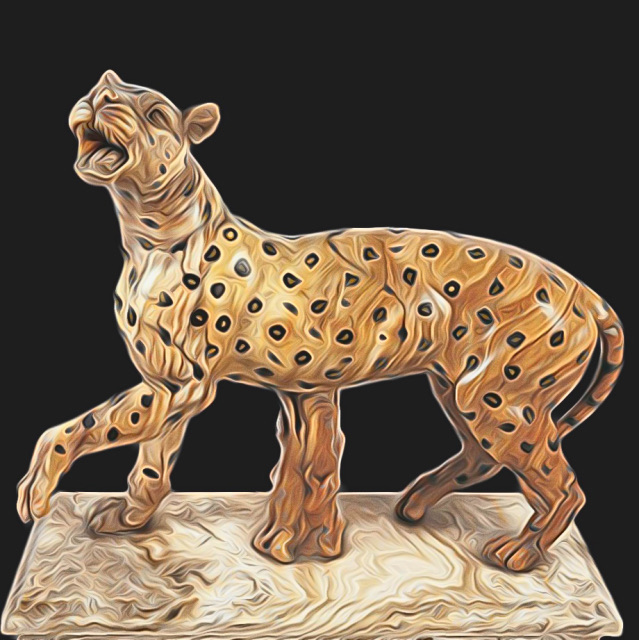
JaguarHall of AnimalsThe full story

Vatican Museums audio guide

In antiquity a leopard was named "the animal of god" that was frequently kept in sacred imperial menageries. The mythic image of the leopard represents fearlessness, courage, valour, fidelity, aggression and ferocity in battle. The animal resembles an jaguar, irbis, cheetah and leopard at the same time. But this is hardly a statue of jaguar. As this animal is native to South America that was not discovered at that time. It is not so important which animal was carved out of a stone. All felines represent a cult noble belligerent character. This statue of leopard is unusual as it is partially coloured. The different fragments of black and amber alabaster create animal's natural colours.

Original author’s text, preserved unchanged.

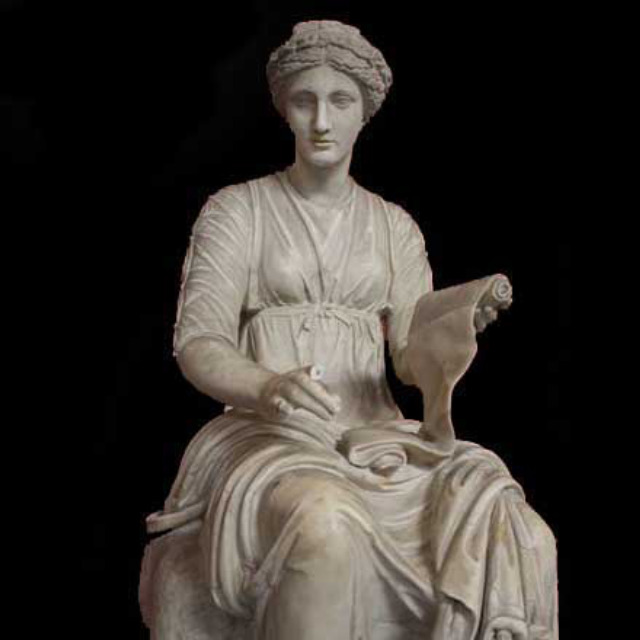
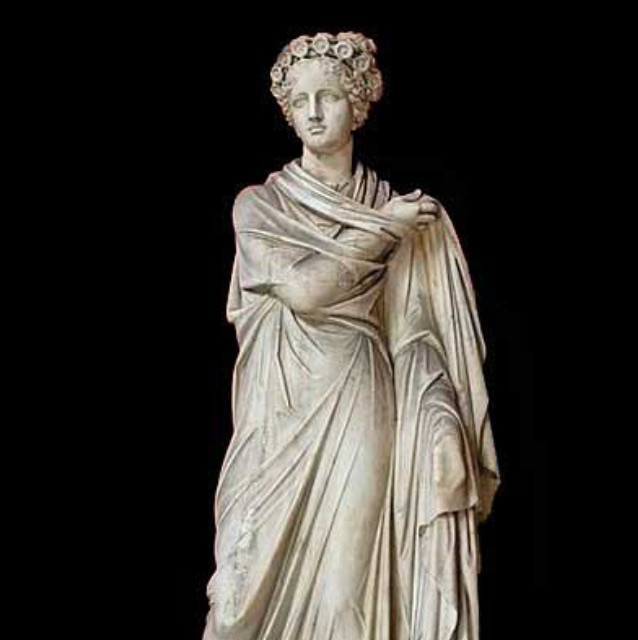
ClioHall of the MusesThe full story

marble

Vatican Museums audio guide

Clio is the Greek muse of history who is destined to glorify heroic deeds of people and gods. Clio wears a wreath of laurel on her head. Laurel is a symbol of glory, victory and peace. It was given to heroes. The muse of history is crowned with the wreath. It means that she is always ready to put down the names of heroes. She holds a parchment stem in her hand. It contains the chronicle of the accomplished feats. Clio also enters the names of noble people and gods into the stem.

Original author’s text, preserved unchanged.

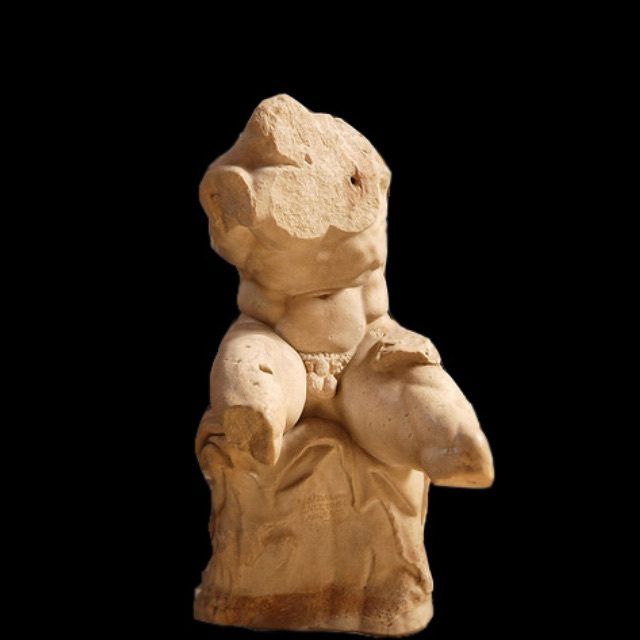
Belvedere TorsoHall of the MusesThe full story

II century BC · marble

Vatican Museums audio guide

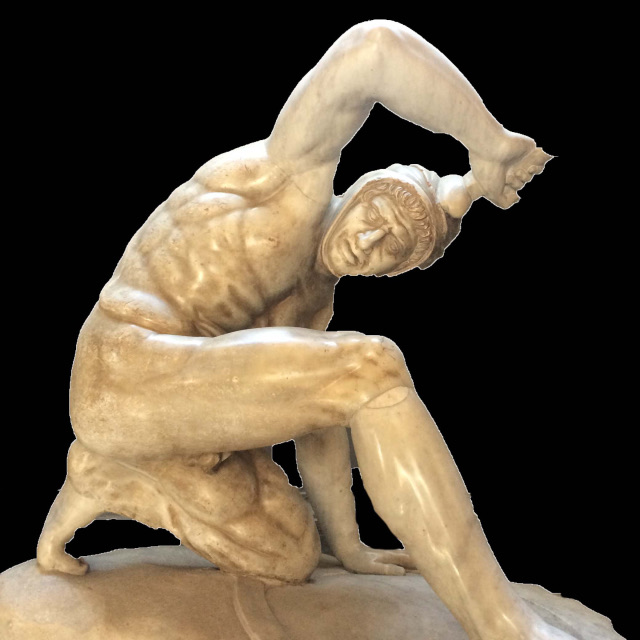
Historians have debated about the origin of the Belvedere Torso. But despite the lack of the information on the statue, it is known that Michelangelo himself admired the refined and realistic lines of the musculature. While painting the ceiling of the Sistine Chapel with frescoes, he used the image of the carefully graved statue. But when the painter was asked to restore the missing parts of the torso, he refused to do it as he considered the statue to be ideal. The neo-attic theorist Johann Winckelmann compared the torso with "a mighty oak that has been felled and stripped of its twigs and branches". Historians assume that the statue may represent Heracles, Polyphemus, Prometheus, Ares or Philoctetes. But the most popular version speaks that it is the Greek Ajax, sitting on the stone and thinking of the suicide. Art experts established that the head was leaning towards the right hand. And he gripped the sword with which the hero would take his own life. Supposedly, during the Trojan War Odysseus was appointed a commander and not Ajax, and he was so furious that he killed himself.

Original author’s text, preserved unchanged.

This story is part of the itinerary
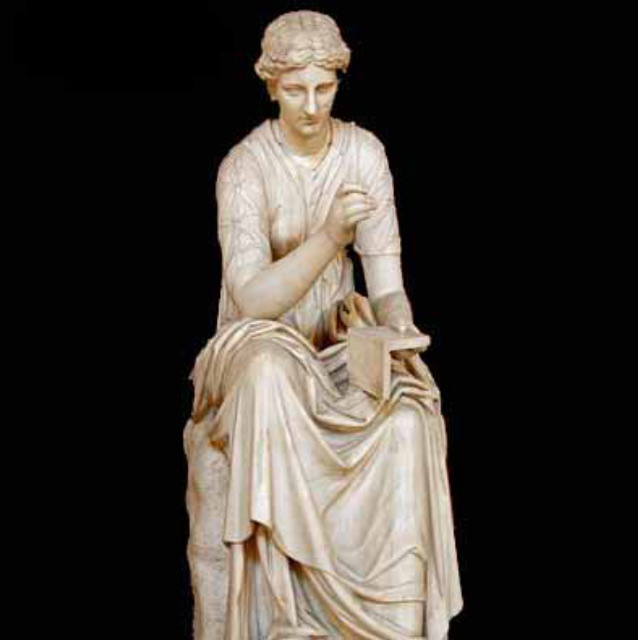
CalliopeHall of the MusesThe full story

marble

Vatican Museums audio guide

Calliope is the most eloquent muse, patroness of epic poetry, philosophy and science. In Greek her name means "beautiful-voiced". That's why Dionysus called the poetry "Calliope's scream". Calliope is the elder daughter of Zeus and the mother of a famous legendary hero Orpheus. He got his musicality and poetry from his mother. Calliope holds a wax tablet and a wood stylus, a writing tool. So it makes the phrase "write in high style", i.e. in eloquent and sonorous style.

Original author’s text, preserved unchanged.

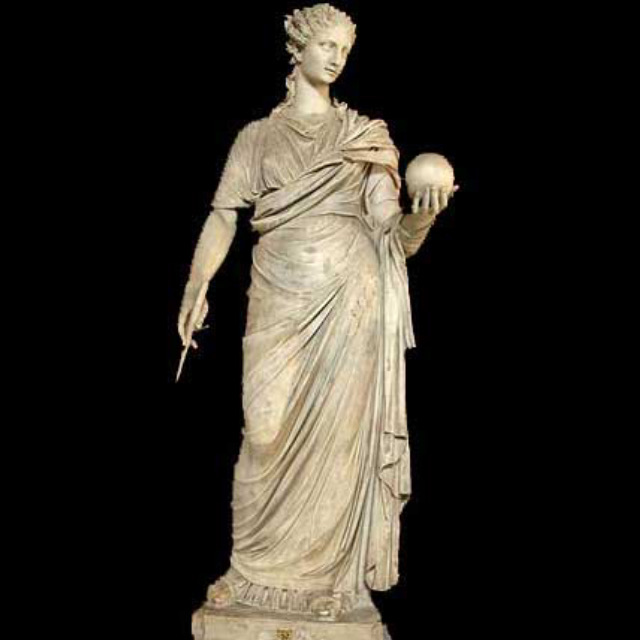
UraniaHall of the MusesThe full story

marble

Vatican Museums audio guide

Urania is the muse of astronomy. When the Greek mythology was developing the concepts of muses, astronomy was not a complicated exact science. It was rather a set of hypotheses for the sky and stars. So Urania was often called "celestial" muse. The severe Urania is portrayed holding a globe and a pointer in her hands, like a scholar teacher.

Original author’s text, preserved unchanged.

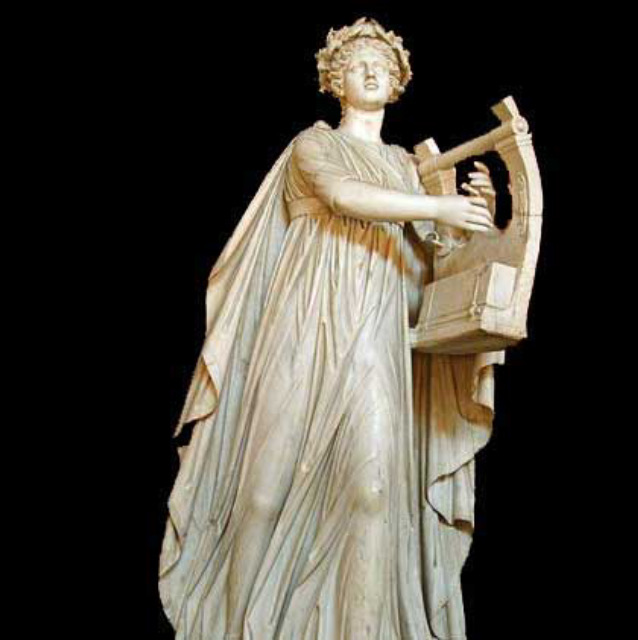
ApolloHall of the MusesThe full story

marble

Vatican Museums audio guide

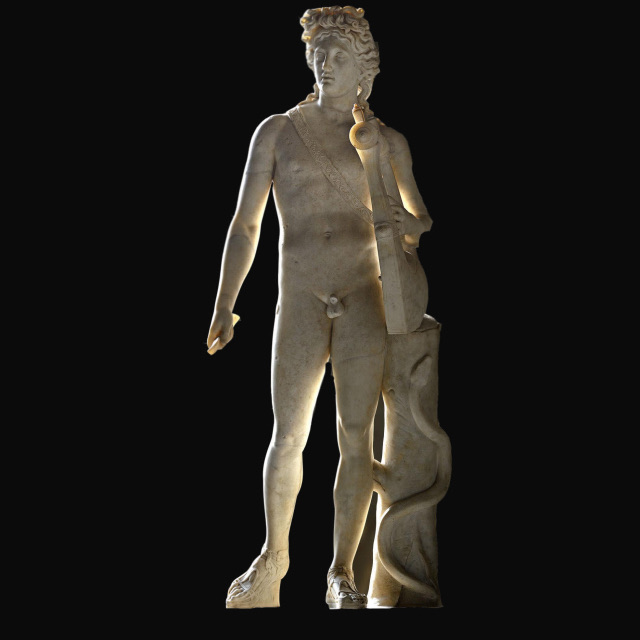
Apollo is a patron of arts, poetry, music and a leader of nine muses. First, ancient Greeks believed that Apollo protected livestock. Then he was considered to be a foreteller and, at last, the father of the sun and light. The young god holds a cithara in his hand. It seems as if he plays and sings at the same time. The figure of ancient Greek hero Marsyas is carved on the cithara. According to legends, Marsyas was a talented musician and competed in playing the cithara against Apollo. The muses judged the contest and preferred Marsyas. Then Apollo began to play the cithara and sing simultaneously. Marsyas could not do it and lost. As a punishment for his hubris, Apollo hung Marsyas on a pine tree and flayed him alive.

Original author’s text, preserved unchanged.

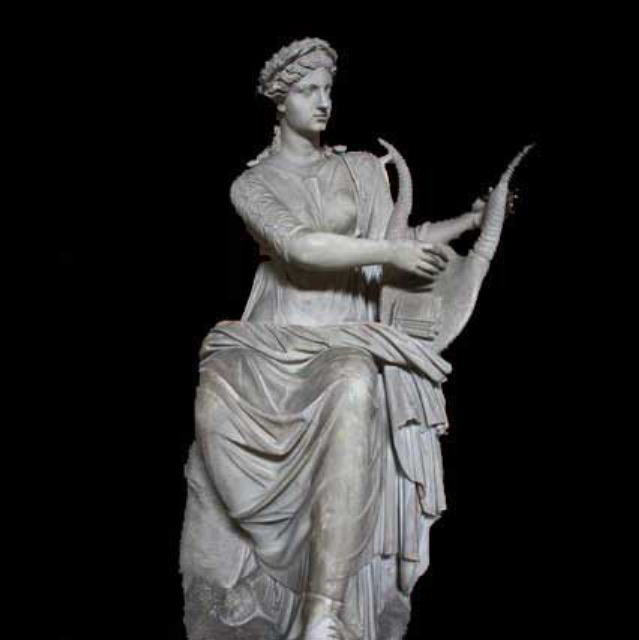
TerpsichoreHall of the MusesThe full story

marble

Vatican Museums audio guide

Terpsichore is the muse of dance performed in harmony with the dictates of heart. According to a version, she is the mother of the sirens. A lyre in her hand symbolizes music that was an inextricable part of Terpsichore's life. She was a skilled dancer, and her mastery of dance represents the balance of nature, human body movements and emotions.

Original author’s text, preserved unchanged.

PolyhymniaHall of the MusesThe full story

marble

Vatican Museums audio guide

Polyhymnia is the muse of sacred poetry, sacred hymn and oratorical art. She symbolizes the faith glorified in music. Ancient Greeks believed that the success of orator depended on Polyhymnia's mercy. An orator should have propitiated the Muse and then she endowed him with fantastic eloquence. If the orator did not address to Polyhymnia, his speech was not successful.

Original author’s text, preserved unchanged.

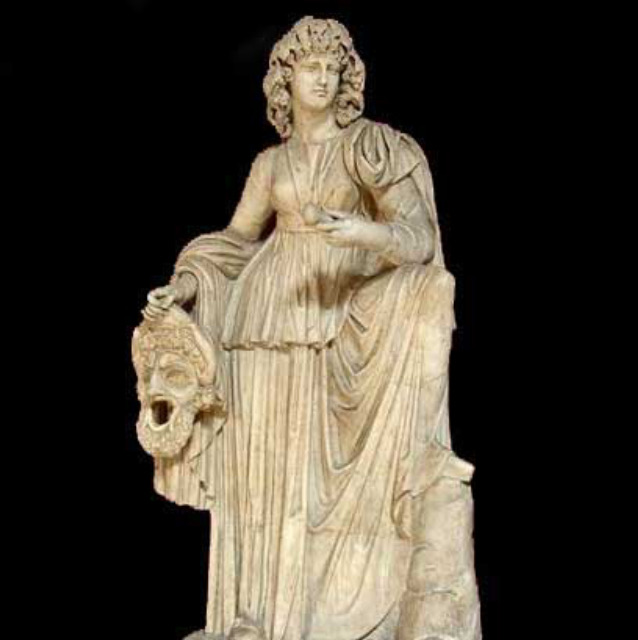
MelpomeneHall of the MusesThe full story

marble

Vatican Museums audio guide

Melpomene is the muse of tragedy, chorus and musical harmony. She was initially named a patroness of sacred songs, then – a patroness of sad songs and, at last, the muse of dramatic art and theater. She represents the tragic principle of theater. Melpomene wears a theatrical cloak, holds a tragic mask in her right hand and a knife in her left hand. Traditionally, the mask symbolizes a theater, and the knife is a symbol of the inevitability of punishment of those who disobeyed the gods. According to legends, it was Melpomene who gave birth to perfidious sirens who lured sailors with their singing voices.

Original author’s text, preserved unchanged.

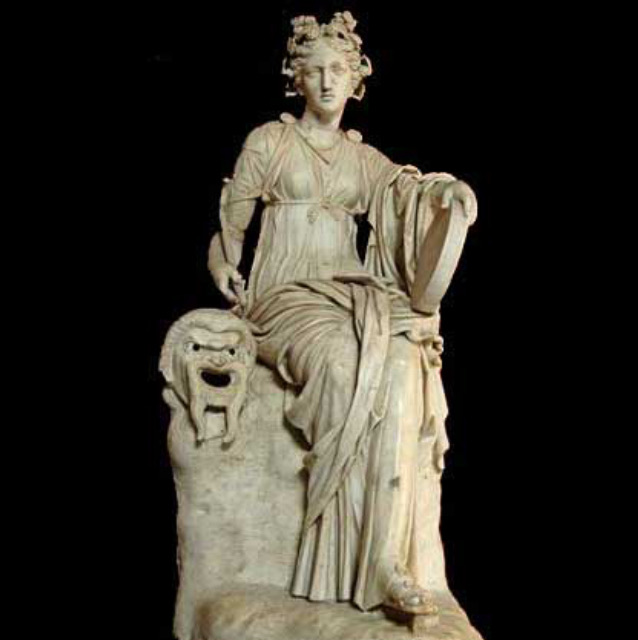
ThaliaHall of the MusesThe full story

marble

Vatican Museums audio guide

Thalia is the Greek muse of comedy and idyllic poetry. She is portrayed holding a shepherd's crook, a comic mask and a tambourine. Her head is crowned with a wreath of field flowers. It refers to joyful and vivacious poems about the lifestyle of shepherds and peasants working and living in the open country.

Original author’s text, preserved unchanged.

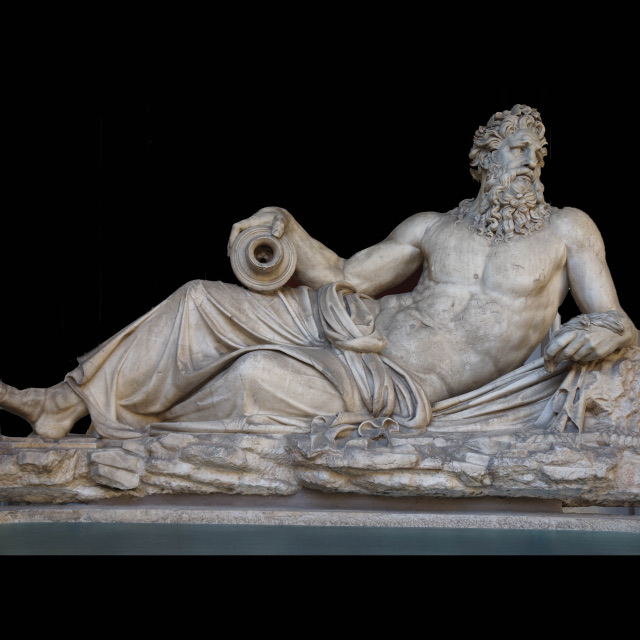
God of the River ArnoOctagonal CourtThe full story

170 year · marble

Vatican Museums audio guide

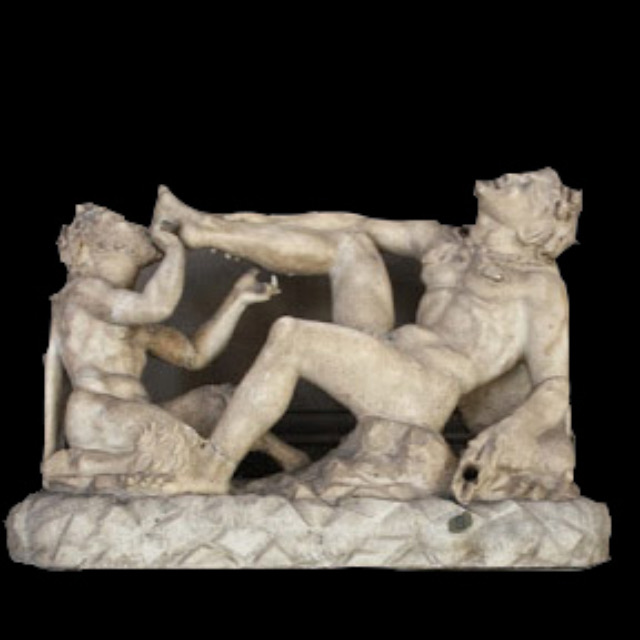
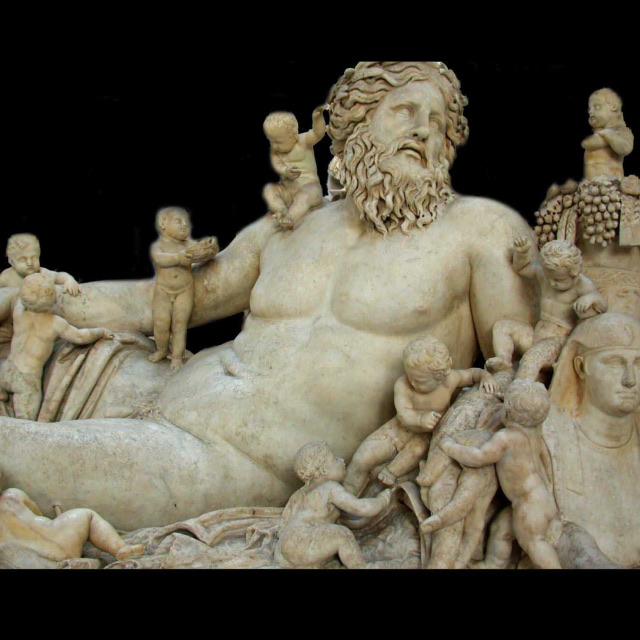
The god of the River Arno in Florence is a mighty and strong titan with a frowning, serious and speaking bearded face. The figure of the god represents the power and strength of the river that gives birth. Originally, the sculpture of the god was a part of a fountain, the basin of which is a sarcophagus decorated with scenes of battles between Greeks and Amazons. This statue portrays the river god in a traditional pose when he reclines with a jar in his hand. A small lion's head is carved on the jar. The cat elements prove that the River Arno can be identified with the River Tigris of the ancient Mesopotamia.

Original author’s text, preserved unchanged.

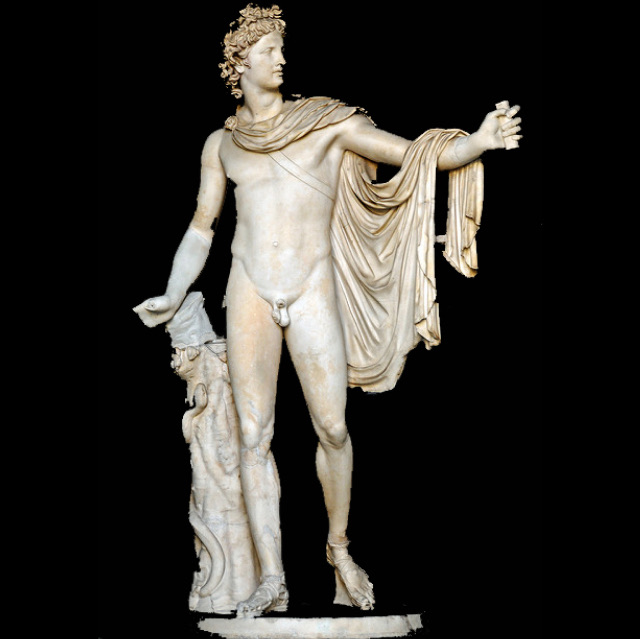
Apollo of the BelvedereOctagonal CourtThe full story

Leochares · 140 year · marble

Vatican Museums audio guide

Apollo, the god of sun and light, was called "splendid" or "radiant". For several centuries it was an idol of male beauty. And just after its creation the statue of Apollo of the Belvedere was admired by both ordinary people and prominent sculptures. The art expert Johann Joachim Winckelmann considered the statue as a benchmark of Greek art. He said that "of all the works of antiquity that have escaped destruction, the statue of Apollo represents the highest ideal of art". As soon as the marble statue was discovered not far from Rome in the middle of XV century, it was placed in the garden of Belvedere in the Vatican. So Apollo was called the Apollo Belvedere. The sculpture of the Apollo Belvedere depicts the god as a mighty and handsome archer. His moves are dynamic, decisive and brave. According to historians, Apollo supposedly holds a bow in his left hand and an arrow in his right hand. He seems to have just released an arrow, waiting what target it is going to stick. The arrows and bow in his hands represent his right to punish sinners and purify repentant persons from their sins. Apollo's head is crowned with a laurel wreath, a symbol of winner. Near the youth is a tree trunk with Dragon Python killed by Apollo in Delphi.

Original author’s text, preserved unchanged.

This story is part of the itinerary Read the story
Hermes of the BelvedereOctagonal CourtThe full story

Praxiteles · V century BC · marble

Vatican Museums audio guide

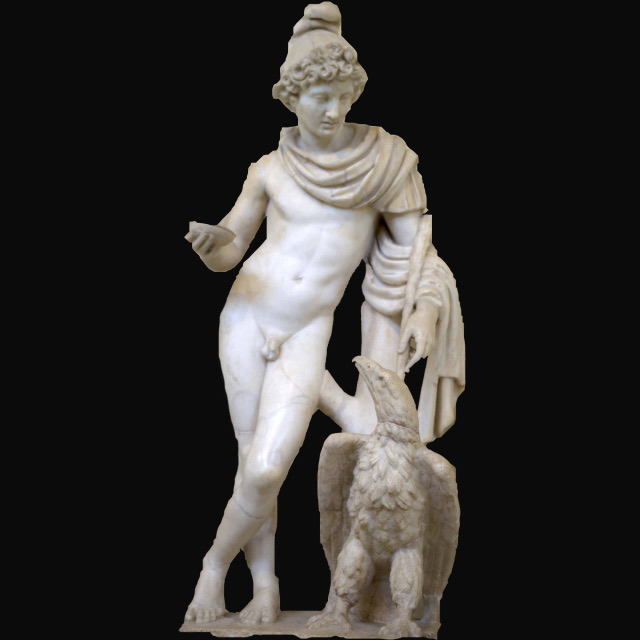
Hermes was the emissary of the gods and the conductor of souls of the dead to The Underworld. His other name was Psychopomp, what literally means the «guide of souls». Hermes was also the patron of herdsmen, ambassadors, travelers, magicians, alchemists and astronomers. Besides, merchants, tradesmen and athletes revered him. According to legends, Hermes invented units of measurement, numbers, and alphabet and taught it to people. The statue depicts young, strong and handsome Hermes in quiet expectation. The young god looks ahead tranquilly. He is melancholic; his gaze is lowered, while a cloak thrown over his shoulder is wrapped around the forearm. Hermes gently leans his right foot against the trunk of a palm tree. The author embodied in the sculpture that special dreamy charm with which Hermes is fulfilled. Marble conveys the smoothness and softness of the movements of Hermes amazingly, while shows the youth and strength of his figure.

Original author’s text, preserved unchanged.

This story is part of the itinerary
PerseusOctagonal CourtThe full story

Antonio Canova · 1801 year · marble

Vatican Museums audio guide

The sculpture depicts a famous Greek story about Perseus' victory over the Gorgon Medusa. The story began when king Polydectes wished to marry the beautiful Danaë. She was the mother of Perseus who was against this marriage. Then Polydectes tricked Perseus and made him promise to kill the Gorgon Medusa. The king hoped that Perseus would die in the fight against the Gorgon, but other things happened. After many hardships the young Perseus reached the island where the Gorgons lived. He knew that everyone who looked at Medusa would be turned into stone, so he beheaded the Gorgon by looking at her reflection in his copper shield. The sculpture of Perseus portrays him after the defeat of the Gorgon. He holds a sword in his hands and wears the sandals of Mercury. He was given these attributes to fly to the island of the Gorgons and to defeat Medusa.

Original author’s text, preserved unchanged.

VenusOctagonal CourtThe full story

170 year · marble

Vatican Museums audio guide

Venus is an ancient Roman goddess of love, beauty, fertility and prosperity. In Greek culture she was called the mistress of hope and the symbol of victory. Lavish feasts were arranged in her honor, and she was incarnated in dozens of sculptures. Venus is considered to be the mother of Aeneas who fled from the sieged Troy to Italy. There his descendants founded Rome, and Venus was worshiped as the genetrix of Romans. The attributes of the eternally young beauty Venus are a poppy, a rose, a pigeon and a hare as symbols of fertility. Romans believed that Venus was capable of controlling the will of wild animals and charming them. According to historians, the sculpture of Venus Felics is a sacrificial gift to Venus from the empress Sallustia and her son Helperid. Art experts assume that the missed left hand might have held an apple or a mirror. Historians also assure that Venus looks like Faustina the Younger, a wife of Roman Emperor Marcus Aurelius.

Original author’s text, preserved unchanged.

LaocoonOctagonal CourtThe full story

Polydorus · III century BC · marble

Vatican Museums audio guide

The group of statues of Laocoon and His Sons shows Laocoon and his sons being attacked by sea serpents. At the height of the Trojan War Laocoön warned Trojans about the cunning and artfulness of Greeks. He asked the citizens not to take the Trojan horse. But the people did not listen to Laocoön, and then he decided to throw a spear to show what it was. But the mighty Poseidon wanted Troy to be ruined, so he had to prevented Laocoön from disclosing. Poseidon sent two huge serpents to attack Laocoön and his sons. The sea serpents came up from the sea, coiled the necks of their victims and killed them. The group of statues expresses melodramatic teatricalism. The sculptor masterfully used his knowledge of human body to engrave the figure of Laocoön at the tensest moment. The muscles of his body were tense with pain, and his mouth was distorted with death cry. He is mourning not so much himself as his sons. Not only the description of the battle-to-the-death reflects the tragedy. The hopelessness is that the suffering of Laocoön and his sons are desperate as they will be killed in a few minutes. But even knowing it well, Laocoön still hope to push the sea serpents off and get rid of them. The sculpture amazes with the realism and details of the muscles of human body, tense and resistant.

Original author’s text, preserved unchanged.

This story is part of the itinerary Read the story
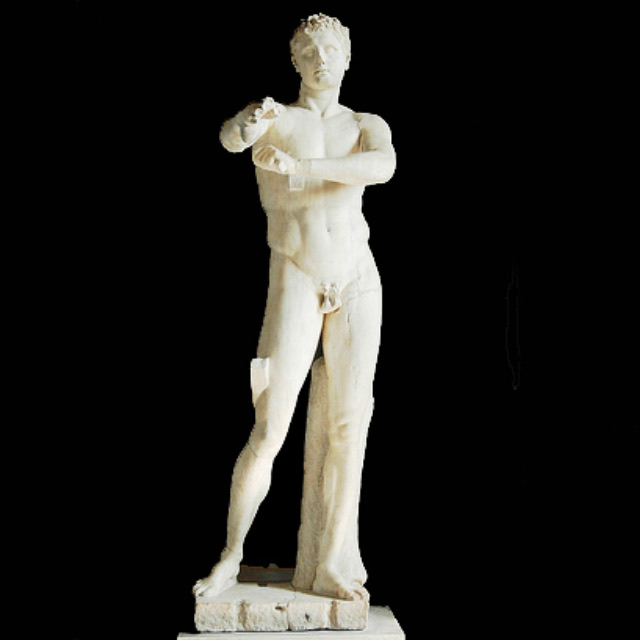
ApoxyomenosCabinet of ApoxyomenosThe full story

Lysippos · V century BC · marble

Vatican Museums audio guide

Apoxyomenos is a symbol of ancient sports and eloquent demonstration of a lean athletic body of Greek athletes. The word "Apoxyomenos" comes from the Greek verb meaning to clean oneself. Before competitions ancient Greek athletes used to anoint their bodies with oil that was covered with sand during a tournament. After competitions athletes scraped off the mixture of sand and oils with a special spoon called the strigil. The statue of Apoxyomenos shows a graceful, a little relaxed, but serious sportsman. His lean plastic figure serves as a silent evidence of the popularity of sports in antiquity. This is a copy of the bronze statue of Apoxyomenos made by the Greek sculptor Lysippus in 320 B.C.

Original author’s text, preserved unchanged.

This story is part of the itinerary
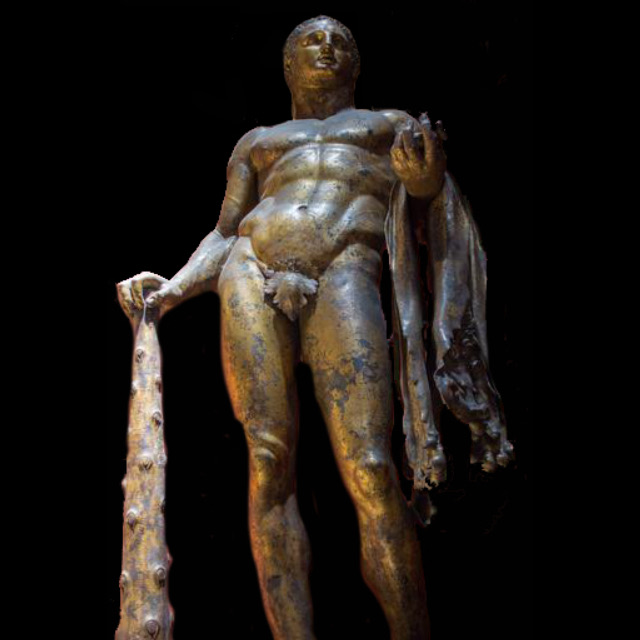
HeraclesRound HallThe full story

bronze, gold

Vatican Museums audio guide

This is the world's only bronze statue covered with the antique original gild. Heracles holds a heavy club, the lion's skin and the apples of the Hesperides in his hands. They remind about the first and last of the twelve Labours of Heracles. The skin of the Nemean lion is a symbol of the first labour of Heracles. The athlete was supposed to kill a huge lion terrorizing the hills around Nemea. When Heracles found a cave where the beast lived, he blocked the entrance with a stone. Then he stunned the lion with his club and strangled the beast to death. The apples of the Hesperides symbolize the twelfth, the most difficult task accomplished by Heracles. According to legends, he was supposed to go to a titan Atlas and fetch three golden apples from his garden. Atlas was holding up the sky on his shoulders, and the garden was guarded by the Hesperides, his daughters. Before Heracles managed to pick three apples, he found the way to the garden, tricked the dragon defending the trees and Atlas himself.

Original author’s text, preserved unchanged.

This story is part of the itinerary
AntinousRound HallThe full story

marble

Vatican Museums audio guide

Antinous, a young handsome Greek, was the favorite of the Roman emperor Hadrian. They met in 124 A.D., and since then Antinous always accompanied the ruler. His alliance lasted for 6 years, and in 130 A.D. the youth died in the waters of the Nile. So far the causes of his death have remained unclear. Historians have several hypothesis, among them are suicide, tragic accident and ritual human sacrifice. After his death Antinous was deified and his cult spread throughout Greece and Egypt. There the youth was identified as Osiris, a god of resurrection who had also drowned in the River Nile, but then he resurrected and made soil fertile. The sculpture embodied the real features of Antinous: his strong body, broad shoulders, eye-catching face. He is portrayed strong as athlete and handsome as god. His beauty is voluptuous and soft as if it is surrounded by sadness. The statue shows Antinous as Dionysus, a god of wine and vegetation. His head is embellished with the symbols of the god of wine — a wreath of ivy and a diadem.

Original author’s text, preserved unchanged.

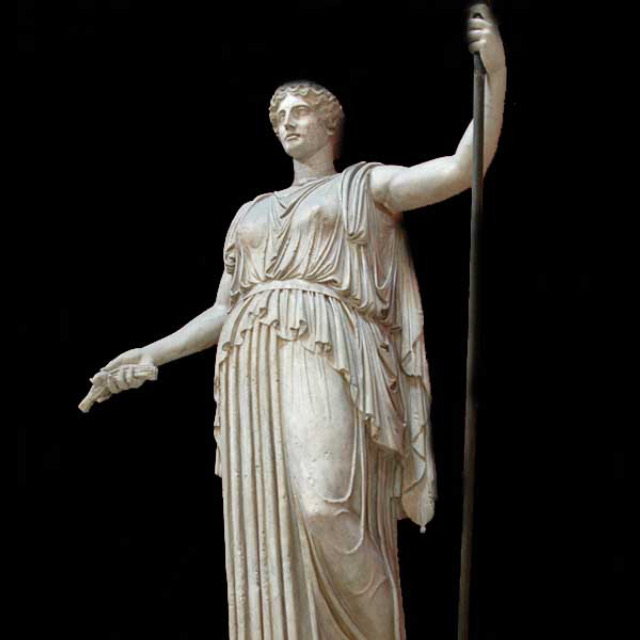
DemeterRound HallThe full story

marble

Vatican Museums audio guide

Demeter was the goddess of fertility and farming. Her second name is "mother earth" who taught people how to farm. The most famous legend of Demeter tells about her searching Persephone who was taken by Hades to the Underworld. Demeter walked the earth far and wide to find her daughter, meanwhile the earth turned barren. People were starving and they did not have gifts for the gods. The gods implored Demeter to come back to Mount Olympus, but she refused. Then Zeus ordered his brother Hades to release Persephone. When the daughter came back, Demeter stopped grieving and put on a wreath of cornflowers on her head. Celebrating, the goddess gave to people corns, and they started to grow wheat. The sculpture portrays Demeter calm, dignified, with a frank look. But not all historians believe that this statue is Demeter. There are some doubts as there are no goddess' specific attributes. It is called Demeter as it holds a poppyhead, a symbol of fertility, in its right hand. But a scepter in her left hand may allude to Hera.

Original author’s text, preserved unchanged.

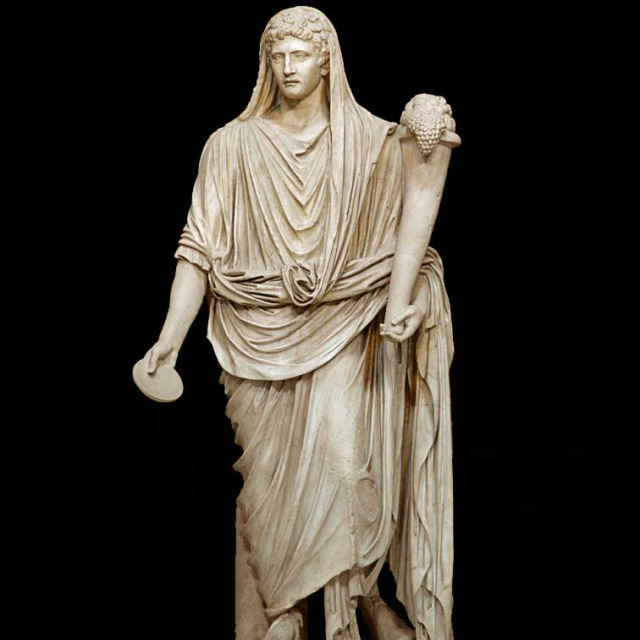
Genius Togatus of AugustusRound HallThe full story

marble

Vatican Museums audio guide

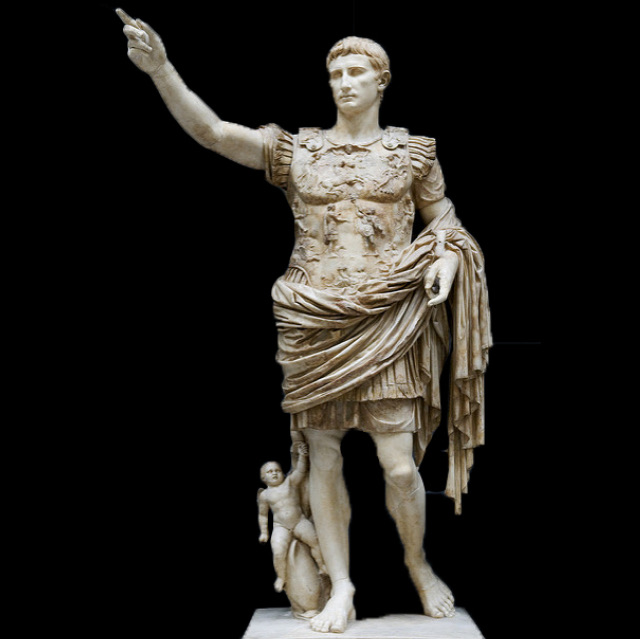
In Latin togatus means a person dressed in toga. This is a national garment of a full Roman citizen. The toga was popularized by Emperor Augustus. He instructed Romans to wear toga before going to Forum, the business center of a city. Thus, the toga became a symbol of Ancient Rome, an attribute that people were obliged to put on whether they went to the market, temple or meeting. The toga was draped, and it was commonly believed that only Romans were capable of learning "the great skill of draping". The Emperor Genius Augustus draped in toga embodies a free Roman respected by society. Augustus' head is covered with the toga. It means that the emperor is ready for the consecration – offering up the sacrifices. In his left hand Augustus holds the horn of abundance as a symbol of fertility and satiation of his people. In Roman culture, the genius is the grandparent, a spiritual keeper of man's destiny. He was worshiped and hoped for. Step by step people started to associate this cult with the respect of emperor. Augustus was called Genius for his merit to the Fatherland, greatness and protection of Roman people.

Original author’s text, preserved unchanged.

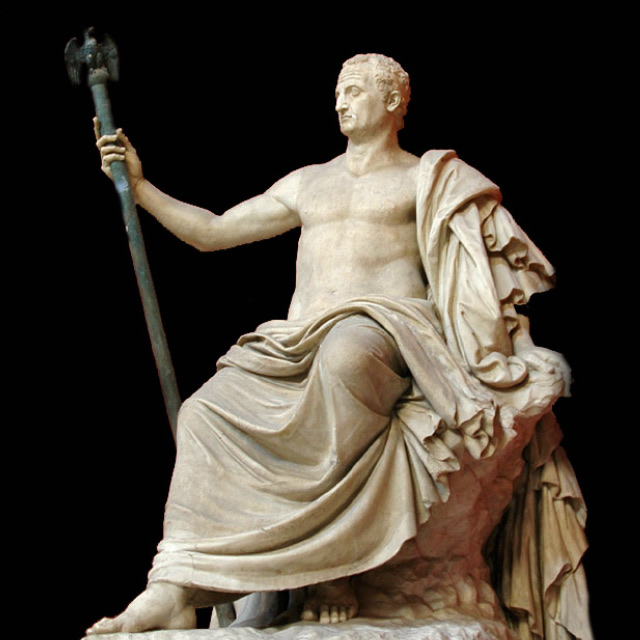
Imperator GalbaRound HallThe full story

marble

Vatican Museums audio guide

Servius Galba was a ruler of the Roman Empire only for six months, from June 68 till January 69. Galba was born in a noble family and made a remarkable military and political career. He was the first Roman emperor who seized the power after the rebellion of soldiers. It is this internal military conflict led to the constant struggle for power in the Roman Empire. New riots overran Rome and, after all, Galba was killed. According to legends, Galba was a severe commander. Reportedly, he did not allow his soldiers any leaves, exhausted them with physical exercises and permanent work. According to historians, by the end of his life Servius Galba was weak and ruined with diseases. But the sculpture shows him as aged, but still strong and mighty man, holding a rod, a symbol of power, in his hands.

Original author’s text, preserved unchanged.

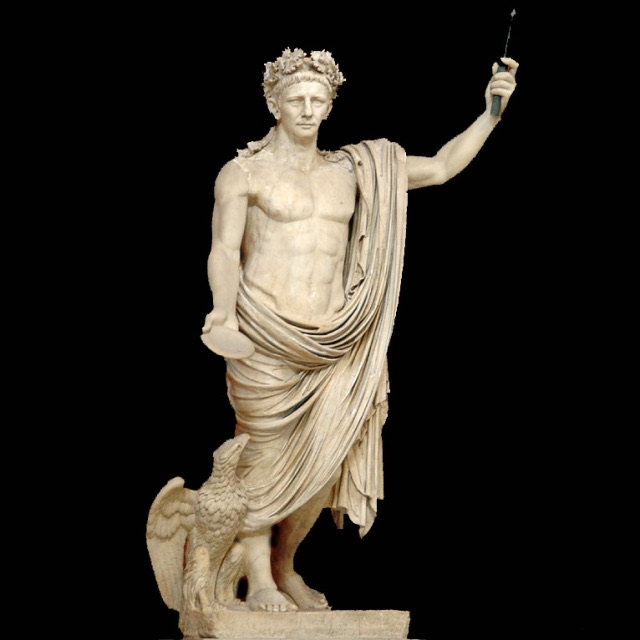
Claudius as JupiterRound HallThe full story

marble

Vatican Museums audio guide

Claudius, who became an emperor after Julius Caesar, ruled the country incompetently. The legends say that Claudius was short-sighted and narrow-minded, unable of controlling a big state. He was shy, foolish and indelicate, which deprived him of titles and ranks. But in fact Claudius was good at history, archeology, Greek and Roman literature. When he was a child, Claudius used to get ill, which had an effect on his physical and mental development. Despite the unattractiveness of Claudius' figure, his statue portrays him as Jupiter, a handsome, strong and dignified god. The ideal proportions of his body disharmonize with his face. The torso, legs, arms, protruding ears, a wrinkled face and hollow eyes are not harmonic. A wreath of oak leaves is on the head of Claudius. This is a symbol of fertility, courage and power. Military victories marked the emperor's reign. An eagle, Jupiter's eternal companion, sits at Claudius' feet. He symbolizes the wisdom and the coming military victories.

Original author’s text, preserved unchanged.

Hera BarberiniRound HallThe full story

marble

Vatican Museums audio guide

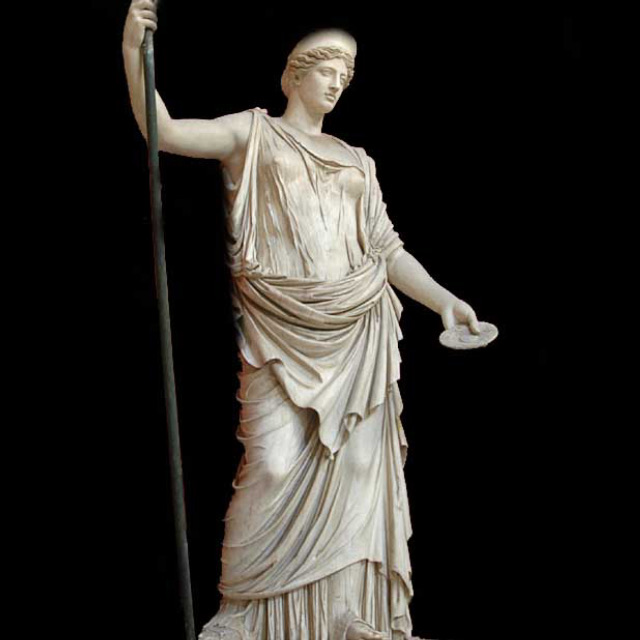
Hera is the goddess of marriage and wife of Zeus. She protected married couples and blessed them with children. Hera respected the sanctity of marriage very much and tried to protect her family and be a faithful wife. She did her job well, but the same cannot be said for Zeus. He had numerous lovers, and that's why Hera always made scenes, but later she reconciled with her husband. The goddess dressed in a sumptuous attire traveled by a silver chariot with golden wheels pulled by immortal horses. She was the strongest among the Olympian goddesses and sat near Zeus on the golden throne. The sculpture portrays her as a graceful, splendid and queenlike. Hera Barberini is depicted holding a rod in her right hand with her head bowed a little bit. Thus, the goddess demonstrates her power and affection for people. The statue is made of numerous marble fragments. Some fragments were used to create the left foot and the breast. This is an antique tradition when a full sculpture may be made using minimum amount of stones.

Original author’s text, preserved unchanged.

Juno SospitaRound HallThe full story

marble

Vatican Museums audio guide

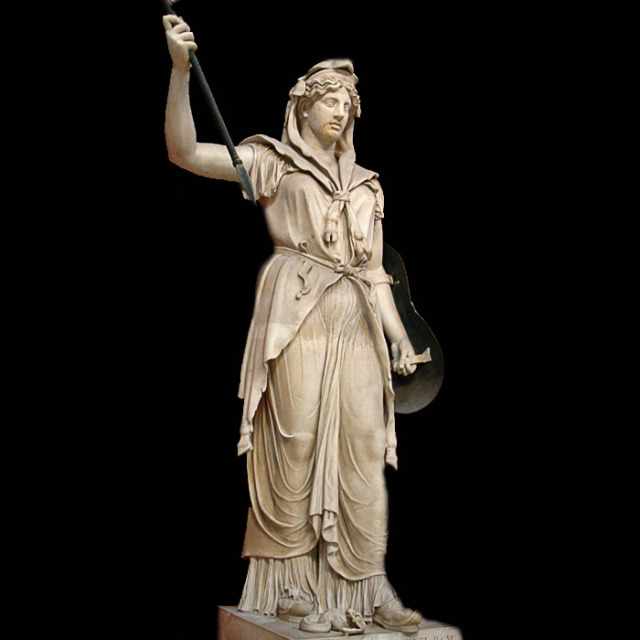
Juno is one of the most respected goddesses of the Ancient Rome. The month of June is named after her, and the goddess was called Sospita, i.e. Saviour. She was a patroness of the Moon, women and marriage and a member of the Capitoline Triad that included Jupiter and Minerva. The goddess of wisdom Minerva and the patroness of fertility Ceres were her advisers. Each woman is considered to have her own juno, a companion and protectress. Juno is depicted as a severe woman who stands still and looks into the distance. A diadem covered with a skin is on the goddess' head. This is the skin of goat Amaltheia who nurtured Zeus when he was an infant. The goddess holds a spear and a shield in her hands. It refers to another Juno's title. She symbolizes victory and military prowess. Ancient Romans used to call to her when they asked for success of military campaigns.

Original author’s text, preserved unchanged.

04Pinacoteca34 · exhibits
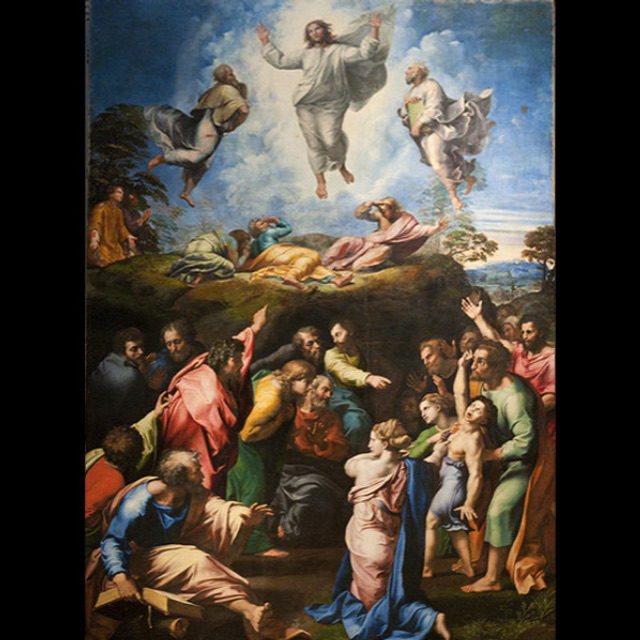
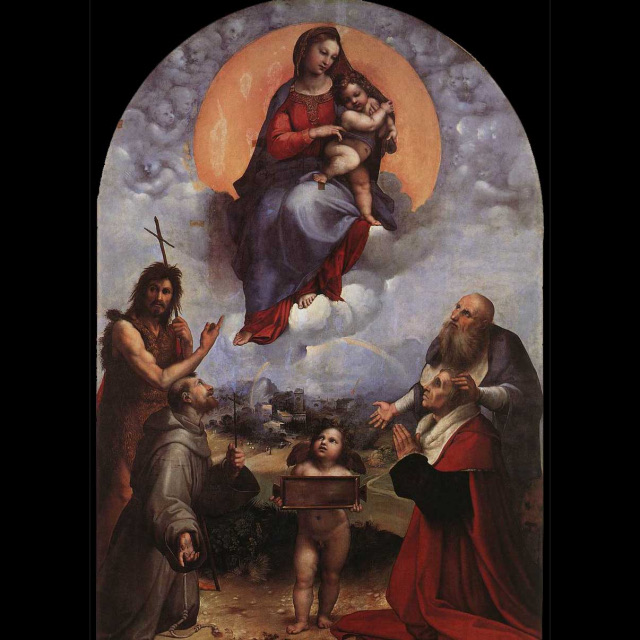
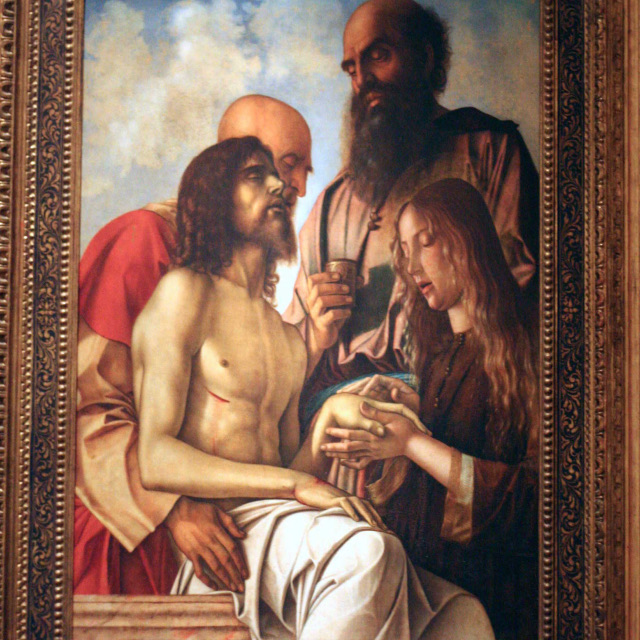
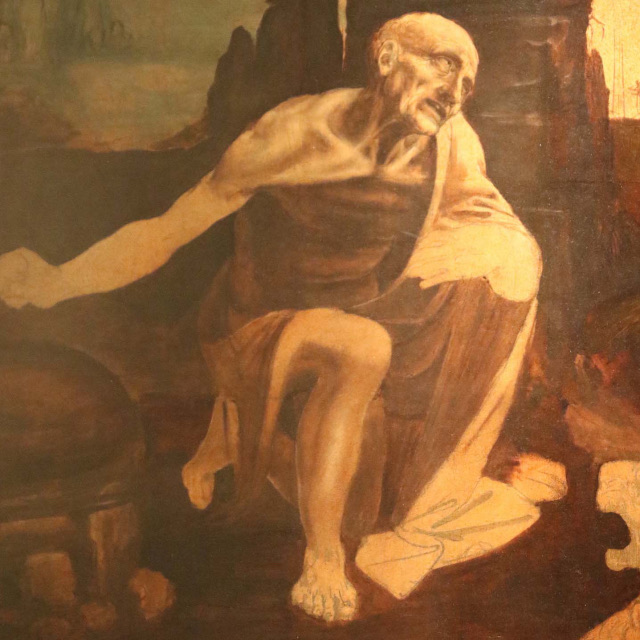
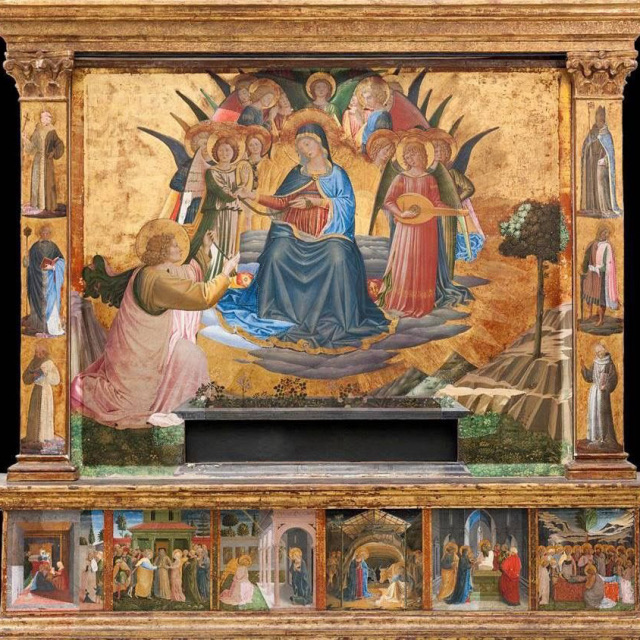
The Vatican Pinacoteca was arranged by Pope Pius VI in the second half of XVIII century. Originally the pontiff placed his collection of paintings in one hall. Since then the collection was growing, and the hall was enlarged. Finally, in 1908, eighteen halls of the Pinacoteca opened their doors for visitors. Here you will have to visit more than 15 halls with amazingly beautiful mosaics, tapestries, icons, sculptures and paintings by the Italian painters of XII-XIX centuries. You should stop to admire the religious paintings by Caravaggio, Raphael, Titian, da Vinci. An attentive viewer will notice that the canvases of different painting schools are displayed there, including Florentine school, Baroque, Flemish, Dutch schools and school of Raphael Santi. Going through the halls of the Vatican Pinacoteca, you will see the paintings "Transfiguration" and “Madonna of Foligno”, "Madonna of the Girdle" by Benozzo Gozzoli, "Vision of St Helena" by Paolo Veronese, "Entombment of Christ" by Michelangelo, “Madonna and Child” by Pietro Perugino, “St Jerome” by Leonardo da Vinci and “Lament over the dead Christ” by Giovanni Bellini. In the Eighth Hall you will look carefully at the collection of the tapestries made using cartoons by Raphael Santi, among of which there are "Healing of the Lame Man" and "Miraculous Draught of Fishes". The Eighteenth Hall gathered a big collection of icons made in 15-19 centuries. They are justly considered to represent spiritual practices of the first centuries of Christianity. The Pinacoteca holds almost five hundred paintings from all over the world. The only thing that matters is that you will need forces enough not just glance at them, but understand the particularity, distinctive characteristic that incarnates the spirit of time and the power of the artistic idea.

Original author’s text, preserved unchanged.

Room XVIII. 15th-19th cent.
Icons of the Vatican Museums are an important collection of sacred images. They are an expression of the theology, faith and aesthetic canons of Christianity in the East.  The paintings that form part of the collection were included in the papal collections after 1762 as part of the Holy Museum founded by Pope Benedict XIV in the Vatican Library. The icons presented here represent the most significant of the collection, selected on the basis of their iconographic types and cultural zones. Dating from the 15th to the 19th centuries, they come from post-Byzantine Greece, the Balkan and Slavic countries, Russia, the region previously under Venetian rule, the Adriatic and the Middle East. These territories have always been associated with the Byzantine world, in which, from the first centuries of the Christian era, a peculiar symbiosis of theological doctrine and art developed, giving shape and content to the sacred images that we now call icons. The most common form in the collections of the Vatican Museums is an icon of devotional service. These were images, usually of a small format, created for personal and domestic prayer. Although they differ in size from large icons for display in churches, they present similar iconographic themes: images of Christ and the Mother of God, Saints and liturgical holidays.

Original author’s text, preserved unchanged.

Last JudgementRoom I. 12th-15th cent.The full story

1260 year · tempera on wood

Vatican Museums audio guide

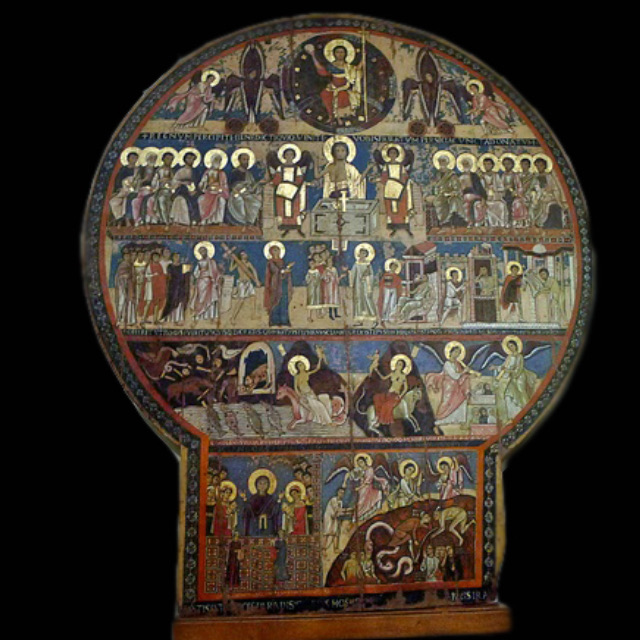
The Last Judgment is the most ancient painting of Pinacoteca. The Apocalypse plot was one of the most important for medieval Christians who believed that the Earth was a disc. And the form of the painting, which is a round with a rectangular base, is a symbol of the comprehensiveness of the Last Judgment. The painting is traditional for 12 century, when altars were decorated with wooden panels showing religious scenes. The figures of the panel are two-dimensional. Faces ofpeople are deprived of artistic vivacity and emotions, and their figures are motionless. They serve as an illustration of the Last Judgment, an explication of one of the most incomprehensible episodes of the Bible. The painting is divided in five phases or registers. Each character takesown place in the religious hierarchy. At the top of the composition is the God holding His regalia in hands. He is surrounded by cherubs. The second phase shows Christ, standing between two angels and twelve apostles before an altar. The third phase contains the most complicated message. It is divided into scenes. On the first left scene is St Paul who guides the Elect. Then Virgin Mary and Stephen, interceding for the innocent, are depicted. On the right, another three scenes, are Dress the naked, Visit the imprisoned, Give the thirsty drink. The fourth phase shows the land and water, birds, fish and ferocious animals spit out the limbs of the devoured bodies, And the angels sound the apocalyptic trumpets and wake the dead. The fifth rectangular phase shows Heavenly Jerusalem and Hell. Here you can see the saved who are waited in the paradise and the sinners whose path goes to the hell.

Original author’s text, preserved unchanged.

Madonna with the Child and SaintsRoom X. 16th cent.The full story

Tiziano Vecellio · 1535 year · Oil on canvas

Vatican Museums audio guide

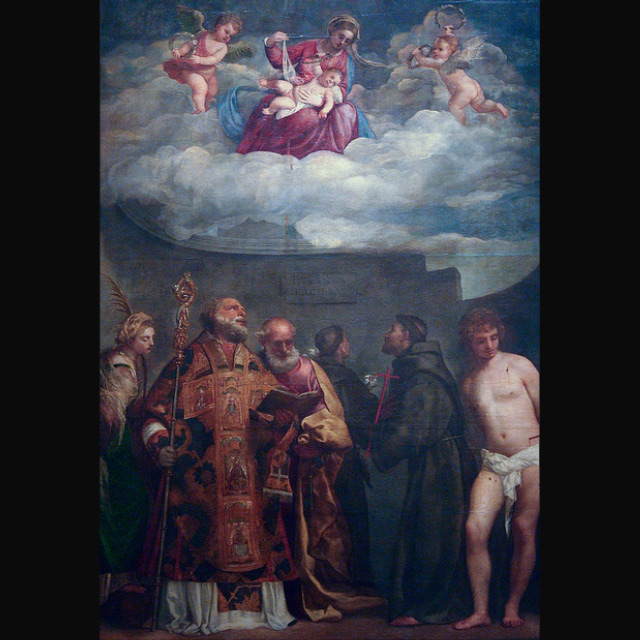
The altarpiece Madonna with the Child and Saints has another name, Madonna of the Frari. This is one of the most impressive and colorful painting by Tiziano, the painter from Venice. The canvas depicts the appearance of the Virgin Mary with the Child before Sts Catherine, Nicholas, Peter, Anthony, Francis and Sebastian. Madonna with the Child on her knees, surrounded by angels, is seated on the cloud and descends towards the saints who saw her. They were in the temple, when the vision appeared to them. The painter shows that each eye-witness of the vision perceives it in his or her way. Some of them look up, some of them look down, but joy, awe, solemnity and greatness of the moment are in the air. The figures are painted brightly, vividly, colorfully and in perspective. The scarcely visible light and rich golden color make the painting look like an icon. Madonna with the Child and Saints was painted for the alter of the church of St Niccolò della Frari at the Lido of Venice.

Original author’s text, preserved unchanged.

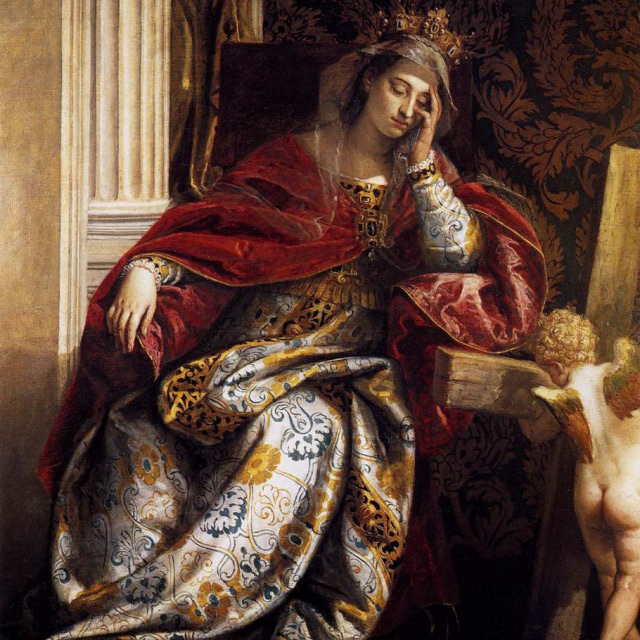
Vision of St HelenRoom X. 16th cent.The full story

Paolo Veronese · 1580 year · oil on canvas

Vatican Museums audio guide

The painting The Vision of St Helena is a bright example of the picture depicted against the secular interior. The painting shows St Helena. She was the mother of Constantine, the first Roman emperor who professed Christianity. According to the legend, an angel appeared to Helena to tell her to go to Jerusalem for the search of Christ’s cross. Though many experts agree that it is not the mother of Constantine depicted in the painting, but the wife of the painter, also Helena. Because the portrayed woman is young, and St Helena sat out on a search of the Cross, when she was aged. Helena is shown seated in the armchair, unwrapped in a gentle slumber. The vision is before her. A winged angel-boy shows her the way to the Cross by holding it in his hands. Helena is dressed in the rich and sumptuous attire with floral patterns. With her head resting on her hand, she sleeps naturally and in detail, the painter depicted Helena's arm relaxing in the sleep. In a few minutes the wrist will completely relax and fall off. Then Helena will wake up, understand the vision and leave for the Holy Land in the search of the Cross.

Original author’s text, preserved unchanged.

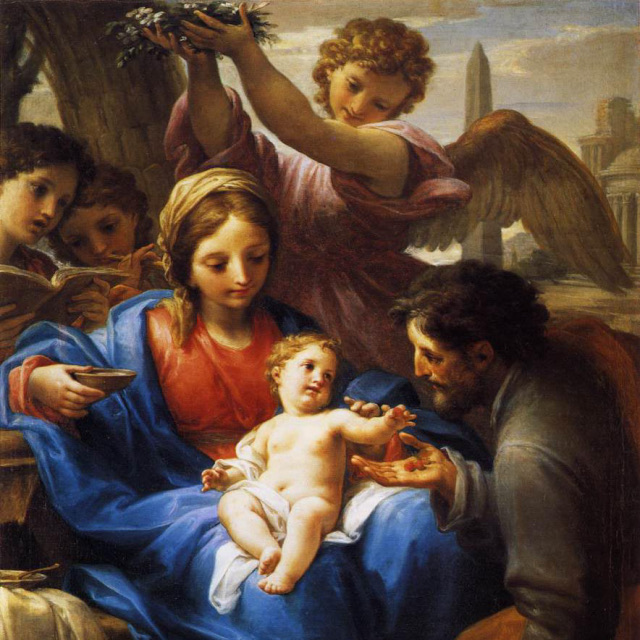
Rest on the Flight into EgyptRoom XI. 16th cent.The full story

BAROCCI Federico · 1573 year · oil on canvas

Vatican Museums audio guide

The painting The Holy Family is noteworthy for its interpretation of a famous episode from the Bible. This iconographic scene serves as a spectacular example of the canvas of the Umbrian school painting. The canvas is infused with poetry and colors. That's why its story resonated with the believers and was extremely popular. This painting is also called Madonna of the Cherries or The Rest on the Flight into Egypt. The painting shows the Virgin Mary, Joseph and the Baby Jesus. The holy family flew from Israel to Egypt to save the son from the massacre of the innocents. Federico Barocci translated the difficult beliefs of the Christianity into the forms comprehensible for ordinary people. The painter made the subject of the painting simple by showing daily routine of the family. Despite this, the canvas is infused with the Christian symbols. Cherry is a symbol of Christ's suffering. It reminds believers about the life peculiarity of the God’s Son. The red color symbolizes the blood shed by him for the sins of people. The purity of colors harmonizes with the flow of lines and the balance between the human and the nature. With no pretentiousness and religious pathos, the figures do not pose on purpose. They are ordinary people, and the painting is as a scene from their daily life.

Original author’s text, preserved unchanged.

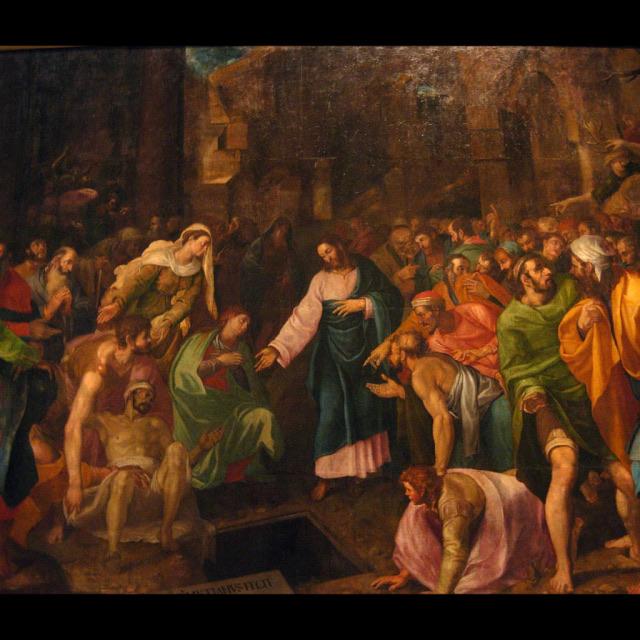
Resurrection of LazarusRoom XI. 16th cent.The full story

Girolamo Muziano · 1555 year · oil on canvas

Vatican Museums audio guide

The Resurrection of Lazarus shows one of the key episodes from the Bible, which demonstrates mercy and limitless power of Christ. This canvas is one of the most significant among all religious scenes. In early Christianity, at the beginning of the first century, the raising of Lazarus referred to the resurrection of all dead during the Last Judgment and Christ after the crucifixion. The miracle of the raising of Lazarus represents not only the resurrection of his body, but also spiritual renewal. The painter depicted skillfully the specifics of the medium, the depth and height of a tomb and the emotions on the faces of eye-witnesses. Lazarus buried in the tomb has resurrected. And everyone speaks only about it. In the painting each person is depicted in a certain perspective, in motion. This is what makes you feel sucked into a whirl of events. Christ is in the center of the composition. His figure is bright and picturesque. The body of Lazarus is not so bright as that of his savior. This is what the Bible episode implies. Because it is not important who was resurrected by the Son of God. But the miracle performed through his kindness and compassion matters.

Original author’s text, preserved unchanged.

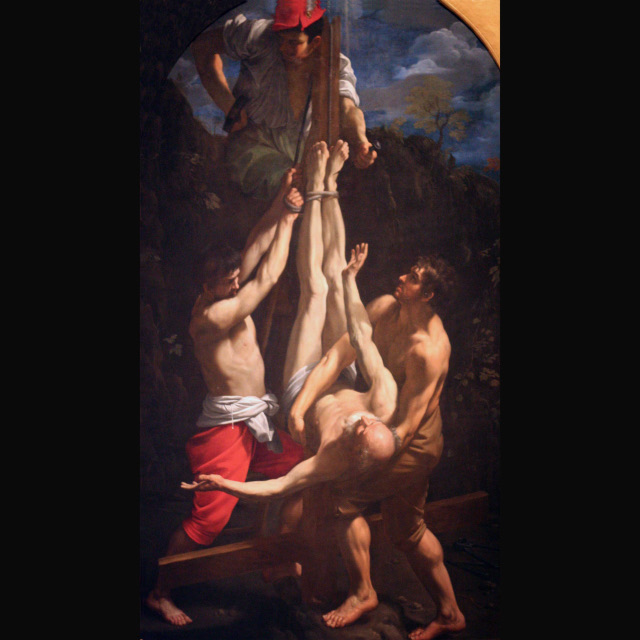
Crucifixion of St PeterRoom XII. 17th cent.The full story

Guido Reni · 1605 year · oil on canvas

Vatican Museums audio guide

The Crucifixion of St Peter shows how symmetrically a painter can build a composition. This painting is a bright example of how a painter controls the medium and plays skillfully with different shades of the same color. The painting clearly shows the contrast between the shades of the skin of Peter and his executioners. The color of their skins is the same, but its shades are different. The body of Peter is deadly pale. It seems to be bloodless and rigid before inevitable martyrdom. Three executioners are about crucifying Peter. While putting him on the cross, they have warmed up, and their bodies are tinged with the shade of yellow wax. The painter made the figures three-dimensional and amazingly realistic due to the play with light. The brightest part is in the center of the canvas. This is Peter's figure. The cross is scarcely visible, but it creates the central line of the painting and divides it into symmetrical parts. While working on the painting, Guido Reni took as model the canvas by Michelangelo da Caravaggio for the church of S. Maria del Popolo. Reni managed to depict masterly the scene and make it unique. For example, the original painting shows Peter's face drawn with pain, and Reni, respecting the martyrdom of the saint, chose not to show his face.

Original author’s text, preserved unchanged.

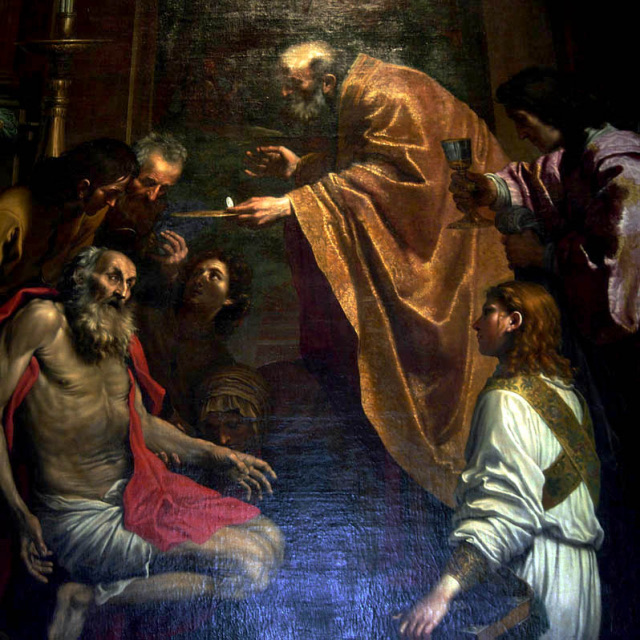
Last Communion of St JeromeRoom XII. 17th cent.The full story

Domenichino · 1614 year · oil on canvas

Vatican Museums audio guide

The subject matter of The Last Communion of St Jerome was not popular among painters due to its complexity and immensity. The painter used clean bright colors that make the painting medium look as it is full of air and light. The depicted figures are realistic, and their gestures and movements are slow and accurate. The disciples bend over a weak, slim and thin-faced Jerome. St Girolamo gives him communion and St. Paola kisses his hand. Their faces are ordinary, but full of compassion and mercy. Jerome's disciples wear rich and sumptuous clothes, and the elder is dressed in a scarlet cloak. A sad lion rests at his feet. This is a legendary animal of the stories about Jerome. Once the elder had removed a thorn from its paw, the beast followed him everywhere. A candle burns behind Jerome as a symbol of his religious and recluse lifestyle. And the high arch of a church frames the discernible landscape and the clear sky ready to take Jerome's soul.

Original author’s text, preserved unchanged.

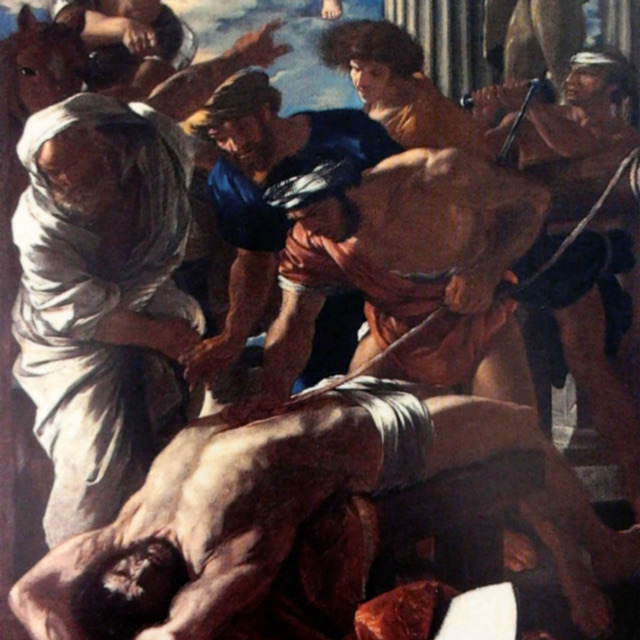
Martyrdom of St ErasmusRoom XII. 17th cent.The full story

Nicolas Poussin · 1629 year · oil on canvas

Vatican Museums audio guide

This painting became a prototype for portraying martyrdoms of the saints and strikes by the detailed description of human sufferings. Its immediate success can be compared to modern one-man exhibitions that makes painters famous. The canvas show the martyrdom of St Erasmus was the fist commission given to Poussin by St Peter's Basilica. Erasmus was a bishop-sailor and killed during the religious persecutions in 303 A.D. According to the legend, pagans, his executioners, forced Erasmus to abjure his religion. As a protector of sailors, Erasmus' attribute was a capstan. When he refused, they extracted the intestines rolling them around his capstan. The painter captured that horrible moment. The face of Erasmus expresses pain and suffering, but it is calm and humble. The composition is full of tension, dramatism and desperation. It is full of motion and dynamism. The figures are grouped against an open square. The painter shows masterly the air and bright light shining on?? the people. The five killers are in fury, but they continue to do professionally their work. A priest in anger bends over Erasmus and indicates the statue of Hercules, a hero and idol of pagans. Thus, the priest seems to show, what for Erasmus suffers. The angels fly over him holding the palm and crown of laurel, symbols of martyrdom.

Original author’s text, preserved unchanged.

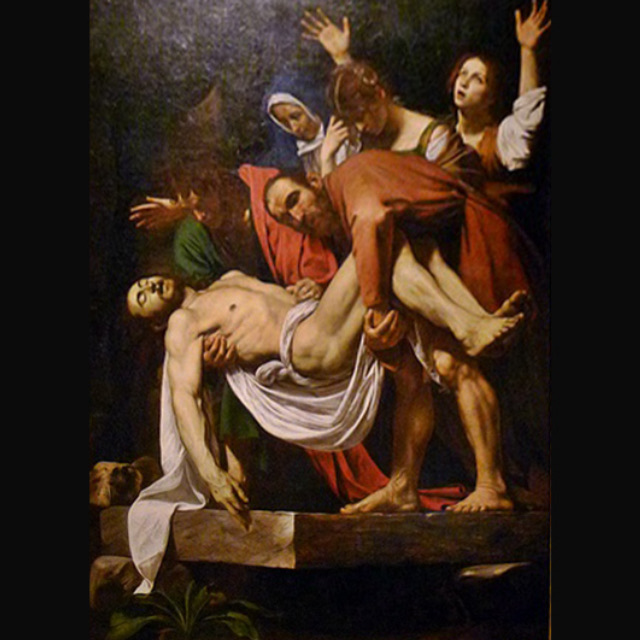
Entombment of ChristRoom XII. 17th cent.The full story

Michelangelo · 1604 year · oil on canvas

Vatican Museums audio guide

The Entombment of Christ is the most monumental and remarkable painting by Michelangelo Caravaggio. Curiously, a quite ordinary brushwork and traditional scene were not welcomed by the contemporaries of Caravaggio. Having seen the Entombment, many painters and collectors were outraged. The painting is infused with human tragedy and endless misery which was not proper to the recognized canons of art at that time. Six figures are shown against the dark background. We can see them bent and turned. The time seems to have stopped. No cries, no lament, no tears. But the canvas keeps clear traces of mourning. Each character embodies the intense grief of farewell to Christ. The viewer's eye can see a sad face of Mary, raising her arms to heaven, Mary Magdalen who bows her head, the Virgin Mary who silently holds out her arm. While pharisee Nicodemus and John the Evangelist concentrate their efforts on burring Christ, but they are also overwhelmed by the same grief. It is difficult for John and Nicodemus to carry a deathly pale body of Christ. Nicodemus felt his legs veined due to the heaviness. He seems to look at a viewer and try to pass his load. In opinion of art experts, the figure of Nicodemus represents Michelangelo himself. Despite the pain and sorrow, the canvas alludes to the upcoming joyful event, the Resurrection of Christ. The painting is a symbol of how Christ who sacrificed himself for the sake of all people will defeat the Darkness.

Original author’s text, preserved unchanged.

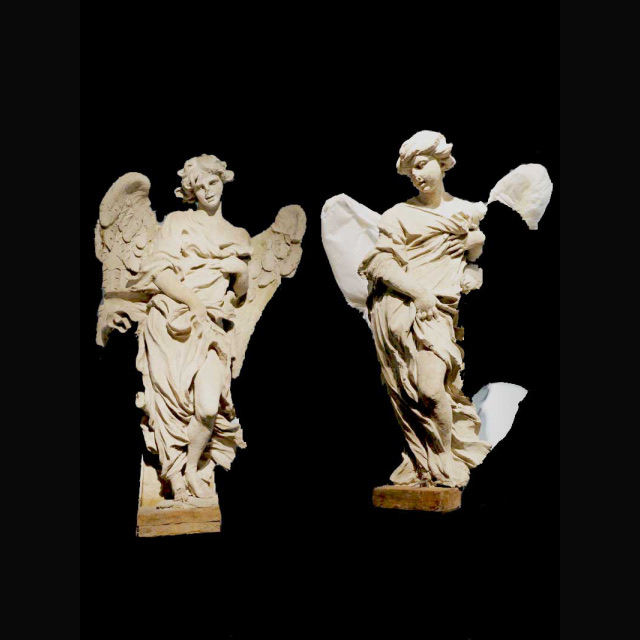
AngelsRoom XVII. 17th cent.The full story

Gian Lorenzo Bernini · XVII century · iron and cane

Vatican Museums audio guide

The four angels of Gian Bernini served as preparatory models for the bronze figures of angels of St Peter's Chair in the St Peter's Basilica. The bronze throne of the Chair was decorated with the angels silhouetted against the clouds. The sculptures of the angels are made on a framework of iron. They are made of clay mixed with straw. Each angel incarnated in clay is exceptional and realistic. The winged cherubs in long and elegant attire are depicted in slow motion. The position of a head, facial gestures, perspectives, the position of arms and wings make the figures picturesque and large. The angels' faces are full of dynamism. The angels smile, observe and are ready to fly at any moment. The creator of the angels, Italian sculpture Gian Bernini, is considered to be the founder and leading master of baroque. In the circles of architects he is mostly known as a creator of the angels. His artworks decorate not only St Peter's Chair in the Basilica of the same name, but also a monumental arched the Aelian Bridge.

Original author’s text, preserved unchanged.

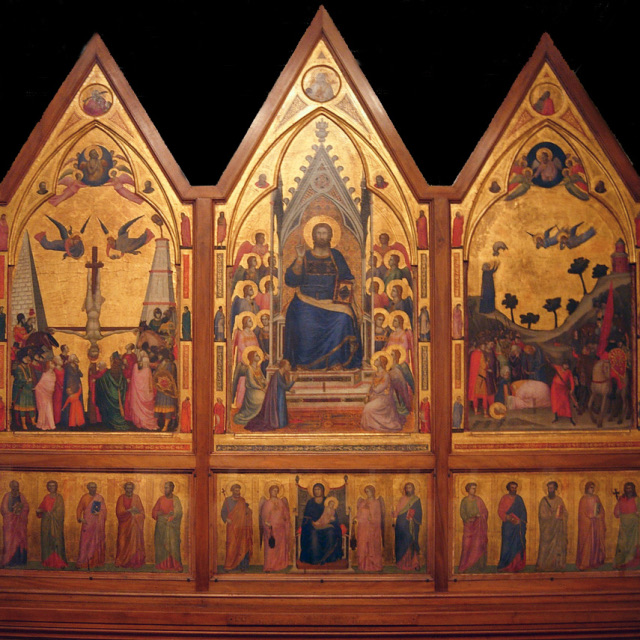
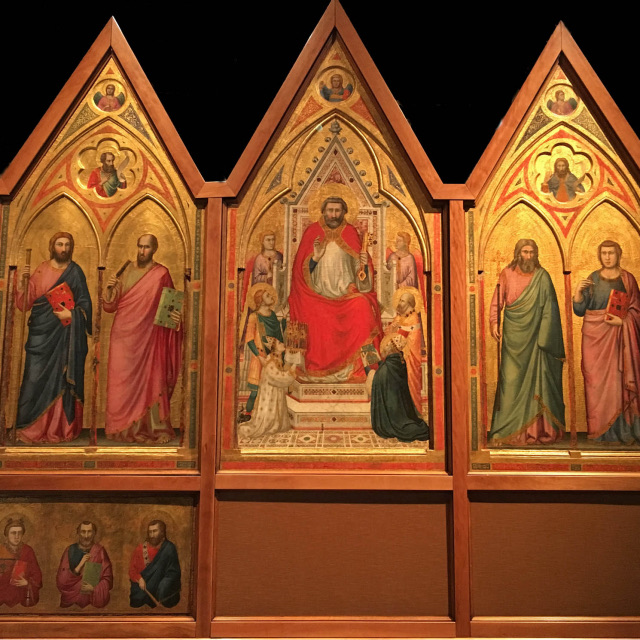
Stefaneschi triptychRoom II. 13th-15th cent.The full story

Giotto di Bondone · 1320 year · tempera on wood

Vatican Museums audio guide

Stefaneschi triptych is a wooden altar painted on both sides, showing the Bible scenes. It was painted on both sides as it was supposed to be seen both by the priest and by the faithful. The paintings in the triptych look like frescoes, and the style reminds Byzantine art. The figures of the saints are painted in bright clean colors against the golden background. It produces effect of inner glow of the painting. The left front fold of the triptych shows the crucifixion of St Peter. The right front fold depicts the beheading of St Paul. In the center is Christ enthroned, raising his arm to bless and holding the Book of Revelation in his left hand. The predella below shows Madonna and the Child, angels and apostles. On the back of the panel is St Peter. He holds the keys from the Kingdom of Heaven in his left hand. Cardinal Stefaneschi and Pope Celestine V kneel before him. The back side panels show four apostles: St James, St Paul, St Andrew and St John the Evangelist. Two back panels of the triptych are lost.

Original author’s text, preserved unchanged.

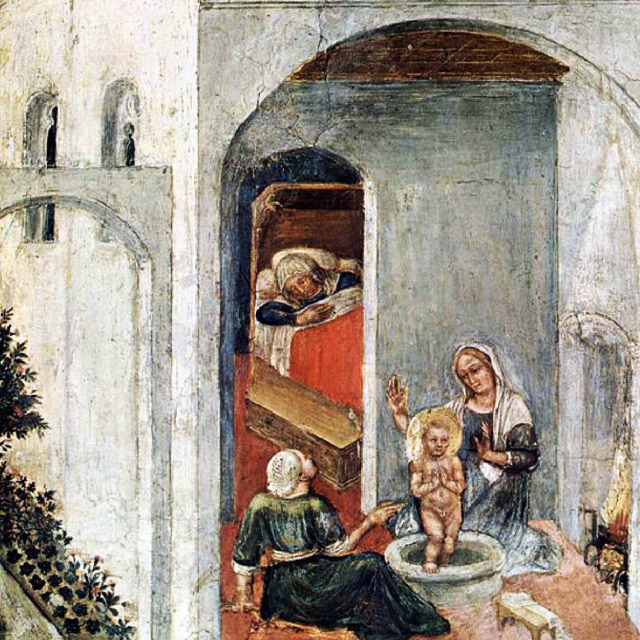
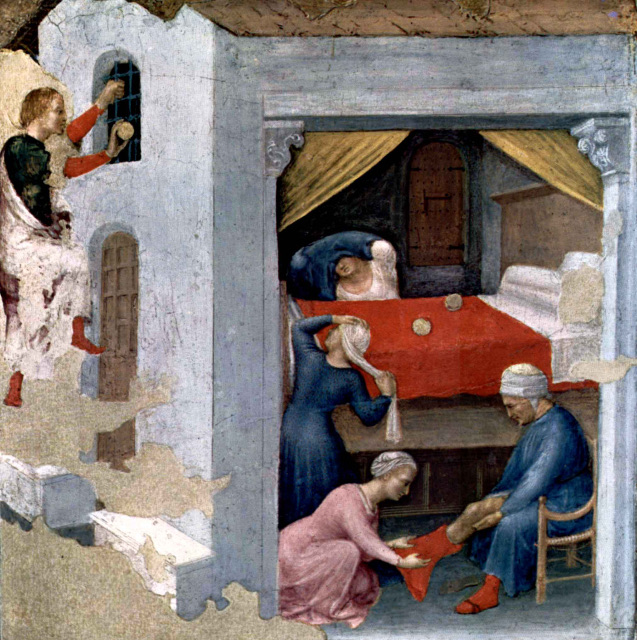
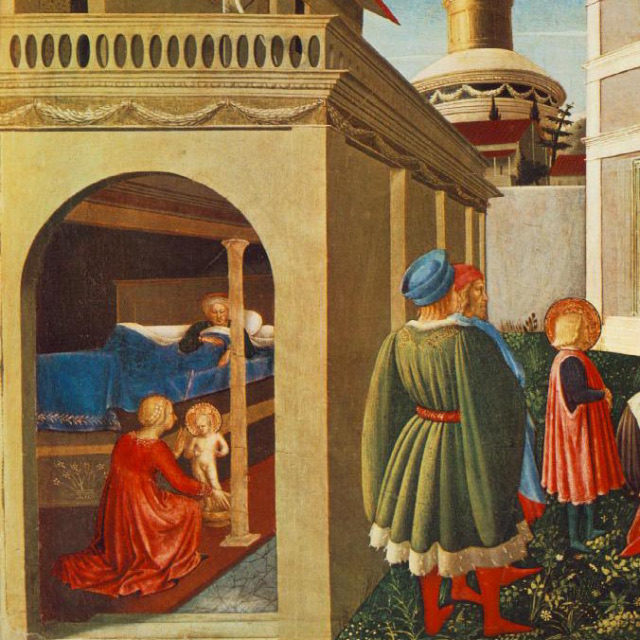
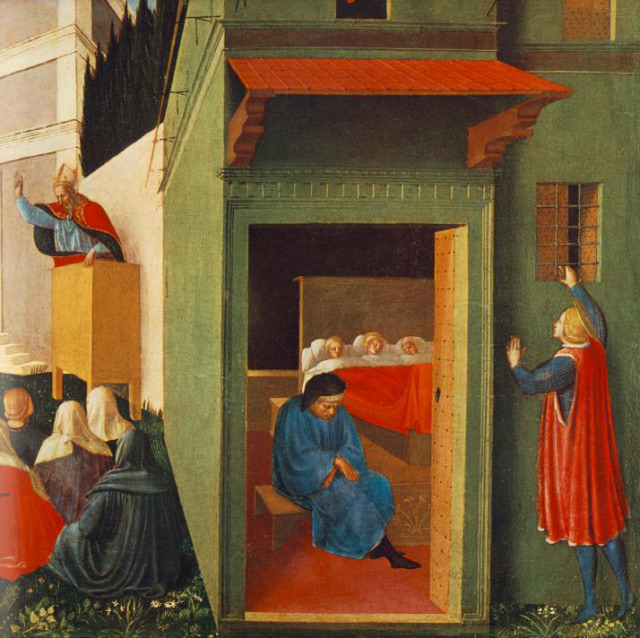
Stories of St Nicholas of BariRoom II. 13th-15th cent.The full story

Gentile da Fabriano · 1420 year · tempera on wood

Vatican Museums audio guide

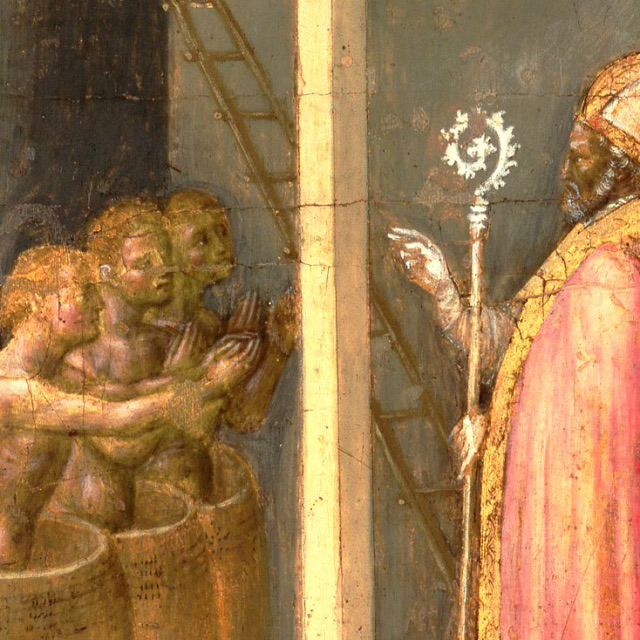
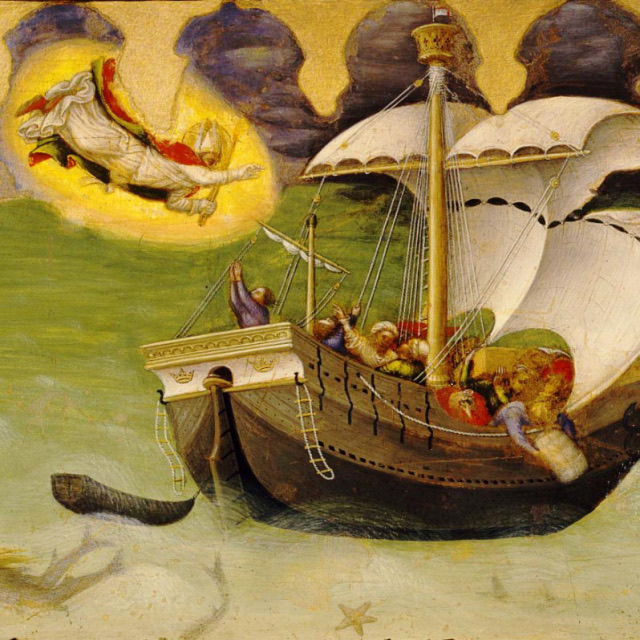
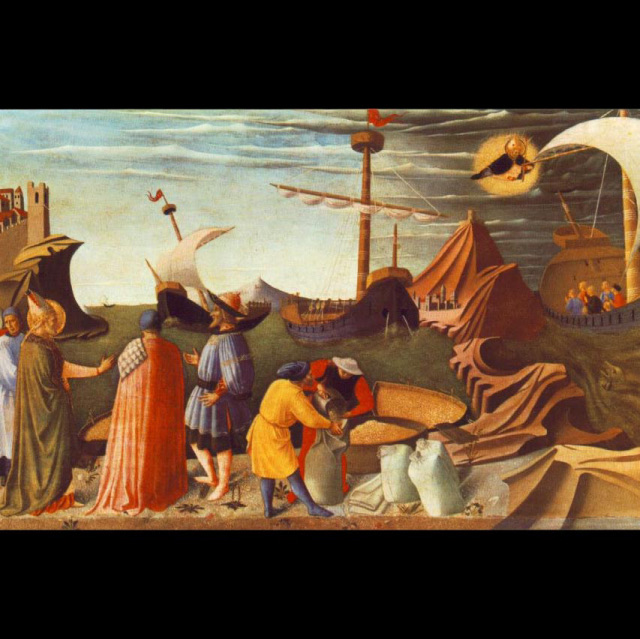
The panel The Stories of St Nicholas of Bari is the best artwork of the Italian painter Gentile da Fabriano. While working, he used bright and clean colors, supposedly shining, and the figures are shown in motion. The panel demonstrates the power, kindness and mercy of one of the most prominent Christian saints, St Nicholas. The first subject of the altarpiece is a birth of Nicholas at the end of III century in the city of Patara, today's Turkey. The second scene shows how Nicholas was lavish in donating golden coins to poor girls. According to the legend, a merchant who was ruined could not marry his three daughters off and chose to make them prostitutes. Nicholas threw three purses filled with golden coins to save the girls from lapse into sin. After that he became the protector of unmarried girls. The third scene speaks how Nicholas resurrected three children. During a terrible famine, a butcher slaughtered them and placed their remains in a barrel, and St Nicholas resurrected them. The fourth scene depicts the miracle performed by St Nicholas after his death. Some travelers went by sea to venerate his relics, but storms and diseases were plaguing them for all the time. Nicholas appeared to them and told that the demon hid a barrel of holy oil on the boat. That was the problem. And if they poured the oil out, they would reach the place of destination. And that happened.

Original author’s text, preserved unchanged.

Miracles of St Vincent FerrerRoom V. 15th cent.The full story

Ercole de Roberti · 1473 year · tempera on wood

Vatican Museums audio guide

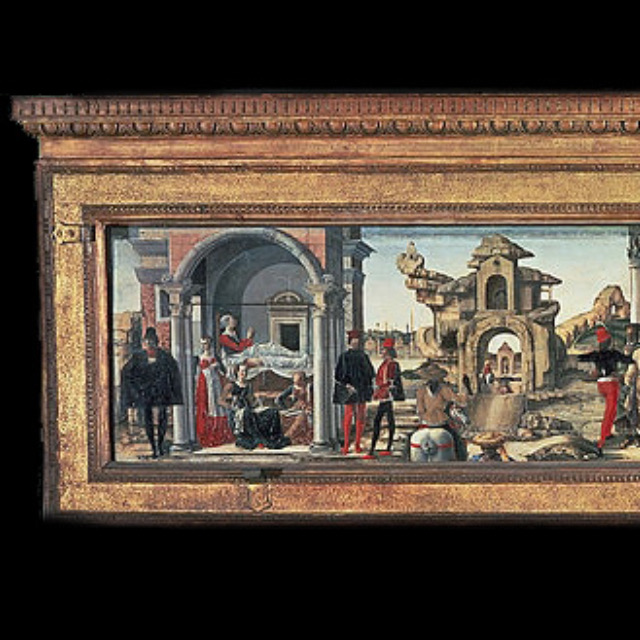
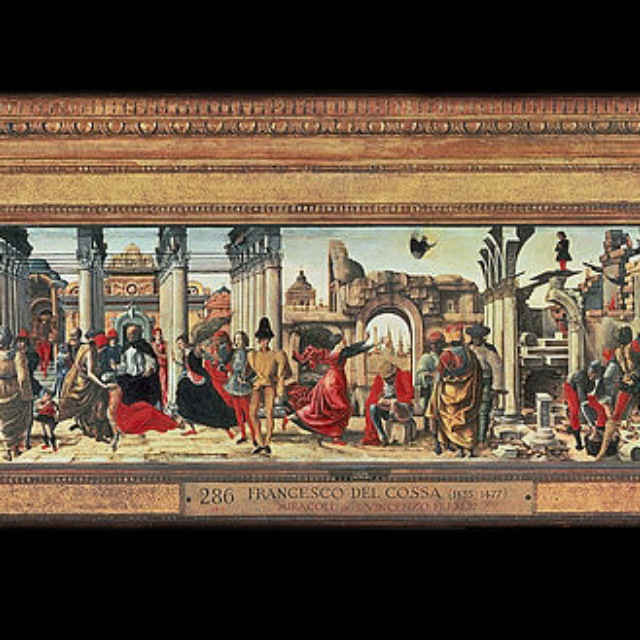
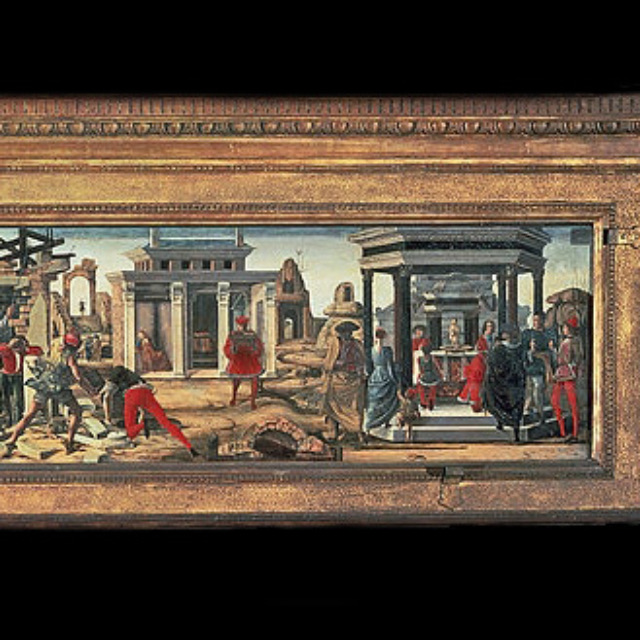
The scenes of the painting The miracles of St Vincent Ferrer are depicted clearly and in details. The image is also known as the Griffoni Polyptych. A polyptych is a low painted wooden panel placed above the alter in Catholic churches in 15 century. The panel is painted in classical magnificent style of Renaissance. The painter used heavy shades to depict figures elevated and serious. Their bright flowing clothes are painted in detail. Due to this figures seem to be ethereal, and the painting looks like an icon. The predella illustrates the Miracles of St Vincent Ferrer, the Spanish saint, who was commonly worshiped in Bologna. The panels of the painting show the episodes follow one another in quick succession: the Healing of the birthing mother, the Raising of a rich Jewish, the Healing of a lame person, the Saving of a child from a house of fire, the Raising from the dead of a child killed by his mother, who had lost her mind.

Original author’s text, preserved unchanged.

Platina- Prefect of the Vatican LibraryRoom IV. 15th-16th cent.The full story

Melozzo da Forli · 1477 year · fresco on canvas

Vatican Museums audio guide

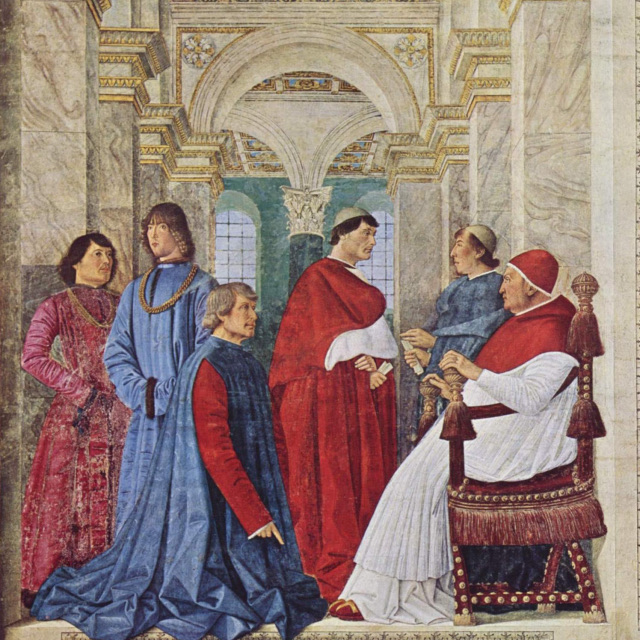
The fresco Sixtus IV appoints Bartolomeo Platina Prefect of the Vatican Library illustrates the most important event for the Vatican Library. Its value lies not only in the fact that the historical event took place, but also in the accuracy of the Vatical Library's picture. The pilastered arcade, columns with molding, a papal throne decorated with golden tassels and fringe demonstrate eloquently the splendor of Renaissance architecture. The fresco shows the appointment by Sixtus IV of the Italian humanist Bartolomeo Sacchi, called the Platina, as the first Prefect of the Vatican Apostolic Library. This historical event that took place in 1475 is depicted against the interior of the Vatican Library. The composition of the fresco is large, and the medium is deep and realistic. The painter made people figures in rich clothes look solemn and folded in vague light. This light tone down the shades and illuminates the colors. In addition to the Pope and Platina, there are another four personages. Platin kneels before Sixtus IV. He points the index finger of his right hand to a Latin inscription that exalts the enterprises of Sixtus IV in Rome city. Sixtus IV is seating on a throne. He is descent and kind, but severe and serious. One may recognize the relatives of Sixtus and people around him. On the right of the Pope is his nephew Raffaele Riario, before him is future Pope Julius II. Girolamo Riario and Giovanni della Rovere are behind Platina.

Original author’s text, preserved unchanged.

Angel musiciansRoom IV. 15th-16th cent.The full story

Melozzo da Forli · 1480 year · fresco

Vatican Museums audio guide

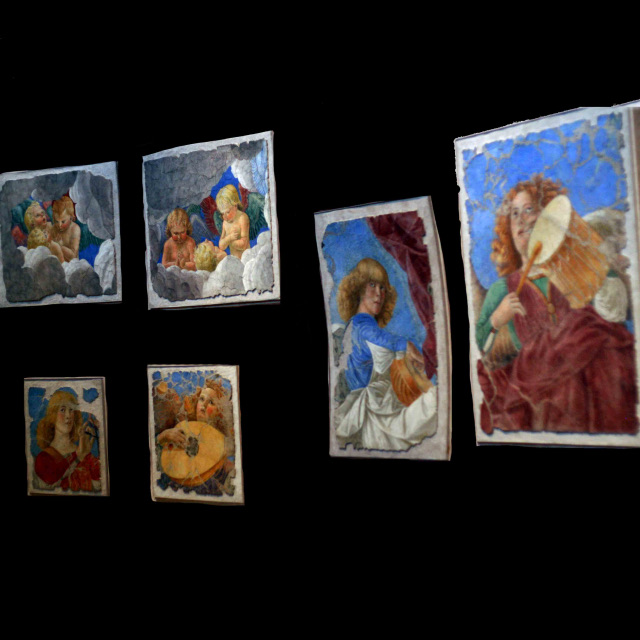
The Angels Musicians is a prominent religious fresco, which became a landmark of Rome. This is one of the most recognizable image of angels. In addition to the absolute artistic value, this fresco is one of few extant artworks of the Italian painter Melozzo da Forlì. In XV century the fresco depicted the orchestra of angels, glorifying the God, was a symbol of the beauty of the heaven for the souls living there. The painter depicted each figure in detail. Even a glance at the angels is enough to get a feeling of featheriness and floating in the air. The fresco shows the angels playing and glorifying the Ascension of Christ. In the fresco each figure is depicted from a different perspective. Despite the complexity of the perspectives, the angels are light and refined. They are depicted according to all rules of perspective. Their movements are flowing and graceful. An angel playing the lute is one of the most famous fragments of the fresco. A young angel with lute, in three quarters, embodies the harmony of divine music. The fresco showing the orchestra of angels and the figure of Christ was a part of the decoration of the apse of the Church of the SS. Apostoli in Rome.

Original author’s text, preserved unchanged.

Madonna and the ChildRoom VII. 15th-16th cent.The full story

Perugino · 1495 year · tempera on wood

Vatican Museums audio guide

The altarpiece Madonna and the Child is one of the best images of the Virgin, Christ and Saints, frequently called The Holy Conversation. The canvas is painted in a refined and easy manner. The bright colors of sumptuous attire harmonize with the architecture. The main characteristics of the painting by Pietro Perugino are the elevation of style, light and air. In the center of the composition is Madonna seated on a lavish throne decorated with antique bas-reliefs. The Child is on her knees, and Saints are by her side. Their dresses and regalia are rich in the symbols showing the importance of the saints for the Church. The figures are depicted against the magnificent Renaissance architecture. The figures are realistic and large, their faces express the respect for the Virgin Mary. On the left is St Ludwig, archbishop of Toulouse with a crosier in his hand. On the right side of Madonna is St Laurence dressed as archdeacon. In the background there are Sts Ercolanus and Constance. They are the protectors of the city.

Original author’s text, preserved unchanged.

Transfiguration of ChristRoom VIII. 16th cent.The full story

Raphael · 1520 year · tempera on wood

Vatican Museums audio guide

The Transfiguration of Christ is a key event in the History of Christianity. And it is depicted in the canvas as the crucial point for the perception of the Son of God. by ordinary people. Raphael painted the canvas by himself without involving his apprentices and finished it just before his death. Some historians suppose that he had finished to paint the head of Christ just a few hours before his death. This is the prehistory of the scene depicted by Raphael. First, Christ asked apostles Peter, James and John to go to Mount Tabor where he was transfigured by showing his divinity. At the same time, a voice from the sky said that he was the only Son of God. Later the teacher and the apostles climbed down the mount and met people, among whom there were a man and his obsessed son. Then the scene of Raphael's painting develops. Moses and Elijah, the prophets from the Old Testament, stand on both side of Christ. They appeared to those present as the symbol of the union of the Old and New Testaments. Moses is a man who transfered people the laws of God, and Elijah is the greatest prophet, through whom the voice of God addressed people. The thrilling apostles fell down on ground, realizing the power and glory of the Son of God. Christ is depicted as light as feather, radiating in glory. The father of the obsessed boy froze, waiting for the healing of his son. Christ returned from the mount and drove out demons. Those present are shocked, they point at Christ, their faces express excitement and deep emotions. The painting shows that only Christ is able to heal human body and soul. That's why the upper part of the canvas seems to be illuminated with the light radiating from his figure, and the bottom part, where people are painted, is obscure.

Original author’s text, preserved unchanged.

Madonna of FolignoRoom VIII. 16th cent.The full story

Raphael · 1511 year · tempera on wood

Vatican Museums audio guide

The altarpiece Madonna of Foligno is a remarkable painting of High Renaissance. It serves as the first version of the composition Sistine Madonna and has another name -Madonna in Glory. Raphael painted it by order. The pope's secretary Sigismondo de' Conti commissioned the picture of Madonna to express his thanks to her for having saved him. The day before his house in Foligno had been struck by lightning. Other versions of the story tells about the fall of meteorite or shell during the siege of the city. The story of the painting explains why the eyes of the saved Sigismondo are full of gratitude and obedience. The secretary wearing a scarlet cloak is on the right. Behind him is St Jerome dressed in a blue cloak. On the left there are St John the Baptist and St Francis of Assisi. The main figures of the painting are the Virgin with a child, are seating on the cloud. Madonna is depicted against the golden glory, the symbol of her divine glory, responding to the look of Sigismondo. In the sky she is surrounded by scarcely visible angels. In the center of the painting is a small angel holding a plaque. There is no inscription preserved, but historians believe that there were the words of appreciation towards Madonna for saving on behalf of Sigismondo. The figures are depicted against the urban landscape of Foligno. Art experts suppose that the urban landscape is painted by his assistant, Giovanni Luteri.

Original author’s text, preserved unchanged.

Lament over the dead ChristRoom IX. 15th-16th cent.The full story

Giovanni Bellini · 1474 year · Oil on wood

Vatican Museums audio guide

Painting The Lament over the dead Christ was the element of the high altar of the church of St Francesco. The picturesque painting shows a famous Bible story after Christ's body was removed from the cross. Giovanni Bellini, a painter of Venice, lived in the times of High Renaissance. He was one of the first among his contemporaries who began to use oil paints. That's the reason why the painting is so colorful, contrastive and full of vibrant colors. Art experts assert that the painter created it using his individual style. That is proved by attempting to express the emotions and feelings of the depicted figures. The all-consuming love for Christ expressed by his followers and his mercy on people is a keynote message of the painting. Christ's face expresses the deep fatigue as a result of the sufferings. Mary Magdalene, Nicodemus and Joseph of Arimathaea gathered around the body of the dead Christ. Their sadness and grief are softened as they realized the great sacrifice of Christ for the sake of people. Joseph of Arimathaea supported carefully the body of Christ, Mary Magdalene anoints his palm with myrrh, holding it in her hand. Nicodemus holds a vessel containing precious myrrh.

Original author’s text, preserved unchanged.

St JeromeRoom IX. 15th-16th cent.The full story

Leonardo da Vinci · 1482 year · Oil on wood

Vatican Museums audio guide

The painting St Jerome is drawn on a piece of wood as a sketch and fragmentary colored. The artwork was commissioned by the church in Florence, but it was never finished. His story is quite interesting. It was first found in 18 century among the exhibits of painter Angelica Kauffmann. After her death the painting was lost and randomly was found many years later. But during that period it was divided into two parts. The bottom part served as the cover of a box in a junk shop. The upper one was the cover of a stool used by a shoemaker. According to the legends, St Jerome became a hermit to translate the Bible into Latin. Interestingly, Leonardo did not represent Jerome as a scientist, but a desperate starving old man. A thin, almost exhausted, Jerome pray for pardon. He is depicted on knees in the middle of cliffs, in the Chalcis desert. We see Jerome getting ready to beat his chest with a stone in his right hand. A lion rests at his feet. According to the legend, the old man extracted a thorn from its paw. So the lion got attached to his savior and followed him everywhere.

Original author’s text, preserved unchanged.

Adoration of the MagiRoom XIII. 17th cent.The full story

oil on canvas

Vatican Museums audio guide

The Adoration of the Magi shows one of the most famous scenes from the New Testament. Despite a great solemnity of the scene, the painting is sombre. It seems to be covered with fog or twilight. The characters look a little bit strained, but at the same time they are joyful and excited. Despite the darkness, the painter focuses on the central part of the canvas. The action is quite dynamic. The painter depicts the figures in motion, they direct their eyes on the newborn, the Son of God, who is in the center of the composition. The Child is calmly and favorably looking at them. This is an emotional high point of the painting. It is the idea and sense of it. People are kneeling down before the Son of the God, and he accepts not only their gifts, but also heartful devotion. Those who came to worship the Child wore expensive and lavish clothes. Their cloaks form a contrast to the ordinary and casual dress of the Virgin Mary. This is a bright example when earthly goods and untold wealth lose completely their meaning before the Divine.

Original author’s text, preserved unchanged.

Marsuppini CoronationRoom III. 15th cent.The full story

Filippo Lippi · 1445 year · tempera on wood

Vatican Museums audio guide

The painted altar The Marsuppini Coronation was created for the St. Bernard Chapel, in Italian Arezzo. The altar is unique for an interesting interpretation of the coronation of the Virgin Mary. The painter divided the composition into three equal parts to highlight the importance of the central scene. Despite the division, its theme and idea make a whole. The artistic value of the altar is in unbelievably clean shades used by the painter. The brightness and radiance of the colors reveal the solemnity, highness and spirituality of the depicted figures. This style is proper for religious Renaissance canvases. The coronation of Mary is the main theme of the painting. This scene is depicted in the central part. The Queen of Heaven, ascended to heaven, put her hands together in prayer and knelt at the feet of Christ. He put the crown on Mary's head. They are shown??? on a marble dais with steps. Behind Christ is a wall with niche in the form of shell. This is the symbol of the Virgin Mary and the miracle of the Resurrection. On the left and right parts of the triptych are angels and saints. Interestingly, the chancellor of the Republic of Florence, Carlo Marsuppini, who commissioned the triptych, and his father Gregorio are depicted by their side.

Original author’s text, preserved unchanged.

Madonna of the GirdleRoom III. 15th cent.The full story

Benozzo Gozzoli · 1452 year · tempera on wood

Vatican Museums audio guide

Madonna of the Girdle is a brilliant example of iconography, famous for the most well-known scene involving the Virgin. According to the Bible, apostle Thomas was not presented at the death, burial and assumption of the Virgin Mary, so he did not believe in it. The Virgin descended from heaven and handed St Thomas the girdle of her dress as a proof of the truth of the event. Since then the girdle has become a holy relic. Today the parts of the girdle are kept in the monasteries throughout the world. The painter glorifies the moment of handing the girdle. He expresses his worship by using lyrical and calm style of painting. The figures are plastic and painted using bright, semitransparent and shining colors. The golden shining background is everywhere, emphasizing the dignity of the scene. The Virgin Mary is seating on the cloud. She is surrounded by angels, and St.Thomas, shocked and accepted, receiving the girdle from her hands. Six key events from the life of the Virgin are illustrated on the predella. These are the Birth, Marriage with Joseph, Annunciation, Birth of Christ, Circumcision of Jesus, Death of the Virgin.

Original author’s text, preserved unchanged.

Stories of St NicholasRoom III. 15th cent.The full story

Fra Angelico · 1445 year · tempera on wood

Vatican Museums audio guide

The altarpiece The Stories of St Nicholas of Bari is notable for a special structure of the composition and style of painting. The depicted scenes are infused with light, they are bright and colorful. The figures are not so realistic as picturesque. They are painted in the medieval painting traditional style, so they are especially noble. With the limited surface, the painter succeeded in creating the deep medium, including the foreground, middle ground and background. On the left of the front is a birth of Nicholas, in the center is Nicholas listening attentively to a summon of the priest, and on the right is the Gift to the three poor girls. This is one of the most well-known good deeds of Nicholas. According to the legend, Nicholas heard that one poor man decided to make some money by making his daughters prostitutes. At night, Nicholas brought secretly a purse filled with coins for the girls, so that the family did not need money. Two episodes are depicted on the back of the picture. The first episode shows how Nicholas receives a load of grain from the imperial courier for the starving city of Myra. The second episode demonstrates how St Nicholas saved miraculously a ship from sinking.

Original author’s text, preserved unchanged.

Portrait of the George IVRoom XV. 18th cent.The full story

Thomas Lawrence · 1816 year · oil on canvas

Vatican Museums audio guide

The portrait of Prince Regent, the future king of England George IV, is a brilliant example of Regency Art and one of the most prominent full length portrait of monarch. Regency was a quite widespread phenomenon in England, when an authorized person was appointed to rule the country cause the monarch was a minor or sick. Prince George IV was such a regent. He liked a dissolute lifestyle: gambling games, women and wine. His extravagance became a symbol and a distinctive feature of Regency Era. A historical joke says that he had to use the crown lent by a jeweler. Due to his enormous debts, he allegedly could not buy it out. But even after his ascend the throne, George IV did not win the affection of his nation. He became the most unpopular ruler of the kingdom and object of satire. It is unclear why? In fact, he was not only a dandy, but also a very generous benefactor who supported painters. The historical portrait of George IV was painted in a special manner of Regency Art. This technique is characterized by the mixture of different styles: the Empire style, Rococo and Classical English painting. The portrait of the king is bright, picturesque and colorful. The sumptuous clothes of George are decorated with the badges of the highest orders of knights, garters and rich tassels. The king is standing next to a table that was given to him by the king of France Louis XVIII. On the table there is his crown and a letter from Pope Pius VII.

Original author’s text, preserved unchanged.

Portrait of Benedict XIVRoom XV. 18th cent.The full story

Giuseppe Maria Crespi · 1740 year · oil on canvas

Vatican Museums audio guide

The Portrait of Benedict XIV, the painting depicting Cardinal Prospero Lambertini, is full of theatrical and flattering greatness. While creating the painting, the painter employed the style of Italian artists and formed his own manner of painting. In the quest for an individual style, Crespi made his contribution to the development of the Italian painting by adding originality, new things and new outlook. That's what characterizes this painting — new trends in the painting of 18 century. The Portrait of Benedict XIV, known as Cardinal Prospero Lambertini, was officially commissioned by him in 1739. After a year Cardinal was elected as the Pontiff, so the painter was asked to alter the portrait. The expert review revealed the different stages of composition up to its final version. The painter significantly increased the size of the figure of the Pope, changed his attire and added the papal tiara as attributes of the papal power and exceptional importance of the character. In fact, Pope Benedict XIV did not have any special influence on the Catholic Church and did not stand out with good deeds or progressive approaches. The commissioned portrait was rather an attempt to look more influential and significant than he was.

Original author’s text, preserved unchanged.

Portrait of Pius VIRoom XV. 18th cent.The full story

Pompeo Batoni · 1775 year · oil on canvas

Vatican Museums audio guide

Portrait of Pius VI is one of a few portraits of the prominent clergy representative who was portrayed as an ordinary man. After his election as the pontiff in 1775, Pius VI contacted with Pompeo Batoni and commissioned a portrait. The fact is that many powerful personages of XVIII wanted to be portrayed by Batoni. It looks that the fact is in his light and natural manner to depict his characters. For instance, the image of the Pope is deprived of arrogance, pathos of baroque and pomposity. And that makes it so real. The composition of the canvas is fairly simple. We see serious, but calm, wise, humble and intelligent pope Pius VI. He is shown seating on an armchair upholstered in velvet, holding a sheet of paper in his left hand. He has only a ring with a small jewel on his finger. Pope is likely to be absorbed in his thoughts, and his eyes are focused on an item in the foreground. This informal portrait of Pius VI, who became an official one, reveals without words that the value of a person is determined not by the magnificence and splendor of his jewels, but his features, achievements and piety.

Original author’s text, preserved unchanged.

Portrait of Clement IXRoom XV. 18th cent.The full story

Carlo Maratta · 1669 year · oil on canvas

Vatican Museums audio guide

Portrait of Clement IX is the best and most glamorous portrait of Carlo Maratta. Before his election as pontiff the name of Clement IX was Giulio Rospigliosi. He was a well-educated and widely-read intellectual. He studied philosophy and theology, wrote prose and libretto for operas. These are the features of a refined, intelligent person that the painter depicted skillfully. Clement's face is stiff, it is obvious that he is tired a little, but his wit does not sleep, and his eyes focus on the viewer. He seems to inspect something or wait for something. Clement holds a book in his right hand, it may be the Holy Scripture. He wears a gaudy best, but not too rich dress. The soft light shines on the figure of Clement as if he sits in the illuminated part of the room. The Portrait of Clement IX is made up of vibrant noble colors of dark brown, golden, white and shades of pink. These are the features of baroque art, its moderate splendor and solemnity.

Original author’s text, preserved unchanged.

St Turibiya's miracle from LimaRoom XV. 18th cent.The full story

Sebastiano Conca · 1726 year · Oil on canvas

Vatican Museums audio guide

The painter illustrates one of two miracles performed, according to the legends, by archbishop Turibiy from Lima, who was canonized in 18 century. The following events preceded the miracle depicted in the painting. Turibiy was serving when he heard shouts. The thirst people were shouting that the river had dried up, they had no drinking water, and they were forced to leave their land in search of any source of water. Saint Turibiy finished the service and came to the dry riverbed. He struck the rock three times with his staff, and the river was filled with the water forming the cross. The painting demonstrates the moment when the riverbed was being miraculously filled up. The people surrounded the Saint are shocked by the miracle. Not only people, but the animals as well, froze by watching how quickly the water was filling up the riverbed.

Original author’s text, preserved unchanged.

Adam and Eve in the Garden of EdenRoom XVI. 19th cent.The full story

Wenzel Peter · 1830 year · Oil on canvas

Vatican Museums audio guide

Peter Wenzel often painted birds and animals, that's why the style of the painting Adam and Eve in the Garden of Eden differs from religious paintings with its lightness and brightness. This is an example of bright and realistic secular painting in warm colors. The painting is nothing like iconagraphic canvases of Renaissance. The painter shows skillfully the lightness of the medium, a slight mist on the horizon and around Adam and Eve. Adam and Eve are depicted in the center of the composition, surrounded by almost two hundred birds and animals. The light shines on their figures. This technique allows to understand that the aim of the canvas is to demonstrate the first man and woman. The movements of Adam and Eve are masterly depicted, realistically and with anatomic precision. Due to their vivacity, the canvas becomes dynamic and expressional. The Garden of Eden stretches away around Adam and Eve. There are a lot of ripe fruit, fragrant flowers and lush trees. The mountains are visible in the distance, the river flows nearby, and in the foreground is a garden, a thick forest, big roses and the species richness of plants. This painting is a symbol of harmony, peace and joy reigned in the paradise created by the God.

Original author’s text, preserved unchanged.

Altarpiece of St. Anthony AbbotRoom VI. 15th cent.The full story

Antonio Vivarini · 1464 year · tempera on wood

Vatican Museums audio guide

The Altarpiece of St. Anthony Abbot, Pieta and Saints is an example of bright painting, when religious themes are masterly mixed with secular subject matters. St Anthony is called the founder of solitary monasticism. He was the first who organized life of ascetic monks in separate hermitages, where they kept a fast and prayed. The altarpiece is painted on the wooden panel and reminds a group of icons. The abundance of gold and bright colors makes the painting looks like the Renaissance canvas. The style of painting is solemn and elevated. In the center is St Anthony - a bearded old man with white hair, wearing a dark cloak of monk and a headwear. He holds a rod and is surrounded by eight saints. Above the image of Anthony is Pieta, Christ with the wounds on his palms and chest. Interestingly, each saint holds a specific symbol or attribute. On the upper left is Saint Jerome dressed as cardinal with a book and a model of church in his hands. On the bottom left there is the saint holding an arrow and a sword. He depicts on the far right side of the painting holding two apples and a sword in his hands. And on the right hand of Anthony is Saint Christopher carrying the Christ Child.

Original author’s text, preserved unchanged.

PietaRoom VI. 15th cent.The full story

Carlo Crivelli · 1494 year · tempera on wood

Vatican Museums audio guide

Pieta is a religious subject matter brilliantly expressed in Gothic. Pieta served as a part of the upper section of a polyptych and was purchased in 1831 by Pius VII in the Marche region. The painting looks like a gorgeous and exceedingly decorative illustration of the Bible episode. The features of Gothic and Renaissance are noticeable. The style of painting reveals that Carlo Crivelli did not paint secular canvases, but he had a vivid imagination and a sense of color. The canvas is magically balanced in colors. How brightly holiday clothes shine and shimmer in the painting! The background is a separate great part of the painter's work. It includes a lot of symbolic images of angels, carpet patterns carefully depicted, highness and delusiveness. Pieta features golden crafted details and the delicacy of personages, which is proper to Gothic canvases. The painting shows Christ removed from the cross and John the Evangelist, Joseph of Arimathea and Mary Magdalen, mourning for him. Their faces are rigid with a slightly theatrical grief, sadness and dramatism. It seems that these are wooden figures or actors acting in a play.

Original author’s text, preserved unchanged.

Martyrdom of St Pietro Arbues'sRoom XIV. 17th cent.The full story

Bartolome Esteban Murillo · 1670 year · Oil on canvas

Vatican Museums audio guide

The painting shows the murder of one of the cruelest Spanish inquisitor in the late Middle Ages, Pedro de Arbués. Before he became an inquisitor, Arbués had been a professor of philosophical studies, doctor of theology and priest. He gave sermons and took care about poor people. But after his appointment as Inquisitor for the Kingdom of Aragon, Arbués burnt at the stake thousands of heretics: Jews and Moors. Due to his ruthlessness, a secret collusion was organized against him. According to the plan, he and other inquisitors were to be killed. At night, when Arbués was kneeling and praying before the altar, the killers attacked and gravely wounded him. The Catholic Church canonized Pedro de Arbués officially and posthumously by declaring him as a martyr and holy man. The canvas was painted for his canonization, almost 200 years after the murder of Arbués. The canvas captures the moment when the Inquisitor was about being stabbed. Despite the angel flying over him and his killers, the painting is infused with gloom. The movements of the killers are well-aimed and quick. The painter shows the moment when the dagger was hung over the doom Arbués. In a split second the spike of the dagger stuck in the heart of the Inquisitor.

Original author’s text, preserved unchanged.

Madonna and the Child with AngelsRoom XIV. 17th cent.The full story

Sassoferrato · 1650 year · oil on canvas

Vatican Museums audio guide

Madonna and the Child with Angels is one of the most remarkable baroque canvas. Despite the religious theme, it is infused with lightness and shine of secular painting. The painter is renowned for his scenes of Bible. The painter's artistic style is clearly influenced by his contemporary, Raphael. The painting reveals classical features of baroque style: lightness and simplicity of composition, delicacy and softness of the depicted figures, naturalness and plainness of their faces. Interestingly, there are few paintings showing Madonna's face so tender, young, light, gentle, almost childlike. Her appearance shows that she is far away in pleasant and sweet thoughts. The painter painted scrupulously all details. The frills of Virgin Mary’s dress, a fillet with a bow on her head, beads, splendid clouds look realistic. The halo around Madonna’s head underlines her greatness and exceptional significance.

Original author’s text, preserved unchanged.

05Room Sobieski1 · exhibits
King Sobieski liberating ViennaExcerpt from a story

Jan Matejko · 1883 year

Vatican Museums audio guide

As soon as this room was decorated and opened, it became one of the rooms of the Papal Apartment belonged to Pope Pius V. The name of the room derives from the canvas hanging on the northern wall. The painting "King Sobieski liberating Vienna" was created by the Polish painter Jan Matejko.

An excerpt from the original text. The full story is available in the audio guide.

06Room of the Immaculate Conception2 · exhibits
Proclamation of the dogma of the Immaculate ConceptionExcerpt from a story

Francesco Podesti · 1860 year · fresco

Vatican Museums audio guide

The Immaculate Conception proclaims that the Virgin Mary was initially chosen to be the Mother of the Son of God. That's why she was free from original sin and did not inherit it at the conception.

An excerpt from the original text. The full story is available in the audio guide.

This story is part of the itinerary
BookcaseExcerpt from a story

1875 year · wood

Vatican Museums audio guide

The bookcase contains the translation of the medieval Papal Bull. This document is a code of dogmas and rules, based on the papal speeches, addresses and declarations.

An excerpt from the original text. The full story is available in the audio guide.

07Braccio Nuovo3 · exhibits
Augustus from Prima PortaExcerpt from a story

14 year

Vatican Museums audio guide

Augustus from Prima Porta is the first Roman ruler who became a severe and autocratic emperor. According to historians, this statue mainly differs from other images of emperor Augustus as it bears a portrait resemblance. A young Octavian Augustus is depicted as a commander delivering an inspiring speech at the Forum. Then there were ten thousand people before him, and Octavian were trying to persuade them to initiate the hostilities against his political opponent Antonius.

An excerpt from the original text. The full story is available in the audio guide.

Statue of the NileExcerpt from a story

Vatican Museums audio guide

The statue of the Nile, the antique god of rivers, represents the vivifying power of the ancient river of the same name. The left elbow of the Nile rests on the sphinx, symbolizing Egypt. A wreath of lotus and ears of wheat is on his head, and his hand holds a horn of plenty, full of fruit and flowers. These allegories speak volumes that the whole Egypt is a great gift of the Nile.

An excerpt from the original text. The full story is available in the audio guide.

PeacockExcerpt from a story

Vatican Museums audio guide

In Roman culture the peacock symbolizes immortality, ascent of the soul and infinity of the world. That's why their statues surrounded the tomb, near the Hadrian's Mausoleum. The peacocks represent the idea of the mausoleum, which means granting immortality to the soul of Hadrian.

An excerpt from the original text. The full story is available in the audio guide.

08Chiaramonti Museum5 · exhibits
ErosExcerpt from a story

II century

Vatican Museums audio guide

The sculpture of Eros represents the cult of the Greek god of love who was worshiped two and half thousand years ago. The image of Eros is important for the worldview of Ancient Greeks. The statues of Eros, standing nearby the statues of Hermes and Hercules, could be often found in Greek gymnasiums for boys. The pupils-athletes were supposed to be like the handsome god of Eros.

An excerpt from the original text. The full story is available in the audio guide.

Statue of CiceroExcerpt from a story

III century

Vatican Museums audio guide

Marcus Tullius Cicero (106 — 43 B.C.) was a Roman orator, philosopher and politician. The statue of Cicero represents the greatness of the philosopher and his austerity, earthiness and modesty. He is an example of a person who created his reputation and made a successful career due to his talent, discipline and patience. The philosopher was confident that only education and science developed a personality.

An excerpt from the original text. The full story is available in the audio guide.

Ganymede and eagleExcerpt from a story

III century · marble

Vatican Museums audio guide

The figure of Ganymede represents the aspiration of human soul for God and symbolizes its equal value with the Divine. The Ganymede group was created under the story from a Greek poem Metamorphoses written by Publius Ovidius Naso.

An excerpt from the original text. The full story is available in the audio guide.

Statue of OdysseusExcerpt from a story

II century

Vatican Museums audio guide

In XII century Odysseus easily surpassed the popularity of some gods by embodying the features of a brave traveler, faithful husband and experienced sailor. This is the first image of a romantic hero who went off to war and came back to his fair lady. The image of Odysseus relates to the time when Greeks traveled by sea for many years, loosing connections with their relatives. He is so important that a common word "Odyssey" is used to describe a long, dangerous sea voyage plagued with hardships.

An excerpt from the original text. The full story is available in the audio guide.

Octavian AugustusExcerpt from a story

14 year

Vatican Museums audio guide

A marble portrait of Octavian Augustus is a tribute to the emperor, a supporter of the institution of monarchy in the Roman empire. During the reign of Octavian the imperial cult primarily emerged in Rome. It is proved by the fact that one of the months was renamed August.

An excerpt from the original text. The full story is available in the audio guide.

09Gallery of Geographical Maps3 · exhibits
Map of SicilyExcerpt from a story

fresco

Vatican Museums audio guide

Discover this work in the audio guide.

Map of Ancient ItalyExcerpt from a story

fresco

Vatican Museums audio guide

Nearby the entrance to the Gallery the map "Ancient Italy" is placed.

An excerpt from the original text. The full story is available in the audio guide.

Map of Modern ItalyExcerpt from a story

fresco

Vatican Museums audio guide

Discover this work in the audio guide.

10Apartment of Pius V1 · exhibits
Last SupperExcerpt from a story

1500 year · Wool warp, wool weft, silk and gilt metal-wrapped thread

Vatican Museums audio guide

The Last Supper is a scene from the Bible that needs no introductions. This is the last meal in the mortal life of Jesus Christ. He gathered his twelve disciples.

An excerpt from the original text. The full story is available in the audio guide.

This story is part of the itinerary
11Tapestry galerry4 · exhibits
Resurrection of ChristExcerpt from a story

1520 year · Wool warp, wool weft, silk and gilt metal-wrapped thread

Vatican Museums audio guide

In whatever place of the room a viewer stands, he is surprised to discover that Christ seems to step forward. This is what makes this tapestry so unique. The peculiarity is its "moving perspective", based on the mathematical calculations.

An excerpt from the original text. The full story is available in the audio guide.

This story is part of the itinerary
Assassination of Julius CaesarExcerpt from a story

1549 year · Wool warp, wool weft, silk and gilt metal-wrapped thread

Vatican Museums audio guide

In 44 B.C. the Roman emperor Caesar was stabbed in the senate chamber. The tapestry shows the moment when four killers attack Caesar. At the same time the present senators, being aware of the upcoming murder, do not interfere and look another ways. According to the history, about 80 persons knew about a conspiracy.

An excerpt from the original text. The full story is available in the audio guide.

Conversion of the Centurion CorneliusExcerpt from a story

1535 year · Wool warp, wool weft, silk and gilt metal-wrapped thread

Vatican Museums audio guide

In the foreground of the tapestry is the Roman centurion Cornelius converting to Christianity. A fair and kind military became the first pagan who accepted Christ.

An excerpt from the original text. The full story is available in the audio guide.

Adoration of the MagiExcerpt from a story

1525 year · Wool warp, wool weft, silk and gilt metal-wrapped thread

Vatican Museums audio guide

In the center of the composition is the Holy Family with the Baby Jesus. The Magi, in other words the Eastern Sages, traveled a long distance from the East to bring gifts for the Son of God. Gold, frankincense and myrrh symbolize that the newborn Jesus was recognized and worshiped as a king.

An excerpt from the original text. The full story is available in the audio guide.

12Stanze of Raphael20 · exhibits
Baptism of ConstantineRoom of ConstantineExcerpt from a story

Gianfrancesco Penni · 1524 year · fresco

Vatican Museums audio guide

Constantine the Great was a Roman Emperor who proclaimed Christianity the main religion of the Ancient Rome and transferred the capital of the empire to Constantinople. Despite his greatness and mighty as a ruler, Constantine kneels obediently before the pontiff.

An excerpt from the original text. The full story is available in the audio guide.

Battle of Constantine against MaxentiusRoom of ConstantineExcerpt from a story

Giulio Romano · 1524 year · fresco

Vatican Museums audio guide

The Milvian Bridge was situated near Rome, at the Adriatic Coast. There, in 312, the battle between Maxentius and Constantine took place. They were fighting for absolute power in the west of the Roman Empire. This battle was a milestone in the transformation of Rome in Christian empire. This canvas is characterized by the highest level of immensity, solemnity and epicism that are typical of Raphael's oeuvres.

An excerpt from the original text. The full story is available in the audio guide.

Donation of RomeRoom of ConstantineExcerpt from a story

Giulio Romano · 1524 year · fresco

Vatican Museums audio guide

Emperor Constantine gives a symbol of state power, the golden statue of the goddess of Rome, to Pope Sylvester. This event took place in St Peter's Basilica that was destroyed later. There is a long prehistory. Constantine does not give the symbol of supreme power for nothing, but for the healing. Once the emperor had leprosy, and pagan priests proposed him a cure for the disease. For this purpose, he needed to kill a few dozens of infants in a pagan temple and bath in their blood.

An excerpt from the original text. The full story is available in the audio guide.

Triumph of Christian religionRoom of ConstantineExcerpt from a story

Tommaso Laureti · 1565 year · fresco

Vatican Museums audio guide

The ceiling illustrates the greatness of Christian religion represented by the painting. The wooden ceiling is painted with many frescoes. But the triumph of Christian religion over paganism is depicted in the center of the ceiling.

An excerpt from the original text. The full story is available in the audio guide.

Vision of the crossRoom of ConstantineExcerpt from a story

Giulio Romano · 1524 year · fresco

Vatican Museums audio guide

Belligerent Maxentius provoked a war with loyal Constantine, in the course of which the battle of Milvian Bridge took place in 312. It is there Constantine asked the God about help on the eve of the battle as he saw the superiority of the hostile forces. He believed that Christian faith could do miracles and asked the God about a positive outcome of the battle. By the evening Constantine and his army saw a huge blazing cross in the sky, above the sun. It seemed to be made of stars, bearing the inscription: "By this symbol you will conquer!"

An excerpt from the original text. The full story is available in the audio guide.

This story is part of the itinerary
Encounter of Leo the Great with AttilaRoom of HeliodorusExcerpt from a story

Raphael · 1514 year · fresco

Vatican Museums audio guide

According to the legend, Pope Leo I stemmed the advance of Hun troops led by the conqueror Attila on his way to Rome. Leo I dressed in rich attire on white horse and surrounded by the cardinals appeared before Attila.

An excerpt from the original text. The full story is available in the audio guide.

This story is part of the itinerary
Expulsion of HeliodorusRoom of HeliodorusExcerpt from a story

Raphael · 1512 year · fresco

Vatican Museums audio guide

A Roman Heliodorus is ordered by Seleucus IV Philopator, the king of Syria, to seize the treasure reserved for poor widows and orphans and preserved in the Temple in Jerusalem. But Heliodorus was caught. Then the God punished him by appearing as angel in golden armor on horseback. The fresco symbolizes the victory of Pope Julius II over the French army and its retreat from the States of the Church, in the Central Italy.

An excerpt from the original text. The full story is available in the audio guide.

Liberation of St PeterRoom of HeliodorusExcerpt from a story

Raphael · 1514 year · fresco

Vatican Museums audio guide

St Peter was put in jail by Herod's command. An angel in the guise of a young boy appeared before Peter and liberated him. The prison seems to be divided into three sections, according to both the concept and the subject.

An excerpt from the original text. The full story is available in the audio guide.

Mass of BolsenaRoom of HeliodorusExcerpt from a story

Raphael · 1512 year · fresco

Vatican Museums audio guide

The Mass of Bolsena illustrates an episode when the doubting priest accepted the God by real faith. According to art experts, the event took place in the XIII century. Once a priest giving communion doubted the offering bread and wine were changed into the body and blood of Christ. And at that moment five trickles of blood ran from the holy sacraments.

An excerpt from the original text. The full story is available in the audio guide.

Ceiling Room of HeliodorusRoom of HeliodorusExcerpt from a story

Raphael · 1514 year · fresco

Vatican Museums audio guide

This room was used for private audiences, meetings and conversations, where Pope Julius II invited top political and religious representatives. That's why the decoration must be ideal and create special environment and serve its purpose.

An excerpt from the original text. The full story is available in the audio guide.

Theological VirtuesRoom of the SegnaturaExcerpt from a story

Raphael · 1511 year · fresco

Vatican Museums audio guide

The Theological Virtues is an allegoric painting that depicts the figure of Justice. The painting shows the episodes telling about the stages of the establishment of Law and its history.

An excerpt from the original text. The full story is available in the audio guide.

Disputation over the Most Holy SacramentRoom of the SegnaturaExcerpt from a story

Raphael · 1509 year · fresco

Vatican Museums audio guide

The fresco shows an extensive discussion about the most important tradition of liturgy — sacrament of communion. But it is more likely to be a form used by Raphael to deliver the main message of the artwork. First of all, this fresco is to glorify Christianity. It is a specific hymn to the church. This is a collective image of Christianity as religion, its symbols, dogmas and laws.

An excerpt from the original text. The full story is available in the audio guide.

School of AthensRoom of the SegnaturaThe full story

Raphael · 1510 year · fresco

Vatican Museums audio guide

The School of Athens is the most famous Raphael's masterpiece. Among numerous artworks of Renaissance it is unanimously recognized the best one. In the center are great thinkers Aristotle and Plato. Plato wears a red cloak and resembles Leonardo da Vinci. He puts up his hands. It refers to his vision and scientific views, according to which ideas develop on heaven. Aristotle in blue dress points downwards, asserting that ideas are inextricably linked with terrestrial life. The fresco shows the great thinkers of the past – Socrates flanked by Plato and Diogenes lying on the stairs. In the foreground, at the bottom, is Pythagoras surrounded by pupils. Thoughtful Heracleitus is in the center, Euclid holding a compass is flanked by Zoroaster and Ptolemy talking to their pupils. Raphael masterfully places about fifty personages in the fresco, paying due attention to each figure and giving considerable roles to all of them. In addition, he arranges his personages following the logic, but preserving their individual characteristics. Michelangelo is reported to have visited the hall of frescoes and have recognized himself in the portrait of Heracleitus. He was very satisfied that Raphael portrayed him far away from the crowd of disputing windbags.

Original author’s text, preserved unchanged.

This story is part of the itinerary Take a closer look.
ParnassusRoom of the SegnaturaExcerpt from a story

Raphael · 1511 year · fresco

Vatican Museums audio guide

A quite green grove on Mount Parnassus and carefree secular society depicted on the fresco represent a harmonious combination of human, nature and art of poetry. Mount Parnassus where Apollo and the muses dwell takes the central place on the fresco. This is a symbol of the world poetry. This is Mount Parnassus where the Castalian Spring begins its journey, a source of inspiration for the greatest poets of all time.

An excerpt from the original text. The full story is available in the audio guide.

Ceiling of the Room of SegnaturaRoom of the SegnaturaExcerpt from a story

Raphael · 1510 year · fresco

Vatican Museums audio guide

The decorated ceiling is divided into four sections. Each of them is dedicated to the aspects of wisdom: Philosophy, Theology, Justice and Poetry. Pope Julius II himself chose these four disciplines.

An excerpt from the original text. The full story is available in the audio guide.

Sea battle near OstiaRoom of the Fire in the BorgoExcerpt from a story

Raphael · 1515 year · fresco

Vatican Museums audio guide

The fresco demonstrates the sea battle near the port of Ostia, the river Tiber. The battle took place in the middle of IX century. The Muslim fleet attacked the Christian one.

An excerpt from the original text. The full story is available in the audio guide.

Crowning of CharlemagneRoom of the Fire in the BorgoExcerpt from a story

Raphael · 1517 year · fresco

Vatican Museums audio guide

In 800 Pope Leo III crowned Charlemagne solemnly in St Peter's church in Rome. Later emperor Charles went down in history as one of the most powerful statesman of the world. In fact, that was not just a traditional act of coronation, but a specific symbolic seal on an amicable agreement between Vatican and France.

An excerpt from the original text. The full story is available in the audio guide.

Ceiling Rooom of the Fire in the BorgoRoom of the Fire in the BorgoExcerpt from a story

Perugino · fresco

Vatican Museums audio guide

Pope Julius II commissioned Pietro Perugino, Raphael's teacher, to paint the ceiling.

An excerpt from the original text. The full story is available in the audio guide.

Justification of Leo IIIRoom of the Fire in the BorgoExcerpt from a story

Raphael · 1517 year · fresco

Vatican Museums audio guide

The Oath of Leo III or Justification of Leo III is the last fourth artwork in Raphael's Rooms. It adjoins the frescoes The Fire in the Borgo, The Crowning of Charlemagne, The Battle of Ostia. Some historians say that Raphael entrusted his apprentices with the work of the painting, and he got involved in painting only specific elements.

An excerpt from the original text. The full story is available in the audio guide.

Fire in the BorgoRoom of the Fire in the BorgoThe full story

Raphael · 1514 year · fresco

Vatican Museums audio guide

Borgo is a territory adjacent to the Palace of the Popes in Vatican. In 847 there was a large fire. The efforts to douse the flames were successful only when Pope Leo IV stepped out onto the loggia. His presence was enough to put out the fire. Basically, this fact is the main element of the fresco, though the Vatican Palace and the pontiff are depicted in the background. Pope Leo IV wears the tiara, a white cassock and a scarlet cloak. He delivers the Romans his blessed speech. Raphael did not focus on the miracle performed by the Pope, but the frightened people who were caught off their guards. In the foreground is a young mother with a child seeking for a shelter. The desperate women kneel and pray for the rescue. Raphael painted the characters from the legendary poem "Aeneid" who managed to escape the fire in Troy. Aeneas snatched his old father Anchises. On the left, near Aeneas, is his wife, the young Creusa, and on the right is their son Ascanius.

Original author’s text, preserved unchanged.

This story is part of the itinerary
13Collection of Contemporary Art12 · exhibits
CrocifissioneRoom of the SibylsExcerpt from a story

Gerardo Dottori · 1927 year · Oil on canvas

Vatican Museums audio guide

The crucifixion of Christ is depicted in an unexpected manner — Futurism. Futurism shows the art of the future where a city, cars and impersonalized society take the central place.

An excerpt from the original text. The full story is available in the audio guide.

ThinkerRoom of the SibylsExcerpt from a story

Auguste Rodin · 1880 year · bronze

Vatican Museums audio guide

Initially, Auguste Rodin named his most prominent sculpture the Poet. The statue is sculptured as a part of the composition dedicated to the Divine Comedy, and it depicts Dante looking down at the sufferings of sinners.

An excerpt from the original text. The full story is available in the audio guide.

This story is part of the itinerary
Reading monksRooms of the early twentieth-century in GermanyExcerpt from a story

Ernst Barlach · 1932 year · wood

Vatican Museums audio guide

The figurine recalls Italian fourteenth-century monumental statuary. The monks are quite obsessed, they seem to be unmoved and plunged in reading.

An excerpt from the original text. The full story is available in the audio guide.

MadonnaMatisse RoomExcerpt from a story

Lucio Fontana · 1956 year · Tufa stone from Vicenza

Vatican Museums audio guide

At first glance, the sculpture of Madonna seems to be formless mass of clay and sand. A young serious face of the Virgin Mary seems to appear out of the heavy mass of plaster as a beautiful cloud. Compositionally, the sculpture is unfinished like a sketch on a canvas. Its shapes are angular, rugged and rough, having no plasticity or dynamism.

An excerpt from the original text. The full story is available in the audio guide.

ChristRoom of religious art in France from the 1920 to the 1950Excerpt from a story

Georges Rouault · 1952 year · Oil on canvas

Vatican Museums audio guide

The painting is full of somber tragic elements and combines Romanticism, Gothicism and Expressionism. Georges Rouault was a religious person, so biblical characters and subjects influenced his oeuvre greatly.

An excerpt from the original text. The full story is available in the audio guide.

Piazza Cavalli in PiacenzaRooms of the painting in Italy between the warsExcerpt from a story

Filippo de Pisis · 1937 year · Oil on canvas

Vatican Museums audio guide

The urban landscape seems to be formed with dynamic, wild and quick brush strokes. Due to the lack of colors and abundance of light blue shades, the space seems to be full of air and wind.

An excerpt from the original text. The full story is available in the audio guide.

PietaRoom of Van Gogh, Medardo RossoExcerpt from a story

Vincent van Gogh · 1889 year · Oil on canvas

Vatican Museums audio guide

Pieta is an author's interpretation of Vincent van Gogh inspired by the painting of the French painter Eugène Delacroix. The irony is that but for the annoying incident, Pieta would not have been painted.

An excerpt from the original text. The full story is available in the audio guide.

Aetas AureaRoom of Van Gogh, Medardo RossoExcerpt from a story

Medardo Rosso · 1886 year · wax

Vatican Museums audio guide

The wax sculpture depicts a portrait of the artist’s wife, Giuditta Pozzi, and their son Francesco. The sculpture is dynamic and plastic, though it has no distinct shapes. This is a bright example of impressionistic sculpture.

An excerpt from the original text. The full story is available in the audio guide.

This story is part of the itinerary
Pope Pio XIRoom of the CreedExcerpt from a story

Adolfo Wildt · 1926 year · Marble and gold

Vatican Museums audio guide

The statue is sculptured under the new influence of art of XX century. Something intangible, cold and great differ the statue of Pope Pio XI from the sculptures made in XVII or XX centuries. The statue represents a fresh look at the marble as material and its properties.

An excerpt from the original text. The full story is available in the audio guide.

Study for Velazquez Pope IIRoom of Great BritainExcerpt from a story

Francis Bacon · 1961 year · Oil on canvas

Vatican Museums audio guide

The pictorial experiment by Francis Bacon is based on the portrait of Pope II painted by Diego Velásquez. Bacon was so inspired by the paintings of the great portraitist that he painted a series of forty paintings named The Screaming Popes.

An excerpt from the original text. The full story is available in the audio guide.

RiderRoom of PontiffsExcerpt from a story

Marino Marini · 1955 year · gypsum

Vatican Museums audio guide

The Rider is a core motif of the sculptor Marino Marini’s oeuvre. The artist said that the connection between human and horse was much more interesting for him than the theme of human and cars that became more and more popular in XX century. The rider is the main idea that was being transformed during the years due to the wars and tragedies and the changes of the sculptor's worldview.

An excerpt from the original text. The full story is available in the audio guide.

Angelic LandscapeSalvador Dalì roomExcerpt from a story

Salvador Dali · 1977 year · Oil on canvas

Vatican Museums audio guide

A landscape is an integral part of Dali's paintings. Many elements of this canvas — an endless desert, thin pale figures, magnificent clouds and distinct shadows of the objects — are shown in other Dali's paintings. The canvas depicts ten figures: five angels, four humans and a white unicorn.

An excerpt from the original text. The full story is available in the audio guide.

This story is part of the itinerary
14Sistine Chapel41 · exhibits
Resurrection of ChristEntrance wallExcerpt from a story

Ghirlandaio · 1483 year · fresco

Vatican Museums audio guide

The fresco shows the moment when Christ rose from the death. With a white flag in his hand, he comes out of the tomb.

An excerpt from the original text. The full story is available in the audio guide.

Discussion over the body of MoseEntrance wallExcerpt from a story

Signorelli · 1483 year · fresco

Vatican Museums audio guide

The fresco shows the Archangel Michael fighting with Satan for the body of Moses. Many historians dispute about the true origin of this subject. It is not certain why Michael was disputing with the devil over the prophet's body.

An excerpt from the original text. The full story is available in the audio guide.

Last JudgementSanctuary wallThe full story

Michelangelo · 1541 year · fresco

Vatican Museums audio guide

This is one of the most complex and mighty frescoes by design and level of its complexity. On the top, to the left are angels bearing in flight. They hold the symbols of the Passion in their hands – the Cross, the Nails, the Crown of Thorns. On the right the angels hold up the column of the scourging and the spear with the sponge soaked in vinegar. It should be noted that the angels are painted wingless, which make them look like ordinary people. In the center of the fresco there is the Mother of God and Christ surrounded by the saints, waiting for the sentence. The figure of Christ is the biggest one, in a dynamic broad gesture, captured in the moment when the verdict of the Last Judgment is uttered. Historians have been debating about the sentiments associated with the Christ’s gesture. One of them say that this is how he placates the surrounding agitation, the others assert that this is a cursing gesture. The Virgin turns her head, awaiting the result of the Judgment. Christ and the Virgin are surrounded by the holy martyrs. They hold the things that caused their death in one way or other. On the right to Christ there is greybearded St Peter with the two keys of heaven. Below we can see St Bartholomew with his own skin which was flayed by pagans. The face of the martyr is a self-portrait of Michelangelo. Opposite him is St Laurence with the gridiron, on which he was burned alive by Roman pagans. On the right, on one of the clouds, we see St Catherine of Alexandria in a green gown. She holds the cogwheel served as the instrument of her execution. Above St. Catherine there is St. Paul in a red cape. Next to her St Sebastian kneels holding the arrows in his hand. Roman soldiers shot arrows at him. Straight above Sebastian St. Andrew seems to come down on a cloud, holding the cross in his raised hand. On the bottom to the left there are young virgins, sibyls and characters of the Old Testament. In the center of the lower section are the angels of the Apocalypse who are wakening the dead by blowing their trumpets. On the right, at the bottom, angels and devils make the damned fall down to hell. At the bottom is Charon who ferried souls on his boat to lead them before the judge Minos, whose body is wrapped in the coils of the serpent. As the fresco depicts nude figures, Michelangelo was involved into the conflict with moralists. The Master of Ceremonies Biagio da Cesena called him to observe the proprieties. He complained that nude figures were not allowed to have been painted in so sacred place. Michelangelo could not contradict him directly, but he responded in another way. On the right, at the bottom, among the dead who were led to Hell he painted a ridiculous man with donkey ears and covered by coiled snake. The figure and face of the man resembled the face of the cardinal. When the master of ceremonies saw his face on the fresco, he complained to the Pope Paul III. The Pope’s response was brilliant: “I can give orders on the earth, or at the very least I would have some impact, if it deals with the limbo. But in all matters relating to the Hell, I am helpless. You should discuss it with Michelangelo…”

Original author’s text, preserved unchanged.

This story is part of the itinerary Read the story
Baptism of ChristNorth wallExcerpt from a story

Perugino · 1482 year · Fresco

Vatican Museums audio guide

To decorate the walls with the biblical motifs, the Pope commissioned Perugino, who was by then a well-known artist. Together with his assistant Pinturicchio, the painter decorated the wall with a canonical depiction of an Umbrian landscape. On a harmonious pastoral background, he placed solemnly dressed nobility hand in hand with biblical characters.

An excerpt from the original text. The full story is available in the audio guide.

Calling of the first Apostles Peter and AndrewNorth wallExcerpt from a story

Ghirlandaio · 1481 year · Fresco

Vatican Museums audio guide

The fresco depicts the calling of Peter and Andrew to become apostles and disciples of Christ. One day, Jesus was walking along the Galilean shore and saw two fishermen, the brothers Peter and Andrew. Jesus spoke to them while they were casting their nets.

An excerpt from the original text. The full story is available in the audio guide.

Temptations of ChristNorth wallExcerpt from a story

Botticelli · 1481 year · Fresco

Vatican Museums audio guide

The fresco shows four key episodes. Three of them are a depiction of the temptation of Christ by Satan. In the first episode on the left, the Devil, in the guise of a hermit, tries to persuade Christ to break his fast, to turn rocks into bread and to eat it. Thus, he is asking him to prove the power of the Son of God.

An excerpt from the original text. The full story is available in the audio guide.

Last SupperNorth wallExcerpt from a story

Rosselli · 1482 year · Fresco

Vatican Museums audio guide

This is the last supper Jesus shared with his twelve disciples, during which he predicts his betrayal by one of the Apostles present. Sitting at the table, Christ breaks bread and passes it to those present, saying: “This is my body given for you.” He refers to the wine in his cup as his blood, which is poured out for people.

An excerpt from the original text. The full story is available in the audio guide.

Sermon on the MountNorth wallExcerpt from a story

Rosselli · 1481 year · Fresco

Vatican Museums audio guide

After choosing his disciples, Jesus Christ descended with them from the top of the mountain and stood on level ground. In the first scene of the fresco, Christ, surrounded by the Apostles, is preaching to a crowd. This event is known as the Sermon on the Mount.

An excerpt from the original text. The full story is available in the audio guide.

Christ Handing the Keys to St PeterNorth wallExcerpt from a story

Perugino · 1482 year · Fresco

Vatican Museums audio guide

Christ solemnly hands his disciple the gold and silver keys, thus giving him the permission to forgive sins and allow souls into heaven. This fresco illustrates the sixteenth chapter of the Gospel of Matthew. The main message of the fresco is depicted in the centre: handing the Apostle Peter the keys to the kingdom of heaven.

An excerpt from the original text. The full story is available in the audio guide.

This story is part of the itinerary
Creation of the Sun,Moon and plantsCeilingExcerpt from a story

Michelangelo · 1512 year · fresco

Vatican Museums audio guide

According to the Book of Genesis, God created the heavenly bodies and plants on the fourth day. His hands volitionally and confidently transmit life-giving energy and power. The Creator doesn’t need to touch objects to convey his will to them. It is enough that he extends his arm towards his creations for them to obey his message.

An excerpt from the original text. The full story is available in the audio guide.

Separation of the Earth from the WatersCeilingExcerpt from a story

Michelangelo · 1512 year · fresco

Vatican Museums audio guide

On the second day of the creation of the world, God separated the firmament from the waters. The fresco shows the Almighty flying over his creation, observing the separated waters and firmament below.

An excerpt from the original text. The full story is available in the audio guide.

Creation of AdamCeilingThe full story

Michelangelo · 1512 year · fresco

Vatican Museums audio guide

Adam, the first man on Earth, was bestowed life by the hand of the Almighty. The mind and will of a handsome and strong young man are still asleep; he limply reaches out his hand to God, who transmits with his index finger life-giving energy to his creation. The figure of Adam holds the power and strength received from God. His gaze, turned to God, is full of anticipation. It is this short distance between the fingers of God and Adam that conceals the essence and magnetic attraction of the whole work. It seems that the Creator sends the man an electric current, the spark of life. God is depicted flying across the boundless space of the Universe. A cloak floats behind him, like a sail. It unites angels surrounding the Creator. An angel looks over God’s shoulder, struck by the beauty of the first man. Art experts suggest that the outlines of the cape resemble the contours of the human brain. This symbol shows God as the supreme mind, the origin of man’s thoughts and will.

Original author’s text, preserved unchanged.
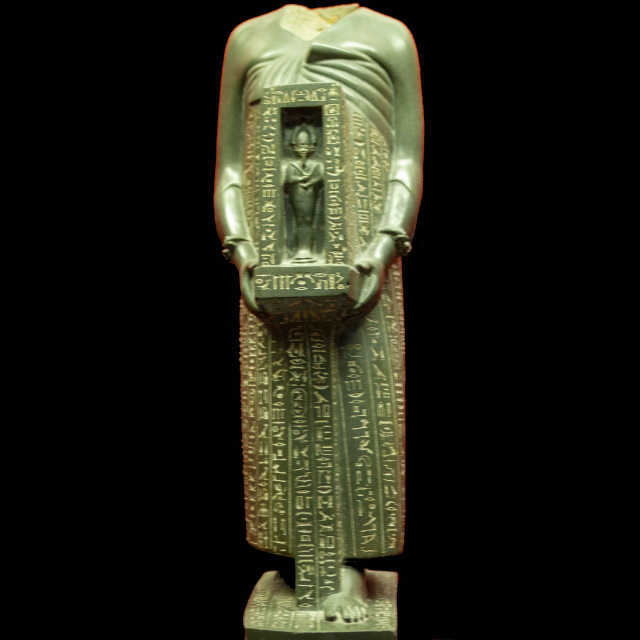
This story is part of the itinerary Read the story
Creation of EveCeilingExcerpt from a story

Michelangelo · 1512 year · fresco

Vatican Museums audio guide

The main figure of the fresco is Eve, created by God from Adam’s rib. She is a young, womanly, timid and helpless girl. Just like a fawn who has jumped up, she looks at God in reverence and awe, holding her palms together in prayer. Her face shows initial amazement, the realisation of her own existence, and gratitude to the Creator.

An excerpt from the original text. The full story is available in the audio guide.

The Fall and Expulsion from Garden of EdenCeilingExcerpt from a story

Michelangelo · 1512 year · fresco

Vatican Museums audio guide

The composition is conceptually divided into two parts. On the left is the scene of the fall. Here, Adam and Eve are a harmonious couple resembling ancient gods, young, peaceful and carefree. In the right part of the fresco, the first people are expelled from the Garden of Eden. They are depicted as suffering and banished by angels.

An excerpt from the original text. The full story is available in the audio guide.

Drunkenness of NoahCeilingExcerpt from a story

Michelangelo · 1512 year · fresco

Vatican Museums audio guide

The fresco consists of two consecutive episodes. On the left, Noah is digging his vineyard. In the centre and on the right, in the second part of the fresco, Noah is sleeping, drunk and naked, with his sons Shem, Japheth and Ham, who is pointing his finger at his father.

An excerpt from the original text. The full story is available in the audio guide.

DelugeCeilingExcerpt from a story

Michelangelo · 1512 year · fresco

Vatican Museums audio guide

The fresco “The Deluge” was the first painting by Michelangelo on the ceiling of the Sistine Chapel. The fresco shows people in the face of imminent death and reveals their behaviour depending on their character. The raging flood in only depicted in general strokes.

An excerpt from the original text. The full story is available in the audio guide.

Sacrifice of NoahCeilingExcerpt from a story

Michelangelo · 1512 year · fresco

Vatican Museums audio guide

When the rain had stopped and once the flood waters had receded, Noah’s ark was washed ashore. When the people stepped on the land, they were struck by the scale of the catastrophe and a number of victims.

An excerpt from the original text. The full story is available in the audio guide.

David and GoliathCeilingExcerpt from a story

Michelangelo · 1512 year · Fresco

Vatican Museums audio guide

The fresco captures the moment when giant Goliath defeated by David falls down.

An excerpt from the original text. The full story is available in the audio guide.

Judith and HolofernesCeilingExcerpt from a story

Michelangelo · 1512 year · Fresco

Vatican Museums audio guide

The fresco depicts a Hebrew woman Judith and her maid, carrying the head of the Assyrian commander Holofernes. Judith became a symbol of the Jewish struggle against the conquerors in the Middle East. She killed Holofernes by herself and freed the Jews from the Assyrian oppression.

An excerpt from the original text. The full story is available in the audio guide.

Punishment of HamanCeilingExcerpt from a story

Michelangelo · 1512 year · Fresco

Vatican Museums audio guide

The name of Haman is mentioned in the Old Testament and associated with the Jewish holiday Purim. Haman was a vizier to the Persian king Ahasuerus. All royal officials knelt down to Haman, except Mordecai, a Jew, who stated that the Jews bowed down to the God alone. The enraged Haman conceived a plan of killing all Jews living in Persia and chose the date – the thirteenth day of the month of Adar.

An excerpt from the original text. The full story is available in the audio guide.

Prophet JoelCeilingExcerpt from a story

Michelangelo · 1512 year · fresco

Vatican Museums audio guide

The biblical prophet Joel was the first who noted his sermons and compiled a collection of prophecies. He warned people about the coming Day of God when all unbelievers would be judged.
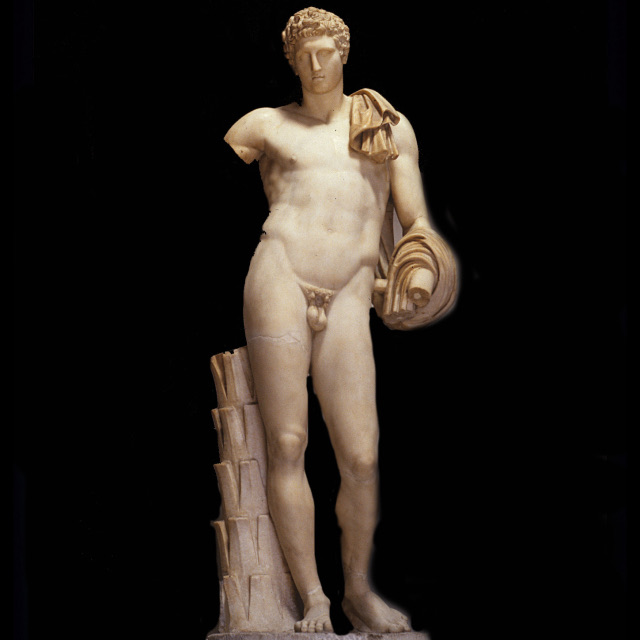
An excerpt from the original text. The full story is available in the audio guide.

Brazen SerpentCeilingExcerpt from a story

Michelangelo · 1512 year · Fresco

Vatican Museums audio guide

During the journey of the Jewish people from Egypt to Canaan Moses made a bronze snake. It healed the people bitten by venomous snakes and became a kind of a symbol of their wanderings through the Arabian desert.

An excerpt from the original text. The full story is available in the audio guide.

Prophet EzekielCeilingExcerpt from a story

Michelangelo · 1512 year · fresco

Vatican Museums audio guide

Ezekiel is a great prophet from the Old Testament who lived in Jerusalem in 7th century B.C.

An excerpt from the original text. The full story is available in the audio guide.

Separation of Light from DarknesCeilingExcerpt from a story

Michelangelo · 1512 year · fresco

Vatican Museums audio guide

In the center of the fresco “Separation of Light from Darkness” is a grey-bearded old man, God the Creator, Sabaoth by one of his names. His figure seems to be all-encompassing and all-powerful. It is the name Sabaoth, which is sometimes used to refer to the Creator, that combines the might and protective power of God.

An excerpt from the original text. The full story is available in the audio guide.

Prophet JeremiahCeilingExcerpt from a story

Michelangelo · 1512 year · fresco

Vatican Museums audio guide

Prophet Jeremiah from the Old Testament lived as early as 600 years B.C. He became a foreteller at the age of 15 and prophesied for 23 years. He warned the Jews, who forsaken the God about his wrath. Jeremiah predicted the punishment of sinners, but the people laughed at him and intended to kill him.  

An excerpt from the original text. The full story is available in the audio guide.

Libyan SibylCeilingExcerpt from a story

Michelangelo · 1512 year · fresco

Vatican Museums audio guide

This Sibyl was named Lybica due to her Libyan origin. We see her tender statuary shoulders, neck, chiseled features, and graceful movements. Obviously, Lybica embodies wisdom, beauty, and greatness.

An excerpt from the original text. The full story is available in the audio guide.

Prophet DanielCeilingExcerpt from a story

Michelangelo · 1512 year · fresco

Vatican Museums audio guide

The great biblical prophet Daniel was born in a rich family. When he was fifteen, he was taken into captivity following the capture of Jerusalem. The boy was trained to serve a king. And as soon as he graduated he was taken to Nebuchadnezzar's court.

An excerpt from the original text. The full story is available in the audio guide.

Cumaean SibylCeilingExcerpt from a story

Michelangelo · 1512 year · fresco

Vatican Museums audio guide

The Cumaean Sibyl is the most famous prophetess whose name is associated with the prediction of apocalyptic events. The Sibyl is seated on a marble throne and engaged in reading and interpreting texts. She is shown as a severe and fat old woman.

An excerpt from the original text. The full story is available in the audio guide.

Delphic SibylCeilingExcerpt from a story

Michelangelo · 1512 year · fresco

Vatican Museums audio guide

The Delphic Sibyl or Delphica was a priestess of the Sun God Apollo. She was born before the Trojan War, in the city of Delphi, where the cult of Apollo flourished and a temple dedicated to him was erected.
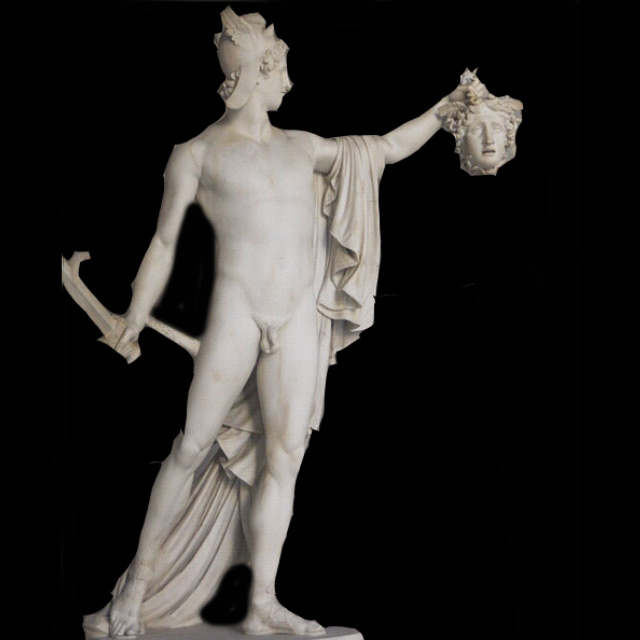
An excerpt from the original text. The full story is available in the audio guide.

Prophet ZechariahCeilingExcerpt from a story

Michelangelo · 1512 year · fresco

Vatican Museums audio guide

Prophet Zechariah was born in 6th century B.C. He predicted many events from the New Testament in detail.

An excerpt from the original text. The full story is available in the audio guide.

Prophet JonahCeilingExcerpt from a story

Michelangelo · 1512 year · fresco

Vatican Museums audio guide

Prophet Jonah lived in the 8th century B.C. When he was a kid, he felt sick and died. But his mother prayed so ardently to the God for her son's rescue that the God raised him from the dead.
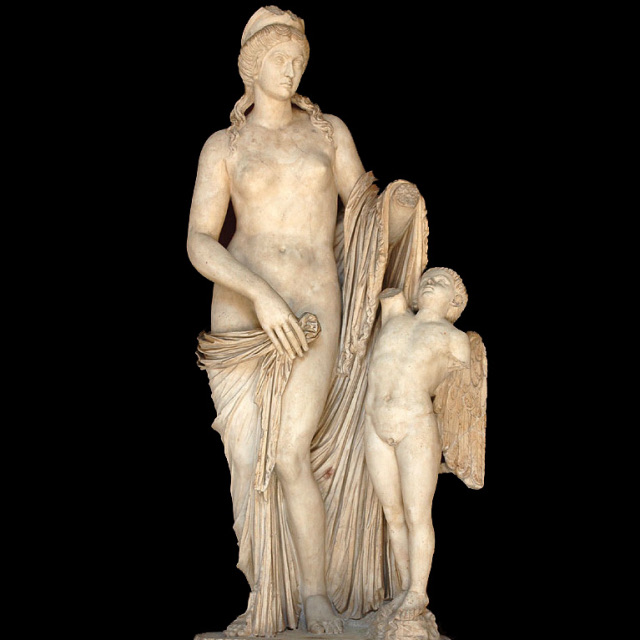
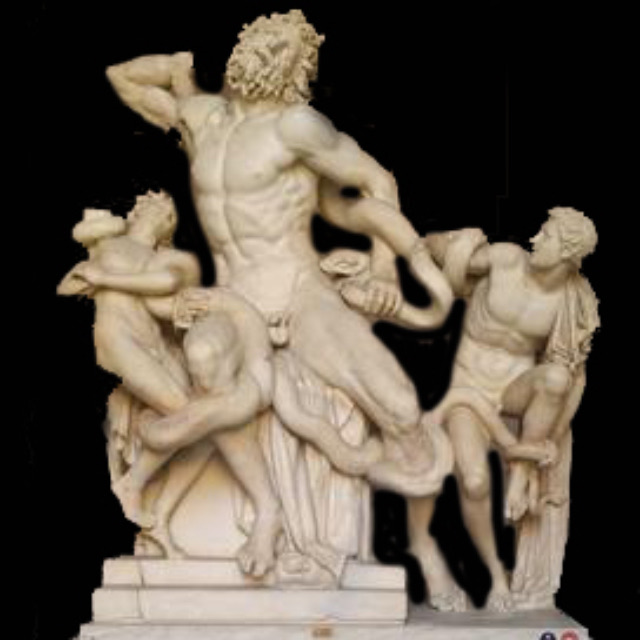
An excerpt from the original text. The full story is available in the audio guide.

Christ's ancestorsCeilingExcerpt from a story

Michelangelo · 1512 year · fresco

Vatican Museums audio guide

The Gospel of Matthew says that Jesus had a big genealogy. Before his coming to the earth there were almost forty generations of his ancestors. The family groups we see in the lunettes are Christ's ancestors. There are tablets containing the names of the depicted people nearby each roughly divided family.

An excerpt from the original text. The full story is available in the audio guide.

Prophet IsaiahCeilingExcerpt from a story

Michelangelo · 1512 year · fresco

Vatican Museums audio guide

As early as 700 B.C. prophet Isaiah predicted the coming of the Son of God, his life, and death. The Book of Isaiah reveals the disloyalty of the Jewish people to the God. The prophet warned the Jews about the coming captivity and the further liberation. He spoke about the devastation of Jerusalem and its further restoration.
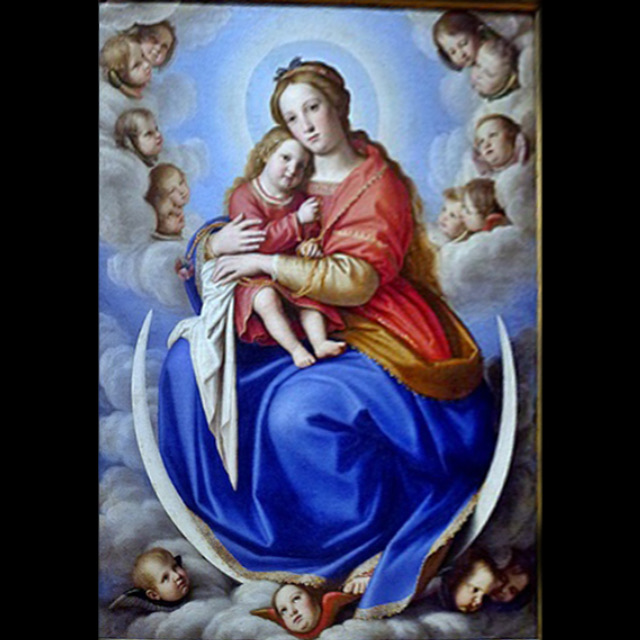
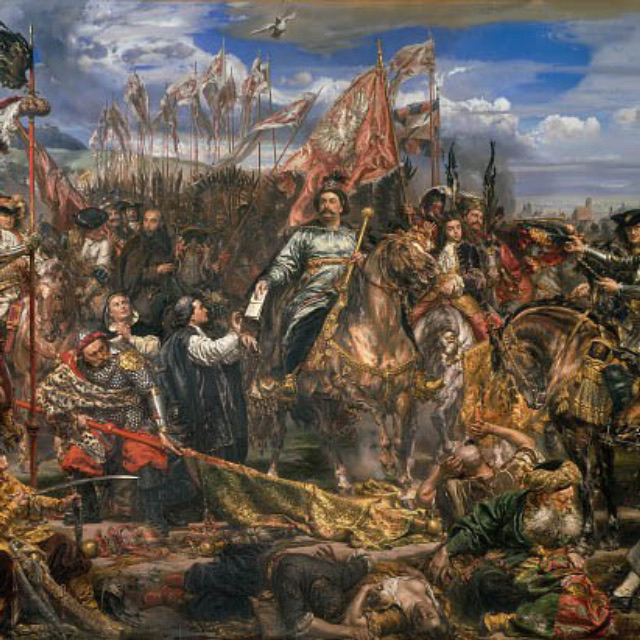
An excerpt from the original text. The full story is available in the audio guide.

Persian SibylCeilingExcerpt from a story

Michelangelo · 1512 year · fresco

Vatican Museums audio guide

In the 13th century B.C. the Persian Sibyl predicted the glory of Alexander the Great and coming of Jesus Christ.

An excerpt from the original text. The full story is available in the audio guide.

Erythraean SibylCeilingExcerpt from a story

Michelangelo · 1512 year · fresco

Vatican Museums audio guide

The Erythraean Sibyl predicted the destruction of Rome, the fall of Troy, wars and the Apocalypse. The Sun God Apollo and witch Lamia are reported to be her parents.

An excerpt from the original text. The full story is available in the audio guide.

Punishment of KorahSouth wallExcerpt from a story

Botticelli · 1482 year · Fresco

Vatican Museums audio guide

The fresco depicts the Old Testament story of Korah heading a rebellion of 250 people against Moses and his brother Aaron. Korah had gathered people and convinced them that Moses was revered undeservedly as the leader of the Israelites. On the right, we see Korah’s angry group with stones in their hands. They are ready to attack and beat Moses.

An excerpt from the original text. The full story is available in the audio guide.

Moses receiving the Tablets with the Ten CommandmentsSouth wallExcerpt from a story

Rosselli · 1482 year · Fresco

Vatican Museums audio guide

The fresco shows one of the key stories of the Old Testament: Moses receiving the Tablets with the Ten Commandments. The fresco illustrates a series of events from Moses ascending Mount Sinai to burning the golden calf. This event happened on Mount Sinai where God had led the prophet. In addition to the commandments, God also instructed Moses on how and when to build the Ark of the Covenant.

An excerpt from the original text. The full story is available in the audio guide.

Trials and Calling of MosesSouth wallExcerpt from a story

Botticelli · 1482 year · Fresco

Vatican Museums audio guide

The fresco shows several most important events from the life of Moses. On the right, Moses intercedes for a Jew who works in construction and is beaten by an overseer. Moses accidentally kills the Egyptian and flees the city.

An excerpt from the original text. The full story is available in the audio guide.

This story is part of the itinerary
Moses's Journey into EgyptSouth wallExcerpt from a story

Perugino · 1482 year · Fresco

Vatican Museums audio guide

The fresco shows five episodes from the stay of Moses in Egypt. The background of the story is as follows: While living in Egypt, Moses witnessed the beating of Hebrews by an Egyptian overseer. He killed the Egyptian and escaped to Midian. There Moses married Zipporah, the daughter of the priest Jethro, and became a shepherd.

An excerpt from the original text. The full story is available in the audio guide.

Crossing of the Red SeaSouth wallExcerpt from a story

Rosselli · 1483 year · Fresco

Vatican Museums audio guide

The fresco illustrates the ten plagues that Moses sent over the Egyptian people when demanding that they let the enslaved Israelites go. In the name of God, Moses demanded that the Pharaoh release the Israelites. To convince the ruler of Egypt, the prophet punished the Egyptians with plagues, which were calamities for them. Seeing the horror among his people, the Pharaoh sent the Israelites on their way.

An excerpt from the original text. The full story is available in the audio guide.

Moses's Testament and DeathSouth wallExcerpt from a story

Signorelli · 1482 year · Fresco

Vatican Museums audio guide

The prophet Moses was 120 years old when he died shortly before entering the Promised Land. By then, he had wandered with the Israelites in the Sinai Desert for forty years. Sensing his death, the prophet gathered around people for a farewell. It is these last moments of the prophet’s life that are depicted in the fresco in four scenes.

An excerpt from the original text. The full story is available in the audio guide.

15Gregorian Etruscan Museum7 · exhibits
Cinerary Urn of the Master of OenomausRooms of Hellenistic Age UrnsExcerpt from a story

III century BC · alabaster

Vatican Museums audio guide

The cinerary urn depicts Oenomaus falling on his kneels about to be inflicted by Pelopes. Oenomaus' daughter Hippodamia flees in fright. And the horses stumbled and fell down. This is the last moment of Oenomaus' life — the sun of Ares, the god of war.

An excerpt from the original text. The full story is available in the audio guide.

Gold pectoralRoom of regolini-Galassi TombExcerpt from a story

VIII century BC · gold

Vatican Museums audio guide

This breastplate is made of a single sheet of gold and embossed with relief designs containing hidden meanings. The breastplate is covered with complex small ornaments structured in strips around a central emblem. Generally, the breastplate is embossed with serial motifs.

An excerpt from the original text. The full story is available in the audio guide.

Pair of lionsRoom of Epigraphs and sculptureExcerpt from a story

VII century BC · tufa

Vatican Museums audio guide

The two animals are depicted in an aggressive pose with their mouths open as they are about attacking. Although realistic, their figures lack anatomical details. The sculpture technique was transmitted from the Northern Syria.

An excerpt from the original text. The full story is available in the audio guide.

Amphora with horse headRoom of Guglielmi CollectionExcerpt from a story

VII century BC · painted ceramic

Vatican Museums audio guide

The front of the vase is decorated with the head of a gold-maned horse. This amphora is a bright example of the Etruscan black-figure painting. It is characterized by clarity, symmetry and accuracy of lines, silhouettes and figures.

An excerpt from the original text. The full story is available in the audio guide.

Mars from TodiRoom of BronzesExcerpt from a story

VI century BC · bronze

Vatican Museums audio guide

The hollow cast statue of Mars from Todi depicts an Etruscan warrior dressed in a breastplate. The body, head, arms, legs and insertions of military suit were separately made of bronze. Judging by the position of the hands, the warrior held a cup in the right hand and a lance – in the left hand.

An excerpt from the original text. The full story is available in the audio guide.

Pair of handsRoom of proto-history in Etruria and LatiumExcerpt from a story

VIII century BC · bronze

Vatican Museums audio guide

The Pair of Hands is an early Etruscan composition, the first attempt to make the human body in art. The hands seem to consist of fingers alone as they are so long and thin.

An excerpt from the original text. The full story is available in the audio guide.

Hut-shaped UrnRoom of proto-history in Etruria and LatiumExcerpt from a story

X century BC · ceramic

Vatican Museums audio guide

This urn contained the cremated remains of an individual aged around 16. Historians believe it may be a young girl. Her remains were put into the urn to recall her essence as a person and her position within a specific social group.

An excerpt from the original text. The full story is available in the audio guide.

Privacy

There are no contact forms on the Waguide website. The main website uses Google Analytics for visitor statistics. Tiqets processes bookings and payments and may process connection data and cookies. The hosting provider may process technical connection data.

Image sources

Museum images are provided by the Waguide project. Photo of the Louvre: Diego Lopez Sebastian (Dieglop), CC BY-SA 4.0. Photo of Winged Victory of Samothrace: Mbzt, Wikimedia Commons. Reproductions of the paintings are in the public domain. Images may be cropped for display purposes.

The Louvre — Diego Lopez Sebastian · Winged Victory of Samothrace — Mbzt · CC BY-SA 4.0