
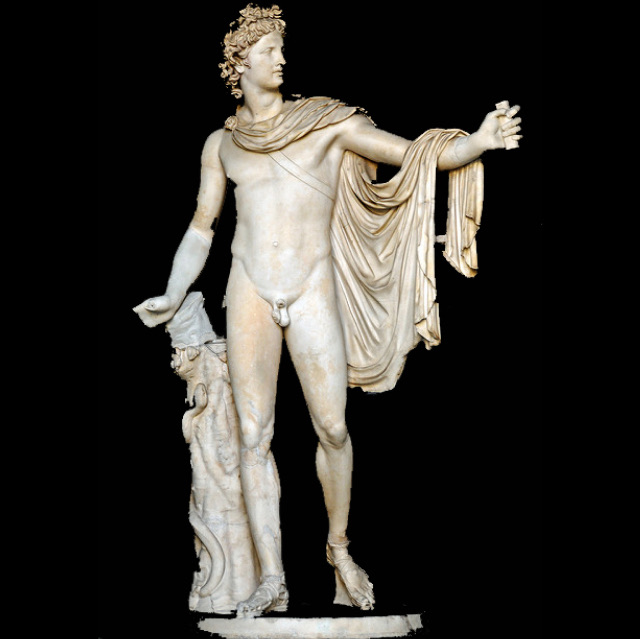
Apollo, the god of sun and light, was called "splendid" or "radiant". For several centuries it was an idol of male beauty.
And just after its creation the statue of Apollo of the Belvedere was admired by both ordinary people and prominent sculptures. The art expert Johann Joachim Winckelmann considered the statue as a benchmark of Greek art. He said that "of all the works of antiquity that have escaped destruction, the statue of Apollo represents the highest ideal of art". As soon as the marble statue was discovered not far from Rome in the middle of XV century, it was placed in the garden of Belvedere in the Vatican. So Apollo was called the Apollo Belvedere.
The sculpture of the Apollo Belvedere depicts the god as a mighty and handsome archer. His moves are dynamic, decisive and brave.
According to historians, Apollo supposedly holds a bow in his left hand and an arrow in his right hand. He seems to have just released an arrow, waiting what target it is going to stick. The arrows and bow in his hands represent his right to punish sinners and purify repentant persons from their sins.
Apollo's head is crowned with a laurel wreath, a symbol of winner. Near the youth is a tree trunk with Dragon Python killed by Apollo in Delphi.
Original author’s text, preserved unchanged.