
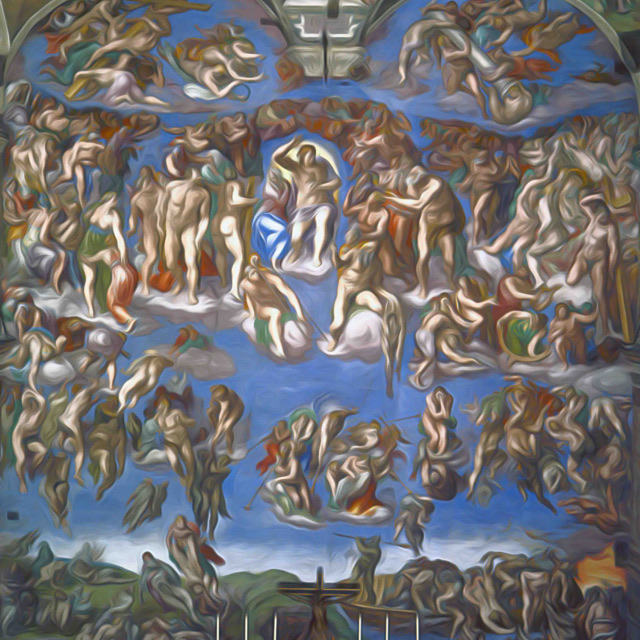
This is one of the most complex and mighty frescoes by design and level of its complexity.
On the top, to the left are angels bearing in flight. They hold the symbols of the Passion in their hands – the Cross, the Nails, the Crown of Thorns. On the right the angels hold up the column of the scourging and the spear with the sponge soaked in vinegar.
It should be noted that the angels are painted wingless, which make them look like ordinary people.
In the center of the fresco there is the Mother of God and Christ surrounded by the saints, waiting for the sentence. The figure of Christ is the biggest one, in a dynamic broad gesture, captured in the moment when the verdict of the Last Judgment is uttered.
Historians have been debating about the sentiments associated with the Christ’s gesture. One of them say that this is how he placates the surrounding agitation, the others assert that this is a cursing gesture.
The Virgin turns her head, awaiting the result of the Judgment.
Christ and the Virgin are surrounded by the holy martyrs. They hold the things that caused their death in one way or other.
On the right to Christ there is greybearded St Peter with the two keys of heaven. Below we can see St Bartholomew with his own skin which was flayed by pagans. The face of the martyr is a self-portrait of Michelangelo.
Opposite him is St Laurence with the gridiron, on which he was burned alive by Roman pagans.
On the right, on one of the clouds, we see St Catherine of Alexandria in a green gown. She holds the cogwheel served as the instrument of her execution. Above St. Catherine there is St. Paul in a red cape.
Next to her St Sebastian kneels holding the arrows in his hand. Roman soldiers shot arrows at him. Straight above Sebastian St. Andrew seems to come down on a cloud, holding the cross in his raised hand.
On the bottom to the left there are young virgins, sibyls and characters of the Old Testament. In the center of the lower section are the angels of the Apocalypse who are wakening the dead by blowing their trumpets.
On the right, at the bottom, angels and devils make the damned fall down to hell.
At the bottom is Charon who ferried souls on his boat to lead them before the judge Minos, whose body is wrapped in the coils of the serpent.
As the fresco depicts nude figures, Michelangelo was involved into the conflict with moralists.
The Master of Ceremonies Biagio da Cesena called him to observe the proprieties. He complained that nude figures were not allowed to have been painted in so sacred place. Michelangelo could not contradict him directly, but he responded in another way. On the right, at the bottom, among the dead who were led to Hell he painted a ridiculous man with donkey ears and covered by coiled snake. The figure and face of the man resembled the face of the cardinal. When the master of ceremonies saw his face on the fresco, he complained to the Pope Paul III. The Pope’s response was brilliant:
“I can give orders on the earth, or at the very least I would have some impact, if it deals with the limbo. But in all matters relating to the Hell, I am helpless. You should discuss it with Michelangelo…”
Original author’s text, preserved unchanged.