
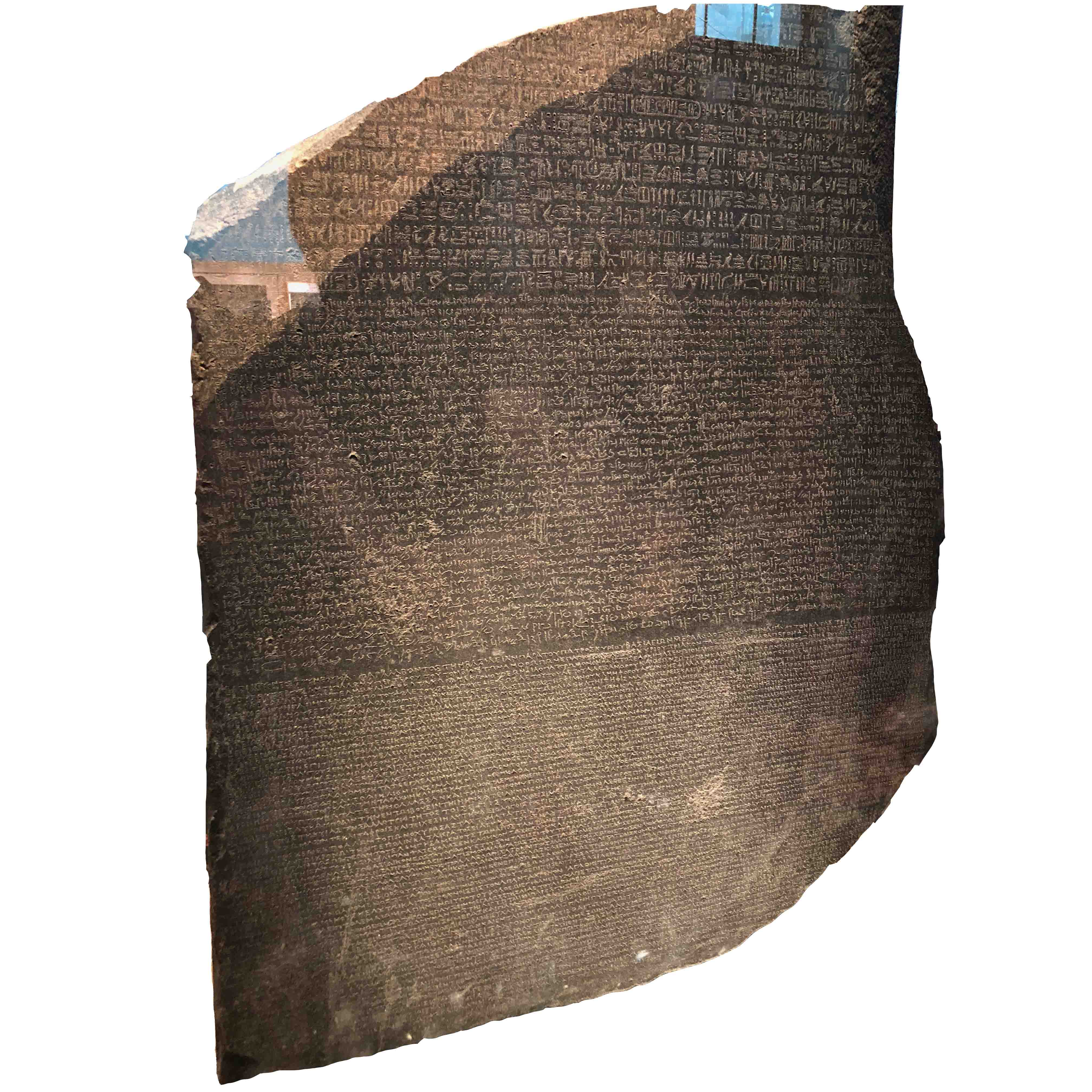
The Rosetta Stone is a monolithic slab of rock similar to granite. It is a boulder covered with small, barely discernible inscriptions in three languages. The first text is inscribed in Ancient Greek, the second consists of hieroglyphs, and the third is written in Demotic script—simplified hieroglyphs. The 760-kilogram stone was discovered by a French captain during the construction of a fort near Rosetta at the Nile Delta, and he immediately realized that this was a great find. The slab was immediately sent to Cairo, to the Egyptian Institute, and then to the British Museum. Scholars set out to decipher the written symbols. They determined that in 196 B.C., Egyptian priests carved a text on the Rosetta Stone dedicated to the ruler Ptolemy V Epiphanes. However, due to damage, none of the texts have survived in their entirety. Deciphering the Demotic script was no trouble at all, whereas the hieroglyphic text remained completely incomprehensible. To everyone, these were unknown symbols that had lost their meaning with the demise of the ancient Egyptians. For everyone, that is, except for the young Egyptologist Jean-François Champollion. Two hundred years ago, he deciphered the hieroglyphs using his knowledge of ancient Greek. The scholar compared the three texts, calculating the meaning of each hieroglyph. His stunning 1841 report to the Paris Academy of Inscriptions, stating that the hieroglyphs on the Rosetta Stone were indeed legible, marked the beginning of Egyptology.
Original author’s text, preserved unchanged.