
waguide
EN

Room 18 · Parthenon sculptures

The Parthenon Horse’s Head

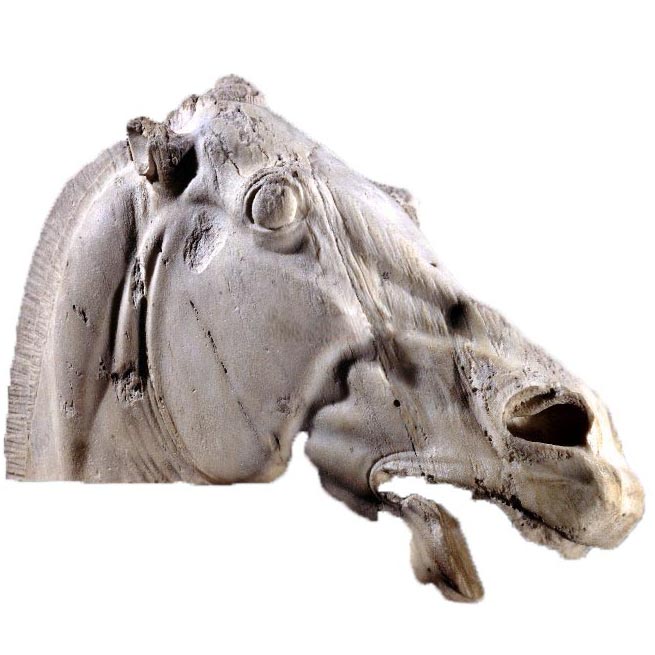
Flattened ears, an open mouth and flared nostrils give this marble horse its striking expression. Find it among the Parthenon sculptures in Room 18, then read the story of the celestial chariot it belonged to.

Editorial introduction · Waguide

British Museum audio guide

The full story
The horse’s head is the only surviving part of the marble pediment titled “The Birth of Athena,” created by the ancient Greek sculptor Phidias. Phidias worked meticulously, capturing in stone the fundamental nature of mythological characters and their important role in shaping the worldview. In other words, he brought myths to life, personifying them by giving them concrete forms and features familiar to the human eye. For example, on the pediment of “The Birth of Athena,” he carved the sun god Helios from marble, emerging from the sea in a chariot drawn by horses.In the right corner of the pediment, another chariot was depicted. In it, its mistress—the moon goddess Selene—leaves the sky at sunrise, yielding her celestial domain to Helios until evening. It is the head of one of Selene’s horses that we see before us now.Thanks to the sculpture’s stunning realism, the horse before us seems almost alive—graceful, noble, and expressive. Though thin and weary, it is undeniably beautiful. Incidentally, the German poet Johann Goethe was convinced that this very sculpture was the most perfect depiction of a horse in existence.

Original author’s text, preserved unchanged.

More ancient sculpture: The Nereid Monument

Room 18 · Parthenon sculptures

Before your visit, please check the museum’s official website for opening hours, the availability of exhibition rooms, entrance points, facilities for visitors with reduced mobility, and luggage policies.

The British Museum
Privacy

There are no contact forms on the Waguide website. The main website uses Google Analytics for visitor statistics. Tiqets processes bookings and payments and may process connection data and cookies. The hosting provider may process technical connection data.

Image sources

Museum images are provided by the Waguide project. Photo of the Louvre: Diego Lopez Sebastian (Dieglop), CC BY-SA 4.0. Photo of Winged Victory of Samothrace: Mbzt, Wikimedia Commons. Reproductions of the paintings are in the public domain. Images may be cropped for display purposes.

The Louvre — Diego Lopez Sebastian · Winged Victory of Samothrace — Mbzt · CC BY-SA 4.0